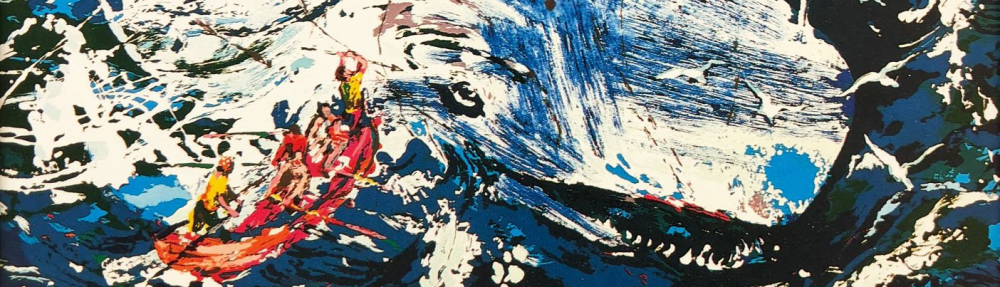
Before Moby-Dick even begins its story, the “Extracts” overwhelm us with fragments: verses from the Bible, lines from Shakespeare, and snippets of travelogues and natural accounts. At first glance, they read like noise, a jumble of borrowed words that delay the narrative before it even begins. But Melville is doing this deliberately. By bombarding us with quotations, he insists that any single perspective cannot capture the whale. Instead, it exists at the intersection of voices, always slipping out of reach.
The contrast between two quotations makes this especially clear. In one, the whale is Leviathan, a biblical monster that embodies divine power and human helplessness. This image casts the whale as a cosmic force beyond understanding. But only a few lines later, Melville includes Shakespeare’s joke from Hamlet, when Polonius agrees that a cloud looks “very like a whale.” Suddenly, the whale shrinks into something absurd, an ephemeral shape in the sky. Side by side, these extracts jar the reader: is the whale the most powerful beast on Earth, or just a trick of the imagination?
This refusal of clarity sets the tone for the entire novel. If the whale can be both terrifyingly real and almost laughably unreal, then no definition will ever be stable. The Extracts remind us from the very beginning that the ocean’s mysteries are too vast for singular answers. We are forced to read in fragments, to dwell in contradictions, to accept ambiguity as the only truth available. Rather than beginning with certainty, Moby-Dick begins with uncertainty. The whale is many things at once: natural, mythical, terrifying, sacred, ridiculous. It is a mirror of the ocean itself, a force that exceeds comprehension. By frontloading the book with a cacophony of borrowed voices, Melville teaches us how to read the novel: not by searching for resolution, but by embracing the fragments.
This is really wonderful. It is even the foundation for a midterm close reading essay because you are making an argument about what the taxes is doing. You begin with a clear thesis statement– the debatable argument about why the text is what you say it does: “By bombarding us with quotations, he insists that any single perspective cannot capture the whale. Instead, it exists at the intersection of voices, always slipping out of reach.” This is great work and exactly the kind of analysis I’m hoping to see! Do consider expanding upon this for midterm essay.