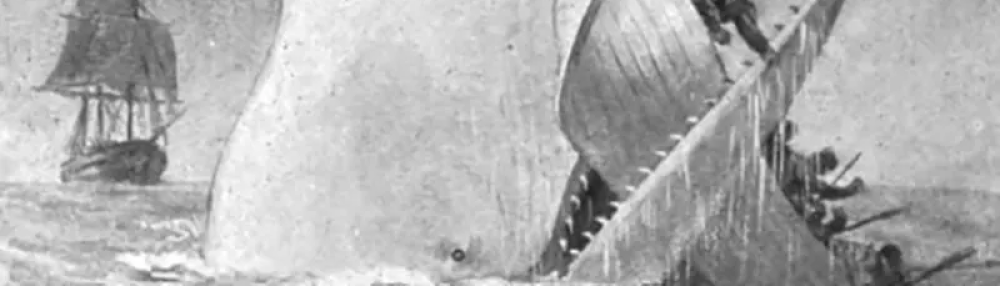
The story of Jonah is one that is well known, especially in the 19th century. An account that could stand to have a passing mention and a reader will know what his author his alluding to. Melville begins Moby Dick with hints of criticism towards Christianity. So, why does he spend a chapter not only retelling, but expanding on the story of Jonah? In his revitalization, Melville adds dimension to the point of view of the story, from Jonah onto his shipmates. The trade of shipping and the crew members are given life. Life in a story that’s important to this novel. Maybe Moby Dick is its own fantastical recount of Jonah. Giving a voice of reason to the captain and crew gives the whaling industry character. By showing the shippers’ outlook readers can sympathize with them. They can see how sin affects others. “Strong intuitions of the man assure the mariners he can be no innocent.” The crew knows Jonah is guilty of something, yet they still let him on board. It all comes down to money. Another theme that Melville seems to have touched on a couple of times already. “Now Jonah’s captain, shipmates, was one whose discernment detects crime an any way, but whose cupidity only exposes it only in the penniless. In this world sin that pays its way can travel freely, and without a passport; whereas a virtue, if a pauper, is stopped at all frontiers.” Another commentary on the joy of money. The autonomy of money. The sin of money. Another commentary that resonates with the corruption of the present.
It is notable that this sermon is preceded by a chapter that focuses on watery graves. Is that chapter foreshadowing? Or just flaunting the realities Ishmael faces. “But faith, like a jackal, feeds among the tombs, and even from these dead doubts she gathers her most vital hope.” Like a jackal, an opportunistic feeder, faith grasps at those in desperation. Like someone who has been swallowed by a whale.
Also, just a quote that I love: “Methinks that what they call my shadow here on earth is my true substance. Methinks that in looking at things spiritual, we are too much like oysters observing the sun through water, and thinking that thick water the thinnest of air.
Great post- you are right to point us to this chapter as a poignant and pregnant one for us to discuss and explicate. I am glad that you got us started here!
Hello Ashley! I found your post very poignant, especially with your discussion of money an within the novel. While the sailors do and will have unique motivations for sailing, for a large amount of them it’s money. People will do practically anything for money, and it has been this way practically since it’s invention. I can’t wait to see how money affects the story and themes throughout the novel!
Hi Ashley! I think this is such an interesting chapter, as it marks the start of a motif ( or pattern) in discussing the morality in religion and worship, and the acknowledgment of sin. You’ve inspired me to go back and analyze this chapter more closely, since it’s something I feel Ishmael will be continuously forced to grapple with, not just as a whaler on a ship, but as a cog in the wheel of a cannibalistic industry, of which faith and religion is suffocated, yet tied to the mast of the ship (essential to maintaining order).