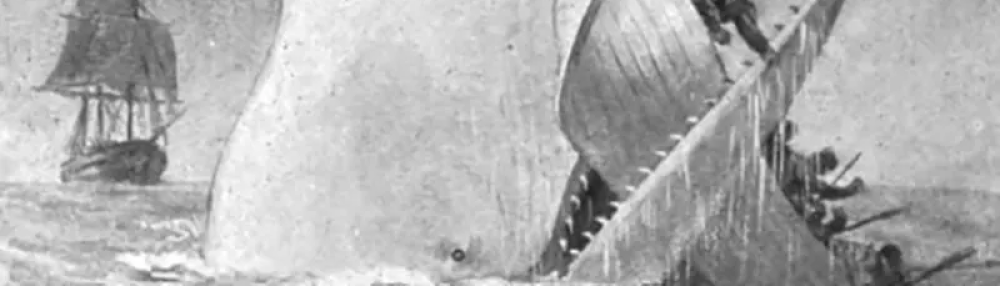
Ahab is searching for God. Chapters 36, 37, and 38 were interesting to me because not only does Ahab confront the crew and have them sign a pact (or a deal with the devil), but Starbuck publicly questions the madness of his captain and voices the doubts that others are more than willing to ignore in favor of peace. What interested me was the fragile peace maintained on the ship, and how Ahab is almost daring Starbuck to challenge him, and inspire rebellion. This instability is revealed to us in Chapter 37, Sunset, where we get insight into Ahab’s inner thoughts. What I found there proves to me without a doubt that this quest, for the whale, is the quest of a fallen man, a quest for God.
Ahab has lost all connection and appreciation of nature: “ Oh! Time was when the sunrise nobly spurred me, so the sunset soothed me. No more. This lovely light, it lights not me; all loveliness is anguish to me, since I can ne’er enjoy it. Gifted with the high perception, I lack the low, enjoying power; damned, most subtly and most malignantly! Damned in the midst of Paradise! (182)”
Like Starbuck, I feel such immense pity for Ahab. Surrounded by the beauty and splendor of the open ocean, which seems to have been his heaven on earth, his paradise, but he can enjoy none of it. Ahab is like a dead man walking. He is completely disconnected from God and fueled only by anger and rage, which is focused on Moby Dick. But why has his disillusion with god become funneled into this Whale? I look to these passages where he acknowledges the accident:
“it was Moby Dick that dismasted me, Moby Dick that brought me to this dead stump I stand on now(177).”
“The prophecy was that I should be dismembered; and – Aye! I lost this leg. I now prophecy that I will dismember my dismemberer. Now then, be the prophet and the fulfiller one. That’s more than ye, ye great gods, ever were(183).”
By describing his losing his leg to the whale as ‘dismasting’ and ‘dismembering,’ we understand that this act by the whale, or by god, threatened his masculinity. His acts of madness, his exertion of force amongst the crew, and intimidation of Starbuck, feel like attempts by him to restore his masculinity and power through his position at the top of the hierarchy. Furthermore, he numerously attempts to scorn God by enlisting pagan harpooners, making them swear an oath to him (to hunt and kill Moby Dick), and describing himself as a prophet and fulfiller, greater than “ye great gods ever were.” This path Ahab is intent on paving has a biblical mirror, and like the fallen angel Lucifer, he has joined forces with his crew to wage war on God and his creatures.
So many good points here. I’m going to pick up on one that I would like to see you pursue further, perhaps in conversation in class: “By describing his losing his leg to the whale as ‘dismasting’ and ‘dismembering,’ we understand that this act by the whale, or by god, threatened his masculinity.” Looking forward to hearing from you!
Hi Angelina, I also found Ahab interesting in these recent chapters. This ungodly, godlike man, who is possessed so strongly by his madness and obsession, and all these religious undertones throughout each chapter in language and metaphor. I like the way you describe Ahab as a dead man walking. I think this brings into question what we think living life is: it is more than the biological concept of being alive, heart beating and breathing and functioning, it is having that internal something–and Ahab’s ‘passion’ cannot qualify as that as it is built on something so stagnant, unchanging, unlike life