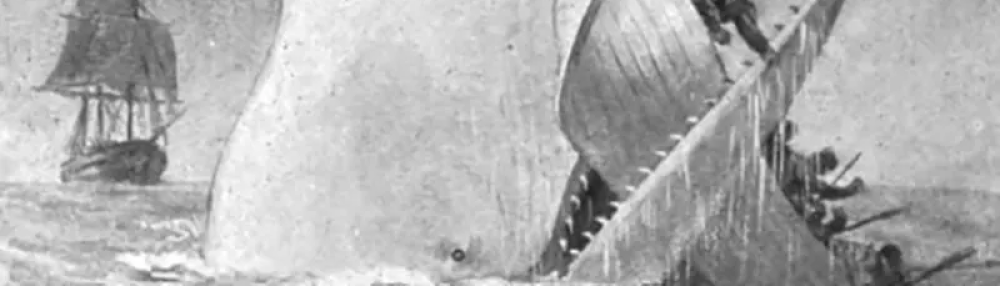
At last, we have found whales within the deep! Chapter 48 sees the introduction of a few new characters, such as the individuals acting as Ahab’s contingency plan against mutiny, as well as a first look at what whaling entails for the crew. Nathaniel Philbrick’s comment about how Moby-Dick could allow aliens to understand 1800’s whaling makes sense, at last!
I feel the need to make a point that it is very clear that Ishmael has a type – first his loving descriptions of Queequeg, then the way that he described Daggoo and Flask on the whaling ship:
“But the sight of little Flask mounted upon the gigantic Daggoo was yet more curious; for sustaining himself with a cool, indifferent, easy, unthought of, barbaric majesty, the noble negro to every roll of the sea harmoniously rolled his fine form. On his broad back, the flaxen-haired Flask seemed a snow-flake. The bearer looked nobler than the rider. Though, truly, vivacious, tumultuous, ostentatious little Flask would now and then stamp with impatience; but not one added heave did he thereby give to the negro’s lordly chest. So I have seen Passion and Vanity stamping the living magnanimous earth, but the earth did not alter her tides and her seasons for that.” (241)
While Flask is described as one might describe a princess or a child – impatient, little, ostentatious – Daggoo is described with words synonymous with nobility – indifferent, lordly, majesty, noble. While Flask is the leader of the boat, the one that is urging the men and calling the shots, Daggoo is painted as the reliable, quick thinking, and sturdy man that ensures it continues.
It seems that any moment we meet a new character with darker skin, we find ourselves given an in-depth description of the way that they carry themselves and the continence of their brow. Yet many of the cast that are white or in power remain faceless within the crew of the Pequod, save Ahab. This reinforces the narrative that Melville was presenting us – that whiteness is absence, that the war that was building at the time was senseless, and that slavery exists for little men to feel as though they have power beyond themselves.
I really like this scene because of the admiration it gives towards Daggoo over Flask. This visual representation of the “noble negro” holding up the “ostentatious little Flask” is another instance of Melville giving credit to the ones that are vital in this whale hunt. I like how you put it as Flask being akin to a little princess who is lifted up by the nobility that is Daggoo; it’s returns to the chivalric language that has been applied in “Knights and Squires” and flips it. This “barbaric majesty” which makes “the bearer [look] nobler than the rider” is a direct challenge to the little white men grasping at that power in their own majestic barbarity, claiming superiority while disregarding their own savage nature.
I loved this connection between ishmael’s type, he clearly has something for the unknown but the way he walks about them after the fact is funny to the way you think about the unknown and then how you treat the unknown
I’d also like to point out that the use of the word “negro” in this passage implies that the term wasn’t just used for racism, but to describe dark-skinned people in general. Daggoo is a dark-skinned man, but his “barbaric majesty” is what earns him the title of a “noble negro.” Ishmael and Flask (even the reader) are impressed by his prowess in whale hunting, so it would make sense for Melville to use the word “negro” in a positive light.