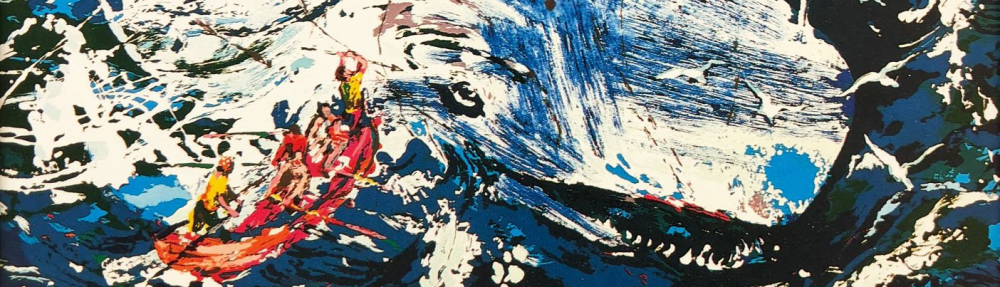
At the end of Chapter 35, “The Mast-Head,” Ishmael closes his reflection on watchkeeping with a particularly haunting sentence: “There is no life in thee, now, except that rocking life imparted by a gently rolling ship: by her, borrowed from the sea; by the sea, from the inscrutable tides of God” (Melville 173). This single line collapses the sailor’s physical experience into more of a spiritual chain of dependence. Melville ties the ship, sea, and God together in a rhythm that both sustains and erases any individuality. Through its careful structure and imagery, the sentence expresses a sentiment that runs through Moby-Dick: life itself is not autonomous but “borrowed,” seemingly passed through vast systems of motion and meaning that render human existence both sacred and unstable.
This moment imparts Melville’s broader interest in the interdependence of creation to his reader. Ishmael’s phrasing builds a very visible ladder of being, starting at the top with God, then sea, ship, and finally man, each one feeding life to the next. Yet the syntax Melville uses suggests that none of these entities truly possesses life in isolation. Instead, they each simply carry the current onward. The rhythm of the line, marked by semicolons, replicates the rocking motion it describes. The pauses create a gentle swaying in the reader’s breath, by her; by the sea; by the inscrutable tides of God, as if the sentence itself moves into and with the ocean. Melville transforms punctuation into motion and the syntax into tide. The line becomes performative, enacting through its form exactly what it claims in meaning: life as continual transfer, an oscillation that never stills long enough to belong to any one being, no matter how big or powerful.
The word “imparted” in the passage is particularly revealing. It does not suggest a permanent gift or state, but more along the lines of a temporary transmission. Something given with the possibility, or inevitability, of being taken back. “Life imparted” is not the same as “life possessed” or “life given.” Melville’s diction, then, implies both grace and dependence; existence is granted in passing. Even the ship, that symbol of human mastery and control, draws its motion “by her, borrowed from the sea.” To “borrow” life is to live on loan or rent, to move only through forces larger than oneself. The ship’s agency, and by extension, you could argue Ishmael’s own, is quite contingent and not absolute. This layered borrowing, from ship to sea to God, diminishes the idea of human self-sufficiency that Ahab so violently defends in the novel. Ishmael’s observation undermines that illusion of control by reminding us that every movement, even our own heartbeat, depends on something inscrutable and beyond human command.
Melville’s choice to describe the sea’s tides as “inscrutable” situates this chain of dependence within both spiritual and existential uncertainty. The word implies not only mystery but also this almost impenetrability that denies any outside interpretation. If the tides of God are truly “inscrutable,” then even Ishmael’s recognition of his own dependence offers no comfort of understanding. Instead, it opens the readers to the unsettling realization that the origin of life’s motion is unknowable. The “tides of God” do not offer stability or salvation to the ship; they offer only continual movement, indifferent to the human need for meaning. Melville thus inverts the traditional idea of divine order. God is not the fixed point around or toward which the world turns, but the unfathomable depth from which motion flows. Vast, silent, and beyond measure.
Still, within this recognition of dependence lies a subtle peace. Ishmael’s description of the “gently rolling ship” tempers the potential terror of the message of the passage. The adverb “gently” softens the image of divine force into something almost maternal. The rocking motion recalls a cradle as much as a wave, suggesting that Ishmael, suspended there between sea and sky, finds an almost kind of spiritual intimacy in his isolation. Here, the sea becomes not merely a site of danger or judgment but a living intermediary between man and God. Through it, Ishmael participates in a rhythm that unites the material and the metaphysical. Even if that rhythm is “borrowed,” it is still shared by all of them in a form of belonging that does not require control.
This passage also gains resonance when considered within the broader context of Ishmael’s experience at the masthead. The rocking motion of the ship is both soothing and destabilizing to him, offering a sense of connection to the sea and, through it, to something larger than himself, yet it also carries the potential for danger. Melville’s imagery of this borrowed motion encapsulates the tension between transcendence and vulnerability. To lose oneself too fully in the sea’s rhythm, to mistake that same spiritual unity for safety, is to risk death. That earlier moment illuminates the closing line’s ambivalence: the same “rocking life” that sustains Ishmael can also erase him by blurring the lines between body and ocean. The sea offers a connection to divine mystery, but it also threatens to absorb the self entirely. These both simultaneously remind Ishmael of his fragility, which highlights the novel’s central struggle between surrender and control as well as faith and human ambition.
Even the sentence’s structure enacts this fragile equilibrium. The repetition of “by” creates a chain of agency that simultaneously affirms and undermines itself. Each “by” displaces life one step further from the speaker: by the ship, by the sea, by God. The preposition functions like a tide itself, pushing the source of vitality outward into the distance and far away from the ship and the reader. Ishmael’s view here emphasizes that humans are not the most important beings but are part of a larger, interconnected world. Humanity does not stand at the center of creation but floats within its circulations. The “rocking life” that passes through Ishmael is only one little eddy in an immense current. His humility before that current distinguishes him from Ahab, whose defiance of dependence leads to ruin. Where Ahab insists on mastery over the sea’s inscrutable power, Ishmael learns to survive through surrender.
Melville’s use of rhythm, imagery, and syntax in this single line crystallizes one of the novel’s deepest spiritual insights: that to live is to be in motion, and to be in motion is to depend. The hierarchy Ishmael outlines of God, sea, ship, man, might appear stable, but the verbs undo that structure. Each “borrowed from” erases any form of ownership, leaving only movement behind. The theology implied here is fluid and dynamic: God’s presence manifests not as authority but as motion itself. In this sense, Melville’s “inscrutable tides of God” show us the novel’s larger cosmology, where meaning is not contained in static and stationary symbols but in the ceaseless interplay of opposites: creation and destruction, calm and storm, surface and depth.
The comfort Ishmael finds in this realization contrasts sharply with the terror that grips Ahab. For Ahab, dependence seems to be quite intolerable; to borrow (and not own) life is to admit weakness. His pursuit of the White Whale is an attempt to shatter that chain, to confront the inscrutable source directly and demand explanation. Ishmael, by contrast, accepts that explanation is impossible. His survival depends on yielding to what cannot be known by him or by anyone.
In this light, the passage’s final phrase, “the inscrutable tides of God,” becomes not just a theological statement but a structural principle for the entire novel. Moby-Dick itself moves according to inscrutable tides, shifting from sermon to stage play, from epic to encyclopedia, from tragedy to farce. Like the sea it describes, the book resists containment. Melville’s prose constantly borrows motion from the forces it evokes, such as history, philosophy, and religion, without ever fixing meaning in one place or to one thing. To read Moby-Dick is to be rocked into that same rhythm, to feel language itself imparting a borrowed life to the imagination.
Ultimately, Ishmael’s reflection at the masthead articulates Melville’s most profound vision of existence. Life, like the ship on the sea, is a constantly ongoing act of balance between faith and doubt, surrender and fear, motion and stillness. The comfort that Ishmael finds does not come from certainty but more from his participation: to be alive is to be a part of a motion that exceeds understanding. When he says, “There is no life in thee, now, except that rocking life imparted by a gently rolling ship,” Ishmael acknowledges the paradox that defines all human experience in Melville’s world: that we are most ourselves when we recognize that our life is not our own. By seeing dependence not as diminishment but actually as connection, Melville offers an alternative to Ahab’s destructive pride, a model of endurance grounded in humility. In the end, the “rocking life” that Ishmael describes becomes a metaphor for survival itself: not the triumph of mastery, but the grace of motion sustained by forces we can neither name nor command.