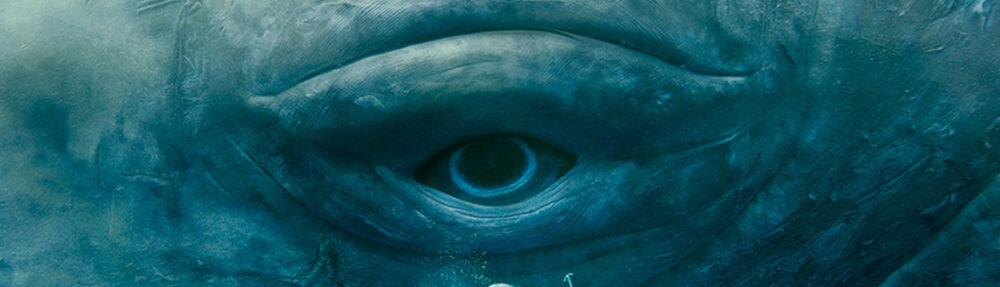
Before Moby-Dick even begins, the “Extracts” flood the reader with borrowed voices that attempt to define the whale. Among them, two stand out for how they capture both the creature’s violence and divinity. In Miriam Coffin or the Whale Fishermen, the whale erupts from the sea as “a mighty mass” shooting upward, a sudden image of raw power and motion (Melville, pg. l). Moments later, in a Whale Song, it is exalted as “King of the boundless sea,” a ruler whose strength becomes a kind of natural law (Melville, pg. li). Together, these lines form a miniature drama of human perception: the whale terrifies, then it inspires. Melville uses this juxtaposition of language, the factual account, and the lyric, to show how humanity transforms fear into myth. By placing the whale between physical reality and poetic imagination, he exposes how our desire to describe the unknown always turns into a need to control or revere it.
As a preface, the “Extracts” work as a meditation on the very notion of knowledge. By stitching fragments from scripture, science, and literature, Melville turns the whale into a vessel for centuries of human thought. Each quote tries to pin down the beast. Yet, when they are together, they expose how language crumbles beneath the weight of what it attempts to capture. The collection reads less like a coherent history and more like an obsessive register, a map charting humanity’s endless circling of the same enigma over and over. Melville’s method isn’t about explaining by accumulating, letting meaning surface through contrast and repetition. The two passages I focus on sit near the end of the chapter, marking a shift from confusion to revelation. After so many competing voices, the whale finally takes shape as both a symbolic presence, a violent body bursting through the surface, and then a mythic figure looming above it. The ascent, from the material to the divine, reveals how language in its effort to capture nature inevitably expands it into something beyond its form.
The extract from Miriam Coffin or the Whale Fishermen offers a glimpse of the whale packing its raw power into a brief, startling flash. The line “Suddenly a mighty mass emerged from the water. Shot up perpendicularly into the air. It was the whale ” (Melville, l) relies on simple, declarative syntax that mirrors the abrupt thrust of the moment. The cadence of the line, shattered by the blunt “It was the whale ” lands, like a gasp, a voice straining to label an enormity that slips past speech. In this fragment, description shifts from mastery to awe. By rendering the whale as a burst of thrust and weight, Melville turns it into a symbol of the clash between humanity and the sublime, a reminder that the natural world cannot be fully measured or contained by observation alone.
Where the earlier extract seizes the whale as a surge of power, the Whale Song converts that vigor into reverence. The passage opens with the exclamation “Oh, the rare old Whale” (Melville, li), instantly conjuring a tone of awe. The transition, from prose to verse, reconfigures the whale’s image; the cadence and repeated motifs hoist it beyond a beast to a symbol. The poem’s steady rhyme, “In his ocean home will be / A giant in might, where might is right, / And King of the boundless sea,” turns the whale into a moral figure whose dominance feels ordained rather than accidental. The phrase “where might is right” compresses the outlook into a line indicating that the whale’s raw power itself supplies its legitimacy. The dread that once haunted in Miriam Coffin now becomes a mantle of nobility as language reshapes menace into a kind of divinity. The repetition of “might” throughout the passage knits strength to righteousness, underscoring how easily the natural hierarchy can be mythologized into truth. Melville’s decision to place the song at the end of the Extracts is anything but accidental. After a series of attempts to capture the whale in words, the last line comes across as an act of surrender. The verse isn’t trying to decode the creature; it simply offers praise, showing that when language hits the limits of the unknowable, it slips into worship. In this sense, the Whale Song finishes the Extracts not with a claim of certainty but with a concession, an admission that awe rather than knowledge is humanity’s ultimate answer to the sea’s immensity.
Read together, these two extracts trace the transformation of the whale from raw power to an almost divine presence, exposing how the words we choose both shape and distort humanity’s bond with the natural world. In the Miriam Coffin passage, the whale’s sudden appearance highlights the limits of perception, a sight registered yet never fully grasped, reduced to the declaration “It was the whale.” In contrast, Whale Song swaps the shock for a flowing harmony of rhythm and order, reshaping the creature into a figure brimming with meaning and moral weight. Melville strings these voices together, each one trailing the next to show how human responses to the migration range from fear to explanation, from confrontation to myth. This pattern hints that our urge to understand nature often morphs into a drive to control or even sanctify it. The whale erupts from the abyss as a heaving mass only to become the sea’s crowned monarch, a shift that mirrors how civilization reshapes mystery into narrative. By tracing this arc, Melville encourages readers to wonder whether such a metamorphosis yields true insight or simply cloaks our awe beneath the comfort of language.
By putting these two depictions of the whale in the Extracts, first, as a force, then as a crowned sovereign, Melville signals the creature’s double nature right at the opening. The shift from terror to awe reflects how we habitually recast the incomprehensible into something we can give meaning to. Each excerpt, in its way, lays bare the wobbliness of our knowledge while underscoring the persistence of imagination. What begins as an act of watching morphs into an act of creation, turning the whale from a mere object of study into a symbol that simultaneously carries chaos and a hint of the divine. Melville arranges his narrative to prove that language never stays neutral; it actively reshapes whatever it attempts to describe. The extracts gently remind us that every effort to define the world ends up revealing much about human limitation as it does about the deep-layered richness of nature. Through the patchwork of appropriated voices, Melville readies us for a narrative that sidesteps the conquest of the ocean, steering toward an encounter with the mystery that pervades its depths.