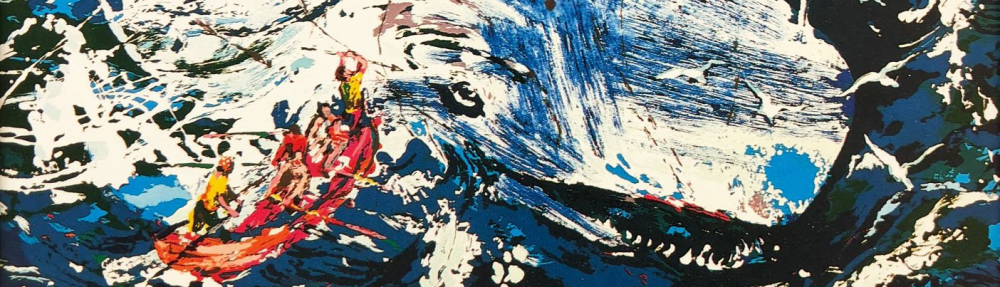
As I was reading Professor Pressman’s article, I couldn’t help but notice the multitasking done not by the mother, but by the child suckling at the teat. A child who has no self-consciousness or control over their body or mind somehow puts the mother second to the primary task of the infant’s wondering eye. Obviously, this is not intentional, but given the state of affairs and the political climate, it’s pretty symbolic of the role women play. Even the mother of a newborn, a woman that has carried and given life to a being, cant even garner the attention or manners to embrace the selfless action provided by the life giver lovingly. “and as human infants while suckling will calmly and fixedly gaze away from the breast, as if leading two different lives at the same time…. even so did the young of these whales seem looking up towards us” (p.423)
“The narrative pauses—taking a moment away from the intricate tales of men, technicalities of whaling, and vast political allegories—to stare into the depths.” (Pressman) Reading this, I envision a car crash on the 805, as onlookers slow down and begin to rubberneck at the tragedy they are willing and eager to see unfold. How many cars? Is anyone hurt? Who’s at fault? Once the crash is in view (meanwhile, while the driver has one eye on the road and the other on the crash), thoughts begin to overcome the brain. If it’s bad, a gasp is let out and empathy ensues; if it’s just a little fender bender, a groan and agitation ensue, with the driver thinking, “all that for traffic to slow!?” Regardless of the outcome, the driver continues, and their narrative resumes. Or put it this way: you’re eating at a restaurant, and out of the corner of your eye, a woman plops her swollen breast, which is an instrument of life, on the dinner table, and you look over and your mind begins to compute what the eye is seeing. A wrinkle in time as your brain pauses and you start to “stare at the depths” of Mother Nature. Some onlookers would turn away in disgust at the audacity of doing something private in a public place, or look in admiration at the sheer beauty that is motherhood. Regardless of the scenario life brings, split-second, unexpected disruptions are part of human nature, and we respond to them—ingesting and pondering. At the same time, your narrative is ongoing, “especially when the world around you threatens the momentary calm.” I’m not sure if anything I said makes sense, but I think you get my drift.
It is a brutal world we live in, and even more so in the field of Whaling, where this group of sailors on the Pequod have very easily killed these calves and mothers, but just like a farmer, they don’t hate their chickens just because they’re making a meal of them. To have that relationship with the nature of life, consciousness, and morality is a special one because in the whaling world, where you must act to survive and conquer, even a desperate serial killer like men still has a heart.

Hi Brock, I found the second paragraph of your response for this week interesting. It touches on a lot of different things, like attention, how we divert ours purposefully and automatically. It also touches on what we deem to be correct/incorrect in society, and how taking a step back can remind us what natural things we have made abnormal in society (like breast feeding). What we think should remain in the public eye vs private eye is often challenged when we are met with raw nature that doesn’t abide by any social anxiety or rules
I’m so glad you read the essay and commented on it, and I appreciate Sophia’s comment on your blog post. I think you both point out, smartly, how the natural (breastfeeding) is always viewed and cultural spaces and paradigms..