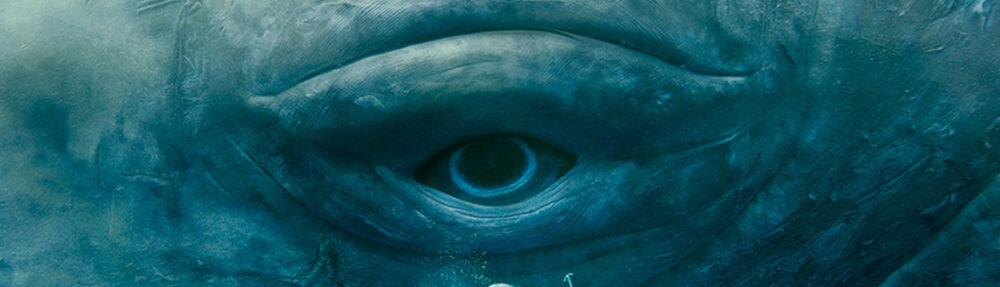
Ishmael studies the sperm whale’s head in Chapter 76, “The Battering-Ram,” using scientific methods and expressing a religious-like sense of amazement. He describes the front of the whale’s head as a lifeless wall which appears completely without sensation or perception. Yet, as he continues, that very lifeless surface becomes something sublime. By the end of the chapter, Ishmael describes the whale as “unerringly impelling this dead, impregnable, uninjurable wall, and this most buoyant thing within; there swims behind it all a mass of tremendous life” (370). The initial observation of body structure reveals a living force that exists beneath the appearance of immobility.
The passage captures Melville’s fascination with contradiction. The whale keeps its motionless forehead to protect its inner power and its vital life functions. The unknown depths of existence become visible through this symbol, which shows that life’s most powerful force operates through silent actions. The two words “dead” and “life” appear together in the same sentence to show how Melville unites physical and spiritual realms. Ishmael shifts his communication from scientific analysis to spiritual language because his whale research reveals the vast extent of his ignorance about the creature.
The scene matches Melville’s general comments about human ability to understand things. The whale’s “mass of tremendous life” fights against all attempts to apply logical thinking that Ahab, the scientist, and Ishmael would use. The effort to understand something of this scale reveals the extent to which our senses can only perceive so much. Nature created an enigmatic forehead shape on whales that humans cannot understand. The author concludes by showing that unknown forces govern the unbreakable wall, suggesting that the universe operates through mysterious ways rather than through direct control. The surface-level understanding we experience does not reveal the actual meaning, because the true process of understanding operates at a deeper level.
I feel that chapter 76 is a redeeming response to chapter 74, where we are first confronted with hopeless and stagnant imagery Ishmael leaves us with when examining whats even left of the whale then. It is interesting how cetology envelops almost all of life’s analogies, physically and spiritually. We rely on material evidence and the physical need of toil and struggle to realize the fullness of our existence, we often forget that behind the entity or thing is something even more complex. In our need to quantify things and label a warning sign against crossing, there is a significant reason why the Pequod ignored Gabriel’s attempt’s to prohibit them from examining the whale, even more significant than spiritual and physical bounds: a sacrifice, making Ishmael’s life to be more monumental and something worth dying to explore more about. I think, to add onto your point, that in the spiritual bounds, we try to put our own language and interpretation in meditation so as to grasp what is the spiritual, and how do we interpret it as a mortal?