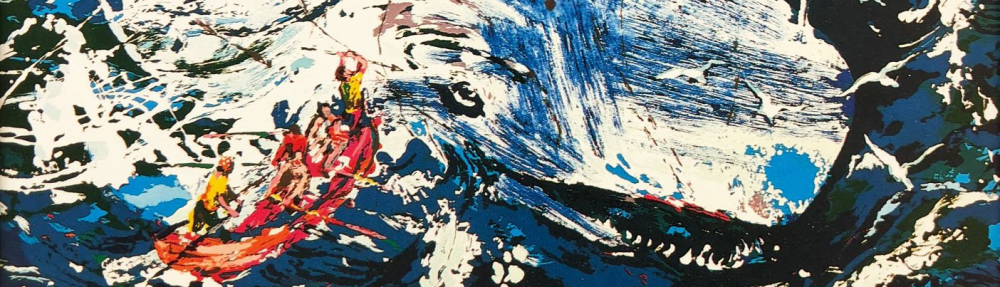
The Royalty of the Sea and Its Wildness

“…in which case you will take great interest in thinking how this mightly monster is actually a diademed king of the sea, whose green crown has been put together for him in this marvellous manner.” (Chapter 75, page 365).

It’s important to connect back to the historical context of this period of whaling and mankind’s ventures into the ocean. The sea, with all its mysteries, was considered a new frontier to be conquered and mastered, primarily through whaling and ocean fishing. It’s through these practices that people of the 19th century could not only establish themselves in the vast realm of the ocean, but wholly master it. Melville’s, or Ishmael’s, description of the whale as “a diademed king of the sea” with a “green crown” of slimy kelp and the rough edges of caked barnacles touches on this point. If whales are to be the kings of the sea, what does that say about the men who conquer and skin them on their boats? Or of Ahab, the crazed assassin of the sea who lives and breathes with Moby Dick staining the backs of his eyelids?

If we consider the ocean as both a thing to be conquered and a vast expanse capable of great destruction, whalers are prized assets to American imperialism in the 19th century. Yet, whalers are not always welcomed back to land with cheers and thanks, but disdain and disgust. Melville touches on this several times throughout our reading of the novel thus far, pointing out the bubbling hypocrisy of landsmen who beg for whale oil to light their reading rooms yet cover their ears at whaling stories.

Based on the quote above, to slay a king means either of two things, based on the broader context: the victory over a great leader who is said to own, whether literally or figuratively, an expanse of wealth or geography, or treason. Considering the first, this makes whalers who successfully kill and harvest all the whale’s assets victors over the ocean. However, the sea is a vast, violent thing full of various kings to be slain, pointing to a more profound message by Melville: man’s inability ever to understand or conquer the complexities of the ocean, despite all our efforts.

How I Annotate! Extra Credit

I started annotating my copy of Moby Dick as soon as I got it, using it as a notebook for our class discussions. Even before we started reading the actual text, I used the blank, or mostly blank, pages at the beginning of the edition to take notes on the historical context and Melville’s background. I’m reminded at every turn of a page that this novel is, in many ways, a preservation of existence, thought, and experience. It’s because of this that my edition is marked up in every way, from highlighter to pen to various color-coded tabs.

My favorite part of my copy is its evolution. In the beginning, my annotations were underlines, hearts, and different variations of “oh my god” or “wow.” Now, it’s a complete analysis, connections to other chapters, or thought-out stream of consciousness spouts. I have three different colored tabs: sage green, light blue/green, and light (almost pea soup) green. The sage green tabs are always located at the top of the page and mark the beginning or end of an assigned reading segment. While reading, these make it easy to distinguish how far I have to go. The light blue/green (It’s important to note here that I am, embarrassingly enough, colorblind, so these colors might be inaccurate) marks quotes that I really liked and will probably quote at various social settings. Finally, the almost pea-soup green mark my all-time favorite passages or quotes that I plan to focus on in future discussions or papers. There are only three of these so far, which makes them easy to find.

Short Paper One: Suicide, the Sea, and Salvation

This segment is at odds with previous discussions of the ocean in the novel, as Melville previously spent copious amounts of descriptions and excerpts from whalers and whaleships describing the dangers of the sea and her creatures. However, it is meant to stand out, as it differintaites the author from the characters. While the excerpts portion of the novel is to give context to the broader picture of the world’s experience with whales, chapter one introduces a different perspective – one that looks at whales not as dangerous creatures capable of significant threat, but of adventer and solution. 


By opening the novel with Ismael, the central narrator, discussing the grey temptations of a dull life, Melville introduces the sea as a primary character capable of duality, acting as both an oasis of sanity and salvation of refuge. This description, beyond Ismael’s blatant introduction of his preferred name, is the first that the readers get of Melville’s protagonist. From this, he is bored to a point of suicide – lingering into coffin warehouses involuntarily, attending stranger’s funerals purpisefully, feeling the cold, boring stillness of unsatisfaction and November depression. His solution for this, for suicide, is to go to the ocean and find adventure within her waves. In his words, “this is my substitute for pistol and ball” (3). 


In this section, the sea is a place of salvation and opportunity – somewhere that Ismael looks to with open eyes and an excited perspective. On land, he finds himself lingering in areas close to death and its permanence. However, by seeking out the ocean and her fluidity, Ismael is rejecting the concrete perspective of the sea being a place of danger and death, even despite the foreword given by Melville and the later scenes of the Chapel and it’s deathly inhabitants. Instead, Ismael is introducing the sea as a central character and solution to life’s most tempting boredoms – a place that acts as a substitute for suicide and the lingerings of melancoly. 

The diction used in the quote above is deliberate and calculated. Involuntarily, Ismael’s acitons on land are tired, repeatative, and full of despndency, yet not deliberately so: His pausings before the coffin warehouses is “involuntary” and he’s “in the rear” of the funerals he comes across. The trip to the sea is the first decision that the reader sees from Ismael, centralizing the ocean as a legitimate solution to the everyday melancholies of life. The irony in this decision is apparent to everyone but Ismael, especially given the multiple introductions by Melville. However, this perspective of the ocean and the monsters she contains is not Ismael’s – going to the ocean and facing the potential dangers in the waters is a more valuable solution to his depression than his current life, making the sea and her inhabitants a refuge instead of a possible death sentence. 


While characters aboard the Pequod seek financial gain from their exploits and catches, Ismael’s primary motivation to join the three year exhibition are not aligned with monetary profit, but in salvation from daily grievances and boredom. This trip, in all it’s confusing turns, cold watchful shifts, and relative isolation, is Ismael’s “substitute for pistol and ball” (3).

Narrative Perspective and Stage Performance

This part of the novel has so many moments that made me question exactly who is in charge of the narrative and how it functions for plot and character development. Specifically, how the description of characters, actions, and scenes works as a plot device to paint the happenings of the Pequod as a much larger thing. One of the first moments and most impactful moments came on page 162 in a description of Flask. Melville writes:

“But the third Emir, now seeing himself all alone on the quarter-deck, seems to feel relieved from some curious restraint; for, tipping all sorts of knowing winks in all sorts of directions, and kicking off his shoes, he strikes into a sharp but noiseless squall of a hornpipe right over the Grand Turk’s head; and then, by a dexterous sleight, pitching his cap into the mizen-top for a shelf, he goes down rollicking, so far at least as he remain visible from the deck, reversing all other processions, by bringing up the rear with music. But ere stepping onto the cabin doorway below, he pauses, ships a new face altogether, and then, independent, hilarious little Flask enters King Ahab’s presence, in the character of Abjectus…” (162).

Flask, after hearing that dinner is ready, seems to go into a dramatic and hilarious performance that involves all sorts of theatrics. This level of performance touches on the recurring themes of theater and Shakespeare throughout Moby Dick, thus far. Instead of describing Flask getting up, grabbing his hornpipe, playing a song, and pulling himself together before joining Ahab, the narrator deliberately describes his actions step-by-step, giving them a level of performance that belongs on the stage of a grand theater. This level of description paints Flask as a character in a much larger production with the Pequod as the stage. In this scenario, Ismael plays the role of the audience, taking in information and having no significant role in the plot (so far) while describing the peculiarities of the ship and her inhabitants. The level of detail given to Flask and his actions is reminiscent of Ismael’s observance of Queequeg in earlier chapters. As we touched on in class, Ismael spends most of his narrative focus simply staring at other characters, collecting and cataloging small details that would otherwise go unnoticed. In this way, in our course discussions on who he is and how reliable Ismael is as a narrator, maybe we’ve got it wrong. Instead of looking at Ismael as the narrator, we might benefit more from looking at him as the audience in a production much bigger than he is.

Ahab, in all his mysterious glory, is the central protagonist who stirs, quite literally, the central plot. In the chapters where Ismael is not directly retelling the happenings of the ship, such as “The Pipe,” there is a noticeable absence of detailed explanations because Ismael is not physically present on stage. Instead of getting the dramatic, theatrical paintings of a scene from Ismael, we, as the readers and audience of this production, are watching it ourselves.

The Sea and Life

There is literally so much that I could analyze from these chapters, but I keep finding this connection between the sea and how it provides a sense of life for seaborne characters. When Ismael sits down for breakfast in chapter 5, he describes the silence and quiet, awkward embarrassment of the table full of sailors, stating that:

“Yes, here were a set of seadogs, many of whom without the slightest bashfulness had boarded great whales on the high seas – entire strangers to them – and duelled them dead without winking; and yet, here they sat at a social breakfast table – all of the same calling, all of kindred tastes – looking round sheepishly at each other as though they had never been out of sight of some sheepfold among the Green Mountains.” (pg. 34).

This reminded me of the very first chapter, where Melville, or even Ismael, describes why he is writing about the sea and the human connection to the ocean. For me, the quote above paints a picture of burly, sea-roughed men who have seen some shit, comfortable on the seas and vocal about what needs to be done. However, when all sat together at a “social breakfast table,” there seemed to be nothing urgently to talk about, despite their shared experiences. In many ways, the sea brings life to these people in ways that common, daily happenings bring awkwardness. Water and sea life bring out aspects of living that normal life simply cannot, which connects back to Ismael’s introduction to the audience, where he declares that he goes to the sea when he feels depressed with his life. Melville even directly states this relation between life and the sea on page 5, where he says:

“It is the image of the ungraspable phantom of life; and this is the key to it all.” (pg. 5).

It’s in these small moments that Melville connects the role that the ocean plays in bringing forth one’s humanity, personality, and the very essence of life. When on the water, these men have to be vocal and social and themselves because they are surrounded by both nothing and everything else. However, when sitting on a social breakfast table on land, the whalers are at an awkward, silent loss.

Purposeful Language and What it Reveals in Melville’s “Extracts”

There were two primary extracts that stood out to me, especially considering their purposeful language and what it reveals about Melville, his story, and the overarching historical context. Firstly, on page xliii, Melville quotes Schouten’s Sixth Circumnavigation, which describes how people “saw such huge troops of whales, that they were forced to proceed with a great deal of caution for fear that they should run their ship upon them.” Here, the word “troops” really stands out to me. I researched it, and a group of whales is actually referred to as a “pod,” which was coined in the early 1800s. This timeframe suggests that “troops” was purposefully used, which implies an automatic sense of conflict towards whaling ships and a natural unity amongst whales.

Secondly, contrasting the usage of “troops” and the implication of battle from Schouten, Melville quotes Paley’s Theology on page xlv. In this, he writes that “The aorta of a whale is larger in the bore than the main pipe of the water-works at London Bridge, and the water roaring in its passage through that pipe is inferior in impetus and velocity of the blood gushing from the whale’s heart.” The focus on the heart of the whale here is interesting, especially as hearts tend to humanize animals to audiences. Here, it’s explicitly used for perspective and sizing.

Both of these quotes reveal a significant amount of context on whales and whaling. Schouten’s quote points to an intentional use of aggressive language to point to whales as inherently unified and aggressive, almost justifying the violence performed against them on the whaling ships. However, Paley’s diction is, whether intentionally or not, a humanization of the whale. Even if the focus on a whale’s heart was used for scale, it’s still putting them into a general perspective for audiences.

Steve Mentz Questions

  1. The fifth word listed in the “Preface to Ocean” reading calls for a change to our language, as you ponder if “our language [is] too visual.” What other linguistic alternatives are you thinking would align with the communication of underwater creatures?
  2. One of the first things that I noted in my reading of “Preface to Ocean” was your use of “moving and moved” to describe the waters surrounding us. What do those past and present tenses touch on with your ongoing studies of deterritorialization and “the blue humanities?”
  3. You’ve mentioned the effect that the eco-crisis and climate emergency have on your field of study. How might the growing concern on this topic influence the future of “the blue humanities,” and how might we, as students and advocates of the oceans, better help?
  4. Visibility and perspective seem to be huge points of interest in the process of destabilizing and adjusting our “old terrestrial language.” What role does visibility play in the advocacy for the oceans and surrounding waters? In other words, do you find that those in more direct proximity to the ocean and waters have a greater interest in “the blue humanities?”
  5. In what ways has your interest in poetry influenced your outlook on your field of study? We often discuss fluidity in our literary discussion and analysis of poetry, which makes the subject of water/oceans and poetry seem like complimentary partners.

“Deterritorializing Preface” Perspective – A Whirlwind

I have to confess that some of the suggestions that Mentz put forth in his preface made me feel uneasy and uncomfortable to think about. The changes, as he describes in his fourth word “ship,” go so far beyond just a material shift in thinking. What he’s suggesting is a complete turning point for all ways of life, intellectual perspectives, political formats, etc. Going to his sixth word, “distortion,” I could not wrap my brain around why I felt so uneasy with some of these changes. Then, it hit me.

I remembered a point that we made in class last Thursday about how we, as human beings, were not supposed to be in the ocean in the ways that we commonly are. We’re fundamentally land-based, so far as including land as one of our highest central issues in our language, political systems, and ways of thinking. The reason that Mentz’s encouragement to adapt to the “visual distortion” of “any aqueous [environment]” makes me so uncomfortable is that it’s so beyond literally all systems that I was taught.

Mentz writes that “water-thinking makes distortion a baseline condition” and that it “sometimes orients us on the buoyant top and at other times closer to the irresistible bottom.” It’s a change in perspective to focus on flexibility and openness, not a solid interpretation of what’s in front of you. There is a bend and flow of the ocean that Mentz is encouraging us to think about in ways that make our stubborn land-based lifestyles tremble a bit because it’s so different. It’s in this difference between the ways of our lives on land, through “grounded metaphors of the state,” and the movement offshore into the deep blue waters beyond that we find the importance of Melville.

As a reader of this six-page preface, I felt uneasy thinking about the changes that would occur through the “deterritorialization” process, whether it’s through the acceptance of buoyant perspectives or the reformation of something once thought to be so permanent as the horizon. I can only imagine how these changes would feel to someone confined to the oceans and waters. Where I can read about these alterations and try to apply them to my ideological perspectives on my own time, someone like Ishmael was surrounded by them, forced to recognize the movement of the currents and replace the term “progress” with “flow” due to necessity. It’s because of the changes posed by Mentz that I’m even more excited to see if and how the characters of Moby-Dick “[swap] out the old terrestrial language for saltwater terms” and outlooks.

What “What ‘Moby-Dick’ Means to Me” Means to Me

I know that this post falls after the deadline, but I’m writing it more to jot down my ideas and key takeaways from the readings and see if anyone else can relate. When Hoare wrote that “‘Moby-Dick’ is not a novel,” but “an act of transference, of ideas and evocations hung around the vast and unknowable shape of the whale, an extended musing on the strange meeting of human history and natural history,” it kind of clicked for me. It reminds me of our first day of the semester, when most of us were confessing to feeling overwhelmed before even starting the novel. Hoare’s comment connects to how Melville, as an author, didn’t write the novel as just a book, but a time capsule of the ideas of the 19th century. Emerson, whom we’ve talked about influencing Melville, urged 20th-century scholars to think for themselves and to work towards intellectual development constantly. This singular quote from this article began a domino effect on how to better approach Moby Dick as an intimidated reader. Instead of reading Moby Dick as a novel like Pride and Prejudice (where the details aren’t elaborated on too extensively and it’s very specifically plot-focused instead of detail-focused), it’s meant to be interpreted, not merely clicked off on my Goodreads “read” shelf.

Emerson’s “The American Scholar”

I’m extremely familiar with Emerson’s work due to his proximity to Louisa May Alcott in her childhood. I did my honors thesis on Alcott’s Transcendentalist background and upbringing, so a majority of Emerson’s either subtle or sometimes direct references to nature and Transcendentalism took me back to the labor of love that was my 25-page paper. It was interesting to read this specific essay and reflect on how his perspective is almost openly mirrored in Alcott’s Little Women, Flower Fables, and her personal letters as both an American author and American scholar.

Emerson points to nature as the first teacher of the American scholar, urging the audience, which extends beyond just Martin Van Buren, to return to the land to be re-inspired and literally touch grass. One of my favorite things about Emerson, and thus Alcott, is how reminiscent the writing is—I can see Emerson looking out his window at Bostonian elms or bluestem grass, recognizing the individuality of nature, and discovering that a return to these central elements is the key to correcting “the degenerate state” (Emerson). I know we discussed the historical context during one of our other sessions, but Emerson’s letter is such a time capsule to the fears that the Industrial Revolution brought. There are so many instances where Emerson warns against a copy-and-paste American scholar, who thinks what others think as if on a mass-produced conveyor belt of national intellect.