The cloudless sky that is affixed above the South China Sea holds no remembrance. Memory, like CO2 and heat, is absorbed into the ocean. Pip, being at sea long enough, is now a memory. Just another greenhouse gas occluding into omniscient seawater. He notices his body straining to stay afloat as he is carried down alive to wondrous depths. Corals sway to the faint current. Reef sharks gently swirl around him, unbothered by his tender presence. The Deep breeds energy, jolting Pip with pulses of knowledge. He is aware of every world; past, present and future. Every transpiring reality surrounded him, like glowing colossal orbs. He witnesses his ancestors, cradled in the same depths, relinquishing themselves to the same transcendent orbs. Mothers weeping; ocean salinity rising. Like them, he surrenders himself into the arms of the miser-merman. These arms, that hold the finite of history, collect Pip among their hoarded heaps and cast him to the depths.
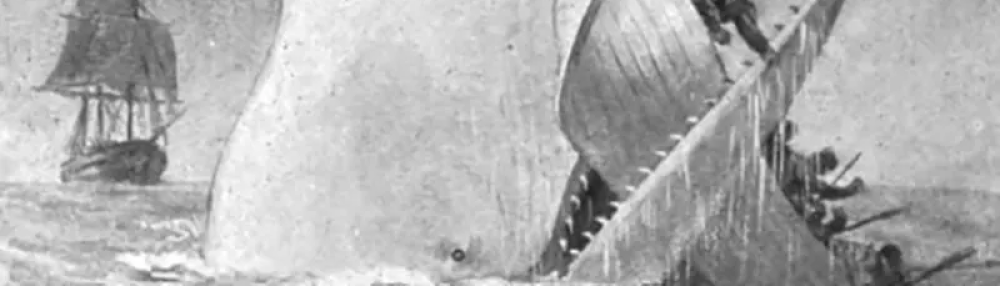
The deep swallows light and disrupts spacial awareness. It is a space for knowing everything and knowing nothing in one swift, spark of a moment. The sound of clicking is heard in the distance, or in the foreground, or somewhere in between. There is no way to tell. Pip is lost in his surroundings yet procured in his being. No longer subjected to earthly toil, to societal intolerance, Pip feels weightless under this unfamiliar immense pressure. The pressure acts as a binary opposition to oppression. It cradles his soul. That is all he can really feel, his soul. He can’t feel his legs kicking or his arms waving, or his head bobbing. He can’t feel his body being dragged onto the deck of an ancient ship. He can’t feel the resuscitation. The clicking multiplies into thunderous echoes. The water around him is displaced. A shock of white, a flash of horror, Pip’s mind slips out of consciousness.
He is awoken by the surge of a massive fluke swimming away, stirring the water around like a school of sardines. Awake in a wake and sieged by what seems to be a starless night sky, an inky cloud where light cannot invade, no matter how much oil is collected. This is the realm where whales govern, where glares do not exist. The blackness permeates Pip. It is the most blackness he has ever contemplated. It feels like home. In a world where shapes barely exist, and the sound that would usually hang upon a breeze dissipates into the cool, dense molasses, communication is seismic. Communication is haptic. Communication is electric and is now a piece of Pip’s freshly attained knowledge. His heightened senses attempt to situate him in this new world. Beings glide around him, he can feel the pressure undulating like a current as they stream past him. He is being examined, beheld, welcomed. Pip felt things he has never felt before. Physical anguish, frothy vengeance, an Ocean full of ache gyrating around him. But also, collective existence, an unshakeable kindredness, a seep of community. One of them stops in front of him, so close their noses are inches apart. Pip can make out the scaled tail that sweeps back and forth holding this… this, thing, this being upright.
“The white whale has sent you here. He is the guardian of innocence, a knight of the Ocean and the great judge of morality.” Aj’s tidal voice drifted back and forth. “He has brought you to the deep, to the wajinru. It means you are one of us, a descendant of the enslaved. Welcome two-legs. I am called Aj.” Aj bowed his voltaic head and touched it to Pip’s cnidarian soul. “O thy fish God in yon darkness, I am Pip. Have mercy. The white whale you say? The white squall. Have mercy on Pip. I was but thrown from a whale ship, shirr, shirr, forced on the hunt.” Pip rambled, his electric mind rampant. “A whale ship” said Aj puzzled. “Were you not held captive?”
“Held captive? No, we Blacks in the North are free, well shirr, if I didn’t go on that whale ship I coulda got chained up myself.” explained Pip. “The North… Blacks? What is Blacks?” Aj wonders. “Ya know Blacks, negroes, I guess you can’t see so clearly down here but, me, I’m Black. The White men they shackle us, whip us, make us work.” Pip describes in sorrow. He never did have to say it out loud. “You mean all those bodies, cast from ships, all those innocent people dead, because, because they’re black?” Aj said, the rage boiling inside of him. “Pip, what else can you tell us of these people? Where do they live, these two-legs?” “I… they, live in America. Some in the North like me, a lot in the South. That’s where you don’t wanna be. That’s where they lash you, where they hang you.” Pip’s grief welling. “America? Pip I have something to ask of you.” “Shirr, shirr.” “I Aj, hold all the grief for my people, for the wajinru, the memories, the hauntings of our past are within me and only within me. I promised my Amaba not to share these stories. Right now, we live only in the present, in togetherness. But I fear for my people. They become restless, they yearn for who they are, for where they come from. I must break my promise, if only for a few days, to fill the cavities of their souls.” Aj says spouting with emotion. “Pip, I believe this is why you are here, why the white whale brought you to us. You hold knowledge from the other world. Will you help me? Will you help me bring relief to my people?”
“O what’s this? One asks for young Pip? Thy white God has brought me here. O that glorious whale. I have never felt more alive than here in this cold, dark abyss. Shirr, shirr I will help you.” Pip replied.
The next few days, or nights, or whenever it was in this place where light does not bother to penetrate, the wajinru congregated. They collected kelp, and mud, and the skin of the dead: sharks, rays, seals. Anything to envelop them, to protect them in what they knew would be a vulnerable state. The water hummed along with their electric palpitations. The vibrating pressure comforted Pip. He was anxious, but he felt free for the first time, alive with the idea of being needed, his mind being desired. The wajinru begin shoaling by the thousands, surrounded by their miry cocoon “Are you ready?” asked Aj. Pip nodded. They floated into the center of this gyrating ball of mud and dead matter. It resembled an oceanic womb, regenerating its inhabitants to foster new life. And inside, the water pulsed like the ocean’s heartbeat. Aj and Pip hovered in the center. Aj snapped his tail to the left and all the wajinru followed suit. He communicated to them through the water. Pounding his tail, electrically transmitting every story he learned from his Amaba. Happy and sad and everything in between, all of them. While he did this Pip went around from wajinru to wajinru. They were still, debilitated with the surge of information. Pip pressed his cheek to theirs, one by one. They wept. In anger, in confusion, in fleeting joy, with vengeance they wept. It lasted days. And this was the first Remembrance.
“The Past—or, more accurately pastness—is a position. Thus, in no way can we identify the past as past.” (Troulliot)
The past shapes the present, therefore, the past surrounds us, like an ocean. Through fiction, the past is retrieved and reconstructed. In his 1851 novel Moby Dick, Herman Melville illustrates the lack of freedom of free Black men leading up to the Civil War. Throwing Pip overboard, and his subsequent enlightenment, is an acknowledgement of the atrocities of the Middle Passage and slavery because it is a recognition of the voices and History concealed in the Ocean’s depths. One hundred and sixty-eight years later, narrative discourse, like Rivers Solomon’s 2019 novella The Deep, continues to reiterate and remember the trauma inflicted on millions of captive people that were thrown overboard. Solomon retrieves the history of people who were deliberately silenced beneath the surface of the ocean. Both of these novels employ the setting of the Ocean to frame significant historical events. In this way, the Ocean operates as an archive of the American nation. An archive that has been concealed, like a witness who has collected hush money. Just as the silence of the ocean is depended upon to exploit it, so is the silence of the trauma of slavery. Emancipation might have been enacted, but the structures of slavery still exist, and silence enables them. Reading Melville’s character of Pip into Solomon’s novella The Deep demonstrates the prevailing marginalization of Black communities from 1851 to 2019. Pip and the wajinru act as voices for the Ocean and for Black communities both on land and those lost at sea.
Pip is a symbol of American blackness in Moby Dick. Christopher Freeburg, in his essay Pip and the Sounds of Blackness in Moby Dick, argues that Pip “allows us to realize that black culture is lodged in the very heart of the novel” (52) Melville is very purposeful and ahead of his time in his usage of Pip. It is Pip’s mere presence that welcomes readers into the diversity of America. This “presence constitutes the greatest value of the novel; he is a symbol of social equality and a catalyst for altruistic insight.” (Freeburg 52) Pip is a symbol of social equality because he demonstrates its inequities. The discrimination that independent Black individuals faced leading up to the Civil War constitutes a lack of freedom. In the “Forecastle—Midnight” Melville displays the marginalization of free Black communities: While ALL yell “The squall! The squall! Jump, my jollies! (They scatter.) PIP (shrinking under the windlass.)…” (193) soliloquizes. Pip giving a separate speech after “all” speak suggests that he is not a part of the crew. The Pequod, representative of the American nation, marginalizes Pip as America marginalizes Black communities. Through Pip, Melville demonstrates how freedom for Black individuals does not necessarily mean autonomy.
The “great shroud of the sea” (624) is a chronicle of all those who have been lost to its watery bowels. Through its obscurity, the Ocean is a silenced archive. It has been used as a naturally occurring cloak concealing capitalist exploitations. In “Pip’s Oceanic Voice: Speech and Sea in Moby Dick” Jimmy Packham “recognizes the power of language as a colonial tool, something which can impose itself onto a silence (…likely assumed) that cannot speak back” (Packham 7) Imposing language onto the voiceless enables History to be altered by colonial narrative. Melville also recognizes this muteness of the Ocean: “the waves rolled by… seemed a silvery silence” (Melville 253), “white, silent stillness of death in this shark” (Melville 206), “jetting his silent spout into the air.” (Melville 595). The archival Ocean and its creatures are speechless. The silence of an archive enables History to invalidate traumas. Silenced trauma and exploitation of the past enables the continuation of trauma and exploitation. Melville recognizes that “it’s the sea’s depths that obscure any voice the sea or its creatures might have.” (Packham 7) Because the Ocean and its inhabitants are unable to advocate for themselves, Melville assigns this task to Pip. “We can understand Pip’s discourse as Melville’s… effort to find a space in language for oceanic depth” (Packham 4) Pip, who was already a medium for the marginalized, forces the reader to acknowledge that the Ocean, similar to Black communities, is underappreciated, over fished(worked) and a vessel for unspoken trauma. Pip “saw God’s foot upon the treadle of the loom, and spoke it.” (454) Pip “spoke it”, that is he spoke for the Ocean and against Oceanic and Black exploitation.
Melville’s concept of whaling drives his narrative. He frames his novel on the surface of the ocean. Therefore, the whalers only comprehend the surface. Pip, who has been “carried down alive to wondrous depths” (453) learns to speak for the deep. Packham raises the idea that Pip “comes to embody the ‘strange shapes’ of the depths, his voice exhibiting an instability that recalls the fluidity of the element into which he has plunged.” (Packham 1) When Pip, who represents American blackness, speaks for the ocean’s abyss, he transpires the annals of a young nation. Pip’s designated voices collide when Pip’s soul is thought to be “in those far Antilles” (Melville 522) The Antilles, the Caribbean, where his ancestors were thrown from slave ships not so long ago. Pip is a voice for blackness, a medium for the Ocean, and ultimately an agent for his ancestors concealed in the sea. By giving Pip this multitudinous voice, Melville advocates for those lost within a buried archive. Melville uses Pip and the Ocean to frame the nation’s historical events.
The acknowledgement of the concealed archive is the cross section for Moby Dick and The Deep. One hundred- and seventy-five-years pass, and the United States continues to exploit its citizens while it feigns perfection. It is a time where Literature rather than History must command the discourse of the trauma of slavery in order to hinder the continuation of it. The Civil War may have legally ended slavery, but as Christina Sharpe points out in The Wake, “Racism [is] the engine that drives the ship of state’s national projects… cuts through all of our lives… in the wake of its purposeful flow.” (Sharpe 3) Slavery, through marginalization, through racism, through incarceration continues to press its haunting mark onto Black society. Silence enables exploitation. Silence of neighbors, silence of mainstream media, archival silence, exploits hidden in coral reefs, are all factors perpetuating exploitation. “The means and mode of Black subjection may have changed, but the fact and structure of that subjection have remained.” (Sharpe 12) Drexciya, clipping., and Rivers Solomon, the curators of the wajinru, exemplify the need to break the silence of this continuation of slavery. Literature like The Deep, which reinterprets the traumas of the Middle Passage into the creation of a new race of merpeople,attempts to begin a process of healing. This healing arises not only by re-gifting life to these erased humans, but by telling their story; uncovering the History that was meant to be obscured by the voiceless Ocean.
In The Deep it is the Ocean depths that act as the setting for the novel rather than the surface in Moby Dick. Expanding to the abyss of the Ocean as a main setting attempts to give definition to the deep, unknown, ocean environment. Similar to Melville, who implements a uniquely American narrative with whaling, Solomon turns to the wajinru to constitute a distinct facet of American history: chattel slavery. Connecting these two stories materializes the Ocean as an American archive. Mooring Pip into the narrative of the wajinru points to the extensive duration the issues of racial marginalization and exploitation have subsisted. Pip, who was written nearly two-hundred years ago, was an attempt to enlighten readers of 1851. However, he continues to be relevant, Pip can easily become a character in a 2019 novel. He does not demonstrate what has passed, instead he now depicts the continuity of Black American subjection. Pip and the wajinru are modern vehicles for the advocacy and amplification of the Ocean and Black communities.
Fastening Moby Dick to The Deep aimed to establish two main assertions of the books: Ocean as archive and the oppression of Black communities. Utilizing Solomon’s narrative enabled a clearer highlighting of these allegories in Moby Dick, a book with endless analyses. Both of these novels employ the setting of the Ocean to frame American historical events. They recognize the important documents held within Oceanic depths and sought to retrieve them. For it is through literature that the past is reconstructed. Literature breaks the silence that exploitation so dearly depends upon. It then became natural to transport Melville’s sea speaking character of American blackness, Pip, to the profundal realm of the wajinru. The nearly 200-year-old Pip, who was fabricated before emancipation, emphasizes the continuity of a nation that upholds slavery as his character retains relevance. Through Pip, the wajinru, and the Ocean we learn that the concealment of sunken traumas promote exploitation. The Lorax might speak for the trees, but Pip and the wajinru speak for the Sea.
Works Cited
Freeburg, Christopher. “Pip and the Sounds of Blackness in Moby Dick.” The New Melville
Studies, Cambridge University Press, 2019, pp. 42-52.
Melville, Herman. Moby Dick. Penguin Books, 2003.
Packham, Jimmy. “Pip’s Oceanic Voice: Speech and Sea in Moby Dick.” The Modern Language
Review, vol. 112, no. 3, 2017, pp. 567-584.
Sharpe, Christina. In the Wake: On Blackness and Being. Duke University Press, 2016,
https://doi-org.libproxy.sdsu.edu/10.2307/j.ctv1134g6v.3
Solomon, Rivers. The Deep. Saga Press, 2019.
