Final Creative Project
Reply
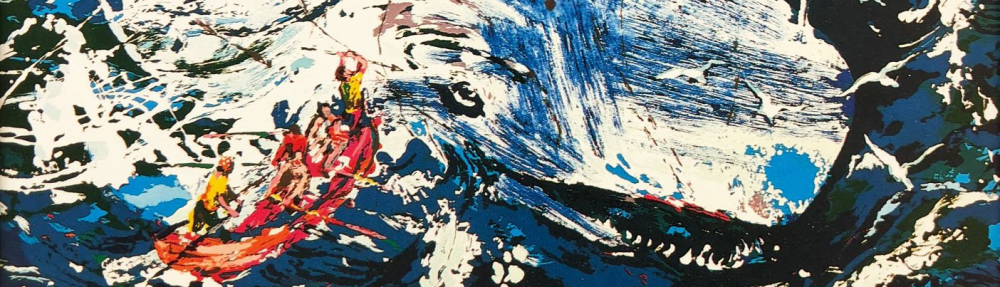
In the end, I have learned that Moby-Dick was never about the whale at all. It was beyond that. The hidden meanings that we have all figured out. The political turmoil, the power structure, the whiteness, the ship acting as an operational system, the repeating cycle, and the characters we have met along the way are what truly matter. This novel truly exceeded my expectations, and Prof. Pressman did an amazing job guiding us through this journey. I would say I was completely clueless, diving straight into the novel, but being together as a class and hearing everyone’s different opinions and interpretations helped me understand the novel critically. At first, I was so shy and awkward around my classmates, but after weeks of being together, I feel so much more confident around others. Now I feel like my mind has opened up; I actually feel smarter for being able to do many interpretations throughout the chapters. But I am still…lazy. However, despite all the laziness, I enjoyed this course so much that I do not want it to end. I do hope more people will receive the chance to study this course because it truly is a ‘once in a lifetime’ experience.
For this final project, I really want to focus on the theme of whiteness because Melville has such a fascinating way of describing it, and I will be utilizing my second essay to its fullest extent by exploring this topic. However, one particular point I am currently stuck on is creativity. I have this desire to be as creative as possible, but my mind is giving me blank answers. I would love to make a creative project that relates to its theme. I am working on how to make an artwork that revolves around the thesis statement, and I will be trying my best to finish it by the end of next week.
In the middle of chapter 87, Ishmael is directly telling readers to understand the importance of killing a sperm whale by saying: “Stick to the boat, Pip, or by the Lord, I won’t pick you up if you jump; mind that. We can’t afford to lose whales by the likes of you; a whale would sell for thirty times what you would, Pip, in Alabama. Bear that in mind, and don’t jump anymore. Hereby, perhaps Stubb indirectly hinted that though man loves his fellow, yet man is a money-making animal, which propensity too often interferes with his benevolence.” (Melville 452).
This passage highlights how a sperm whale is such a rare creature, and by hunting it, humans are exploiting the very essence of a whale, which is oil, to gain profit from it. This also reflects on the problem of slavery, where Melville is creating an analogy between the hunt for the whales and the hunt for the escaped slaves to teach readers to think critically about how humans exploiting whales is similar to humans using slaves for labor. Through this connection, Melville points out the truth that whales were never enemies. It was the humans who did all the hunting, all the killing, and all of the exploitation that they could get their hands on, while reflecting the problem of slaves being captured and sold for labor during that time period.
The mirroring of the hunt between whales and slaves was to tell readers that it was always about money. In this passage, Stubb said: “We can’t afford to lose whales by the likes of you” (452). He is referring to Pip as ‘the likes of you’, meaning he is very much annoyed by the fact that Pip keeps messing up everything. This attitude of Stubb is influenced by money, and when money controls you, nothing matters anymore, including the lives of people on that boat. The reason why the hunt between whales in the sea and slaves on land mirror each other is that both were used for the purpose of capitalism. Think about it, when people sell whales, they usually extract gallons of oil and sell it for consumers to use. When it comes to fugitive slaves, there are markets that people use for the slave trade. They use the auction block as a way to sell slaves to the wealthy for labor. In this case, the consumers and the wealthy are mirroring each other because they were meant to exploit, while whales and slaves are considered to be objects, things to be sold for the purpose of money. This is peak capitalism because businesses were meant to operate and make profits, while exploiting more and more valuable resources.
Stubb was referred to as specifically a ‘money-making animal’ because he lost the human nature of showing his emotional side to others. In the passage, we get a glimpse of Stubb through Ishmael, where he said: “Hereby, perhaps Stubb indirectly hinted that though man loves his fellow, yet man is a money-making animal.” (Melville 452). The sea plays a huge factor here because it influenced Stubb, while using the values of a whale in order to lure Stubb in and show him the importance of money. Because money is power, and when power rises, that is when greed plays into hands. Humans will do whatever it takes to exploit their own resources. To them, nothing is ever enough, and they will keep talking until there is no resource left. In this passage, when Ishmael refers to Stubb, a human being to an animal, it means Stubb blindly follows money, like an animal blindly hunting its prey. He does not think meticulously like a human; instead, he seeks what he sees. In this case, a whale is all that Stubb sees, and when Pip interferes with him, Stubb literally threatens Pip that he is going to leave him behind because he is being too clumsy. Stubb only sees whales, which is why human lives do not matter to him. Stubb could leave a hundred Pip behind with no problem. The real problem here is that capitalism is what changed Stubb, and it made him into a money-making animal with no thinking at all.
With the analogy between the hunt for whales and the hunt for fugitive slaves, Melville is showing readers the truth of how whales were never the enemies. Humans are the reason why whales are being hunted. They are also the reason why slaves were captured and sold for labor. In the passage, Stubb told Pip: “We can’t afford to lose whales by the likes of you; a whale would sell for thirty times what you would, Pip, in Alabama. Bear that in mind, and don’t jump anymore.” (Melville 452). This particular phrase shows how undervalued a human life is when it is being compared to whales. However, a fugitive slave is different because they are worth being purchased over. You see, the humans, alongside their curiosity, led them to hunt, to explore, and to exploit everything that they could lay their hands on. This is important because all actions have consequences, and every action that they took, such as hunting whales, capturing slaves, led to exploitation and inequality among themselves. Nothing good comes out of it, and money is what influences all of them to do these things. Melville is letting readers know the danger behind these specific circumstances because he wants us to learn from it. It’s insane how Melville sees this happening way longer before we do, and we are too blinded by the fact that money is what empowers us when the truth is it’s been controlling us this whole time.
The whales did not do anything to us; it was we humans who endangered them first, and we are the threat to them. If we think about it, the whales were out in the sea, enjoying their own company and their own home, and all of a sudden, these aliens came out of nowhere, attacking them face-on. What would their response be? To fight back. They will fight back to defend themselves and their homes. This applies to the slaves on land as well because slaves are normal human beings, but because of their skin color, it made them turn into something that inferior to others, hence it was the assumption that those who are lesser are not considered to be a human being, and that makes them view slaves as less than a human and more than an object. But money plays the real game because both the whales and slaves are worth something, and humans did what they could, which is to exploit and deceive in order to get more money. Greed, selfishness, and assumption are what influence humans.
This is why it has come to the conclusion that humans were different due to these factors. I do believe that Melville succeeded in letting people know the importance of it because humans do learn from their mistakes. In today’s society, we have learned that racism stems mainly from slavery, and we have moved away from it. We learned about sustainability and how resources have been exploited for a really long time. We came up with alternatives in order to hunt and farm more sustainably. This tells readers that humans can be changed for the better, and we should have done it a long time ago if we all understood what Melville is trying to say through this novel. But I am glad we saw this mistake beforehand and are trying to fix it.
After reading through chapter 135, there is this particular passage that quite confuses me, but as I tried to figure out the meanings behind it, I believe that Melville is trying to build up tension for the audience as we are about to reach the end. The passage states, “How the wild winds blow it; they whip it about me as the torn shreds to of split sails lash the tossed ship they cling to. A vile wind that has no doubt blown ere this through prison corridors and cells, and wards of hospitals, and ventilated them, and now comes blowing hither as innocent as fleeces. Out upon it!-It’s tainted. Were I the wind, I’d blow no more on such a wicked, miserable world.” (Melville 614). This passage fascinates me because it makes me feel like I am reading poetry. But why does it feel poetic? Is there more behind this particular passage? I think perhaps Melville is trying to use imagery for the audience to feel and see what the wind felt like while you are out at sea. He calls the wind ‘vile’ because it has so much freedom to go anywhere it wants while it pierces through Ishmael’s heart and soul. There is some sort of parallel here between the wind and the crew, where the wind is full of freedom and the crew is stuck out in the sea for eternity. Though the last line is interesting because there is a sense of selfishness here, coming from Ishmael. His negative mindset about the world makes me wonder why he thinks such negative thoughts. Perhaps it is because Ishmael has been out in the sea for so long that his mindset sort of change due to all the hunting. It makes him depressed and view the world more negatively. It almost feels like he is no longer himself.
I consider The Forge to be an extremely sad chapter, mainly because my favorite person, Ahab, sounds particularly sad in this chapter. The passage states, “This done, and Ahab moodily stalked away with the weapon; the sound of his ivory leg, and the sound of the hickory pole, both hollowing ringing along every plank. But ere he entered his cabin, a light, unnatural, half-bantering, yet most piteous sound was heard. Oh, Pip! thy wretched laugh, thy idle but unresting eye; all thy strange mummeries not unmeaningly blended with the black tragedy of the melancholy ship, and mocked it!” (Melville 533). I really like this passage because Melville is using sound to describe the current state of the whole ship. He uses the word ‘hollow’ particularly because the ship feels empty and dark, especially with Ahab’s presence; this adds more meaning to the term, of how Ahab’s mood has been affecting the ship this entire time. The Pequod represents a mass of emptiness, a void where silence brought loneliness into Ahab. The reason why I believe Ahab feels lonely is that he has been distancing himself for quite some time. There is a difference between him and the crew, a social hierarchy where Ahab is on top of it, and the crew is at the very bottom. This explains the distance between them because they could never fit in a different environment when they are already in their own comfort zone. But then Pip’s ‘piteous’ laugh came in, his laugh acts as a reminder to Ahab that he is not alone, and there will always be people around him, whether he accepts them or not. You guys are probably wondering: Why is Pip’s laugh important? This is because Ahab considers this ship to be melancholy, empty, and dark. It reminded Ahab of the memories when he first became a whaleman, and Pip’s pitiful laugh possibly balances out the creepy vibes that the ship is having. His laugh mocked everything that this ship stands for, and Ahab loves it.
I got hooked while reading this chapter because this is one of the most realistic chapters that I have ever seen so far. You might be wondering: “Why is it realistic?” I would say that it is because humans were born with a desire for something that they longed for a period of time, or rather, I would say, we were born with greed in our minds, at least for once in our lifetime. In this case, for Stubb, it’s the riches that he has always been after. There is a passage where they display Stubb’s true desire, where he said: “Stick to the boat, Pip, or by the Lord, I won’t pick you up if you jump; mind that. We can’t afford to lose whales by the likes of you; a whale would sell for thirty times what you would, Pip, in Alabama. Bear that in mind, and don’t jump anymore. Hereby perhaps Stubb indirectly hinted that though man loves his fellow, yet man is a money-making animal, which propensity too often interferes with his benevolence.” (Melville 452). Why does this matter, you might ask. It matters because at the end of the day, there is something that we are always after, there is something that we keep in our minds at night to remind ourselves why we are pursuing our goals, for what purpose we are pursuing this. When it comes to Stubb, he loves his fellow man, Pip, for sure, but if he were to be given a chance to save Pip or the whale, what would he choose? I think you already know the answer. The whale makes a profit because it is considered to be the creature of the sea; it makes a profit because of the oil that humans want to exploit for their own benefits. Stubb is inherently blinded by riches that Melville considers a ‘money-making animal’ because he has already set his mind on the money, and nothing could change that. Stubb is like an animal with no thoughts when it comes to money; it is the only thing that is keeping him going, and it is the only thing that he desires. Also, when Stubb said, “By the likes of you”, there is a sense of arrogance coming from his side. It is the utter annoyance that Stubb is expressing here, and I wondered if we’ll get to see more of his side later on.
Throughout the chapter, there is one passage that particularly caught my attention. It is chapter 75, where Ishmael is doing a deep dive-in on the Right Whale’s Head. The passage states, “But if this whale be a king, he is a very sulky looking fellow to grace a diadem. Look at that hanging lower lip! What a huge sulk and pout is there! A sulk and pout, by carpenter’s measurements, about twenty-feet long and five-feet deep; a sulk and pout that will yield you some 500 gallons of oil and more.” (Melville 365). This passage is very interesting to me because it reminds me of an Anthropology class where I was learning about sustainability, where fishermen have their own alternative way to hunt fish without exploiting its species till the point of extinction. The reason why fishes have been on the verge of extinction in today’s society is because humans have been exploiting the ocean for years. We hunt for food, for fish oil, and other vitamins that benefit us, and we exploit them by exceeding the limits every single day. When I look at this passage, I believe the same concept applies to whales. They produced a huge amount of oil equivalent to just one whale, to be exact it’s at least 500 gallons of oil and more. I believe Melville is trying to tell readers how the sulking/pouting whale represents all of the fishes that went extinct in today’s society. Back then, fishes were insanely large, but in today’s society, their sizes reduced significantly. This tells us that humans have purposefully hunted fishes over the limits, and now there are no large fish left to produce. I believe whales are in the same situation because the whale offers oil as an opportunity for humans to exploit. With that being said, the fishes (including the whales) are on the verge of extinction, and the ocean is extremely unsustainable since humans keep exploiting it. As a result, we won’t have anything left to hunt, and all of the species will go extinct. Melville brought in a really good point of how this novel is not just about whales, but about sustainability/ unsustainability to all the fish species.
This novel has been putting me in a chokehold for quite some time because of how slowly it progresses throughout the chapters. There are some chapters where I was like: “What the hell is going on?” and there are chapters where I yelp with excitement, especially the one chapter called Moby Dick, which is chapter 45. The reason why this chapter excites me is that we all get to learn about the White Sperm Whale, and its dangerous intentions while lurking under the sea. There is this one passage where Ishmael states, “The Sperm Whale is in some cases sufficiently powerful, knowing, and judiciously malicious, as with direct aforethought to stave in, utterly destroy, and sink a large ship; and what is more, the Sperm Whale has done it.” (224). What is really interesting about this chapter is that it prompts readers to think about how dangerous the whale is. However, there are more details than just that. Melville purposefully uses Ishmael’s and other whalemen’s perspectives to show the danger that this Sperm Whale causes to humans, while he never points out the danger that humans pose to the Sperm Whale. In my mind, I believe that humans were the ones who inflicted damage on the Sperm Whales first, then, from the Sperm Whales’ perspective, they believe that humans pose to them as threats, which is why they attack large ships, chase after these ships, and destroy them to prevent future disaster for their species. I believe that, just like dolphins, whales are actually really smart beings. It remembers faces and is aware that ships that sailed are meant to attack them, which prompts me with a question: Are Sperm Whales considered to be as malicious as Ishmael claims it to be? Or it was the humans that caused this, and the whales are just simply protecting themselves. For humans, hunting a whale is literally a huge achievement because they get recognized for killing one. It’s the whalemen’s dream to be able to hunt a whale, and that ambitious desire turns them into heartless human beings because they are slaying tons of whales just for that purpose alone. I love learning about Sperm Whales, and the human perspectives are trying to convince readers to bear that same hatred towards these whales because of their maliciousness. But I want to look at it from a different perspective, and it’s really amazing to be able to look at things from different sides.
What is one’s true purpose in life? There are many questions that pop into my head while reading Moby-Dick by Herman Melville, and I can not help but wonder about this particular question: Is there a purpose in life? Or we just keep chasing one thing after another, like our lives depend on it. This novel not only gives me the confusion of the story and its characters, but it also makes me question the true purpose of life. I keep asking myself why on earth someone would be ready to throw away their precious lives just to hunt whales? And the question is obvious because hunting a whale is the golden ticket to heaven, because of the recognition and the admiration one desires that led them to this decision. In this novel, we are going on an adventure with our main character, Ishmael, as we explore the stories of the sea and its people. We are looking through the lens of Ishmael’s perspective, the novel prompts us with the question: Why does it have to be through Ishmael of all people? And to answer this question, it is particularly because just like Ishmael, readers are born with questions about things in life. In this case, the novel is teaching us how to look at things from a different perspective while interpreting their own ideology, thoughts, and feelings. While Ishmael’s identity is questionable, by looking from his and other captains’ perspectives, it points out the god-like nature that Captain Ahab retains, and through the hatred for white whales, revenge has blinded him to the point that he himself is so odd, bizarre, and god-like to the other whalemen.
Captain Ahab’s unpredictable nature is the reason why other captains and whalemen saw him as a god-like figure. Throughout the many chapters that we have read, there are a few points that I would like readers to ponder as we are going to deduce the meanings behind them. The first point came from the other captain’s perspective, where Captain Peleg states: “He’s a grand, ungodly, god-like man, Captain Ahab; doesn’t speak much; but, when he does speak, then you might as well listen. Mark ye, be forewarned; Ahab’s above the common; Ahab’s been in colleges, as well as ‘mong the cannibals; been used to deeper wonders than the waves; fixed his fiery lance in mightier, stranger foes than whales.” (Melville 88). This quote perfectly describes who Ahab is as a person. In Captain Peleg’s perspective, he is a strong man who has faced many challenges to get to where he is today. Ahab is knowledgeable about the whales; he is associated with the cannibals while going to college to gain more knowledge about the world. The way Peleg described him as an ‘ungodly, god-like man’ was a way to tell readers that Ahab did a lot of amazing things while he was one of the whalers. He believes everything Ahab did is impossible, which implies things only a god can do, yet Ahab is still a human being made out of flesh, which is why he is described that way. But while looking at this explanation, readers might wonder what amazing things Ahab did that made him a considerable god-like figure. It is when Captain Peleg told one of the stories to Ishmael, about how Ahab is: “a very vile one…that ever since he lost his leg last voyage by that accursed whale, he’s been kind of moody—desperate moody, and savage sometimes.” (Melville 89). This is the second point that I would like to make because readers can see that Ahab had fought a whale and was actually alive while losing his leg. Furthermore, Peleg adds in: “When that wicked king was slain, the dogs, did they not lick his blood?” (Melville 88). This proves how Ahab is essentially a god-like figure in Captain Peleg’s eyes because he slew a whale while he managed to keep himself alive. This connects with the metaphor of mysteriousness that Ahab offers because when we listen to this story, we can see a vivid image of Ahab standing with his back arched, and his missing leg oozing blood like a warrior who has just defeated an army, while the dogs act as his loyal pets that are following his orders and serving him dutifully. This explains why Ahab, his unpredictable nature, and his stories are so bizarre that people could not believe it until they actually saw it with their own eyes. It almost seems like he is not a real human being, but a deity who just happens to be slaying whales occasionally.
Captain Ahab’s state of mind, his quietness, and composure match the energy of a warrior, which comes off as oddly strange to other people. When I read these chapters, one thing I noticed was that Ahab rarely speaks. He is so quiet that his actions are being read by people, and by Ishmael, who is excellent at reading him. The passage states: “Over his ivory-inlaid table, Ahab presided like a mute, maned sea-lion on the white coral beach, surrounded by his war-like but still deferential cubs. In his own proper turn, each officer waited to be served. They were as little children before Ahab, and yet, in Ahab, there seemed not to lurk the smallest social arrogance.” (Melville 162). I noticed how the officers are being compared to children, as it is the opposite of Ahab, whose energy is so strong and formidable that it terrifies the people in front of him, and it gives the officers the idea of not messing with Ahab because they also heard the bizarre stories that he once created. Perhaps readers might ask why nobody wants to speak to Ahab since he does not show any social arrogance to them? When we look at Ahab from many different perspectives, we are not afraid of him because we understand his characteristics as a human being. But on a realistic side, if we face Ahab directly in real life, like the officers in the passage, we can see that Ahab is an authoritative figure. He does not want to mess around with or be friendly with others. His job as a captain is to guide people well and to do his job. That explains why everyone seems to be uneasy in front of Ahab because only Ahab can do his job well and effectively. This connects to how Ahab is so odd to others because his presence is so terrifyingly strange that people just rather not talk to him at all.
Captain Ahab’s sense of revenge is the reason why he’s been acting odd to others. In chapter 36, the crew mentions Moby Dick as they refer to every white whale they see. However, Starbucks asks: “Captain Ahab, I have heard of Moby Dick—but it was not Moby Dick that took off thy leg?” (Melville 177). While Captain Ahab: “shouted with a terrific, loud, animal sob, like that of a heart-stricken moose; Aye, Aye! It was that accursed white whale that razeed me; made a poor pegging lubber of me forever and a day…and I’ll chase him round Good Hope, and round the Horn, and round the Norway Maelstrom…And this is what ye have shipped for, men! to chase that white whale on both sides of land, and all over sides of earth, till he spouts black blood and rolls fin out.” (Melville 177). This passage is one of my favorites because we are now diving into Ahab’s emotions. There is this strong hatred that Captain Ahab has harbored for a long time, ever since one of the white whales took away his leg. This explains why Captain Ahab always seems to detach from people. He isolated himself from others because his thoughts were too occupied with the white whales, and that pushed him further down to the deep sea, a place where he is just alone, a place where he can be busy with thoughts and emotions. In class, we also talked about how Ahab is on the verge of extinction because there is no one like him. He is his own version, and no one could ever imitate that.Not only does this novel teach us how to understand the characters to the fullest extent, but it also teaches us to know the realistic side of the whalemen who once hunted whales. The novel reveals the mysteriousness that the people and the sea offer while it feeds us with curiosity for us to engage with the meanings behind it, to know what it feels like to be in the position of a whale man. Moby Dick is not just a story of hunting whales; it is a story about humanity, a story of the anatomy of a whale, a story of the ship and the sea. Everything we see in the novel has its own story that will continue to expand infinitely. As we are halfway through the novel, one takeaway for me is to expect the unexpected. There will always be something to learn in this novel, and I hope I will be able to understand all of the meanings that Melville offers.