A Blog For Week Ten (Chapter (73) P. 356

“Do you see that mainmast there?” pointing to the ship; “well, that’s the figure one; now take all the hoops in the Pequod’s hold, and string ’em along in a row with that mast, for ought, do you see; well, that wouldn’t begin to be Fedallah’s age. Nor all the coopers in creation couldn’t show hoops enough to make oughts enough”(P.356). In this quote from Moby-Dick Stub uses a humorous metaphor comparing the ship’s mainmast and countless barrel hoops to describe Fedallah’s mysterious, seemingly ancient age. Melville uses exaggerated imagery and mockery, portraying the superstitious awe the crew feels toward Fedallah. The piling of “hoops” and “oughts” creates a sense of endless repetition, suggesting something beyond human comprehension. This passage shows how the sailors struggle to understand Fedallah’s eerie presence, symbolizing their confrontation with the unknown forces that guide the Pequod. It also underscores Melville’s theme of human limitation no amount of measurement or logic can grasp the depths of fate and mystery embodied by Fedallah.

Week, 9 , Moby-Dick, Chapter 45 page 221

“I care mot to perform this part of my task methodically; but shall be content to produce the desired impression by separate citations of items, practically or reliably known to me as a whaleman; and from these citations, I take it- the conclusion aimed at will neutrally follow of itself”(P.221). Ishmael admits that he will not write in a strict or logical order bur instead use fragments from his experience as a whaleman. Melville’s narrator uses a conversational and almost defiant tone to reject formal methods of storytelling, emphasizing intuition and lived experience over rigid structure. This approach reflects the novel’s experimental form, where truth emerges from fragments rather than linear reasoning. Ishmael’s “separate citations” reveal hoe knowledge of the sea is gathered through practice, memory, and feeling rather than through scholarly method. By blending fact and impression, Melville blurs the line between fiction and documentation, suggesting that meaning is constructed through experience. Ultimately, the passage reveals Ishmael’s belief that genuine understanding of whales, the ocean, or from the chaotic accumulation of lived truths,

Importance of the Jacket

Yousuf Shwiha
Class: ENG 522
Dr. Jessica Pressman
October 19, 2025

Importance of the Jacket

            Early in Moby-Dick, Ishmael wanders into the Whaleman’s Chapel during stormy weather. The shift in atmosphere— “clear, sunny cold” turning to “driving sleet and mist” (39)—sets a tone of uncertainty and foreboding. This passage demonstrates how Melville uses natural imagery and religious setting to link the sea’s harshness with human fragility, creating a moment that dramatizes the spiritual and existential anxieties that underline the novel. Ishmael’s protective jacket, I argue represents safety from the uncontrollable forces of nature. The congregation of sailors and widows all work together to foreshadow the danger of whaling and the inevitability of death, suggesting that Melville uses these images not only as narrative detail, but also as symbolic warnings about the futility of resisting mortality in a profession built on peril.
            “The sky had changed from clear, sunny cold, to driving sleet and mist” (39). Melville juxtaposes clarity and brightness with sudden storminess. The transformation reflects how quickly the sea—and life—can change.  The diction (“driving sleet,” “mist”) conveys both physical struggle and obscurity of vision. The weather doesn’t just inconvenience Ishmael; it symbolically enacts the unpredictability of fate. The novel often links nature’s instability to human destiny. This foreshadows the Pequod’s doomed voyage and establishes an atmosphere of existential uncertainty. Ishmael’s perception of the storm becomes a metaphor for human attempts to navigate meaning in an unstable world. This sudden shift in weather also underscores the ever-present danger of whaling, where safety can collapse into catastrophe without warning. By casting the storm as both literal and symbolic, Melville reminds readers that mortality is never far from the sailors ‘reality. This, the storm becomes an early warning of the futility of resisting death in a profession defined by risk. My evidence from the Moby-Dick is the Storm “The sky had changed from clear, sunny cold, to driving sleet and mist” (p.39).
            “Wrapping myself in my shaggy jacket of the cloth called bearskin, I fought my way against the stubborn storm.” (39) The “bearskin” jacket suggests both protection and a kind of animal disguise. The Jacket in Moby-Dick symbolizes Ishmael’s fragile protection against the immense, uncontrollable forces of nature. It represents the illusion of safety and human endurance in a world governed by chaos and fate. Through this small, personal object, Melville highlights how humans cling to material or spiritual defenses that ultimately cannot shield them from the vast power of the sea or mortality itself. “I wrapped myself in my jacket, and tucking my hands deep down into its pocket, sat down in a corner. I felt as though I had been sliding down into a hollow, dismal gulf.” (Ch. 7, p.38). Ishmael must armor himself against nature.  The verbs “wrapping” and “fought” emphasize physical exertion, showing man’s effort to resist elemental power.  This imagery raises questions about the human/animal divide. To survive, Ishmael doesn’t have an animal skin, blurring lines between civilization and primal endurance. This foreshadows how whalemen must constantly wrestle with their environment, often reduced to instinct and brute survival. Symbolically, it suggests that human resilience comes through merging with, rather than conquering, the natural world. Yet even this act of protection carries irony, since no jacket can ultimately shield a sailor from the inevitability of death at sea. The bearskin emphasizes how fragile human defenses truly are when confronted with the ocean’s vast and unpredictable force. Melville uses this detail as a symbolic warning that survival is temporary, and mortality remains inescapable despite every effort to resist it. My evidence from the Moby-Dick is the Jacket “The cold sleet and snow beat through my jacket as if it were paper” (39).
            “Entering, I found a small, scattered congregation of sailors, and sailors’ wives and widows” (39). The shift indoors contrasts with the storm outside, yet the chapel carries its own storm: grief and absence. The description emphasizes sparsity (“small,” “scattered”) and loss (“widows”). It is not a triumphant congregation, but one marked by mourning.  Melville links the physical storm to the spiritual storms faced by seafaring communities. The widows stand as living reminders of death at sea. This anticipates Father Maple’s sermon and the broader theme of whaling as not only economic labor but also a confrontation with mortality, sin, and divine justice. The very presence of widows underscores that death is not a distant threat, but a constant reality embedded in the lives of those tied to the sea. Their grief serves as a collective warning to many who venture on whaling voyages, by juxtaposing the chapel’s quiet sorrow with the violent unpredictability of the ocean, Melville reveals how mortality permeates both the spiritual and physical worlds. In this way, the congregation itself becomes a symbolic reminder that whaling is inseparable from loss and death, My evidence from the Moby-Dick is the Congregation “The chapel was not crowded, but silent and solemn” (p.40).
            Through the storm, Ishmael’s bearskin jacket, and the mournful congregation of sailors and widows, Melville underscores both the peril of whaling and the certainty of death, using these images not merely as descriptive detail but as symbolic reminders of humanity’s fragile struggle against forces it can never ultimately escape.  Melville crafts this brief passage to interlace natural imagery, bodily struggle, and communal mourning, thereby dramatizing the precariousness of human life in a world governed by both natural forces and spiritual anxieties. The passage exemplifies Moby-Dick’s broader concern with how individuals face overwhelming power—whether nature, fate, or God.  The moment matters because it shows that before Ishmael even boards the Pequod, he is already immersed in an environment where storm and faith, survival and death, are inseparably entwined. It establishes the tension between man’s fragile defenses and the vastness of forces beyond his control, a theme that resonates throughout the novel. By linking the storm, Ishmael’s protective jacket, and the mourning congregation, Melville layers symbolic warnings that death is unavoidable in the whaling life. Each image reminds readers that human attempts to shield themselves-can never fully overcome mortality. Instead, these details foreshadow the Pequod’s doomed voyage, where resistance to fate only highlights its inevitability. In this way, Melville situates whaling as both a literal and existential struggle against forces far greater than man.
“Dry heat upon my brow? Oh! time was, when as the sunrise nobly spurred me, so the sunset soothed. No more. This lovely light, it ‘lights not me; all loveliness is anguish to me, since 1 can ne’er enjoy. Gifted with the high perception, I lack the low, enjoying power”(P.182).

In this passage, the speaker laments the loss of joy and spiritual vitality he once felt in nature’s rhythms-the sunrise that used to inspire him and the sunset that once brought peace. Now, even beauty feels like torment because he can no longer experience it fully. Melville uses intense contrasts (“sunrise nobly spurred me… sunset soothed”) and emotional diction (“damned… malignantly… anguish”) to dramatize the speaker’s inner despair. The biblical tone of “Paradise” heightens the tragedy of feeling exiled from divine or natural grace. This moment reveals a crisis of perception and faith: the speaker’s “high perception” has become a curse, making him aware of beauty but unable to enjoy it. It underscores one of Moby-Dick’s central themes-the torment of human consciousness that seeks transcendence but fir isolation instead.

Moby-Dick, Chapter37 page 182 Week (7)

(This is a quote from Moby-Dick chapter (18)).

” When all preliminaries were over and Peleg had got everything ready for signing, he turned to me and said, “I guess, Quohog, there don’t know how to write, does he? I say, Quohog, blast ye! dost thou sign thy name or make thy mark?” But at this question, Queequeg, who had twice or thrice before taken part in similar ceremonies, looked no ways abashed; but taking the offered pen, copied upon the paper, in the proper plan an exact counterpart of a queer round figure which was tattooed upon his arm; so that through Captain Peleg’s obstinate mistake touching his appellative, it stood something like this.”

In this passage, Herman Melville reveals Queequeg’s quiet dignity and intelligence through an act that others might misread as primitive. Queequeg, the South Sea Islander, is mocked by Captain Peleg for supposedly being illiterate. What: When asked to sign the ship’s papers, Queequeg calmly takes the pen and reproduces the tattooed symbol from his arm—his unique mark of identity. This moment argues that literacy and civilization are not the same as intelligence or self-knowledge. Melville uses this scene to challenge Western assumptions of superiority by showing that Queequeg’s “mark” carries just as much meaning as a written name. His symbol becomes a form of self-representation that bridges body and culture, proving that communication and authority extend beyond language. Ultimately, the scene invites readers to question who defines “civilization” and to recognize dignity in difference.

A blog from Moby-Dick ( week 6)

“The Nantucketer, he alone resides and rests on the sea, he alone, in Bible language, goes down to it in ships; to and from ploughing it as his own special plantation. There is his home; there lies his business, which Noah’s flood would not interrupt, though it overwhelmed all the millions in China.” In this passage from Moby-Dick, Melville describes the Nantucketer as uniquely at home on the sea. What he emphasizes is the sailor’s complete identification with the ocean -it is not just a workplace but a “plantation” that he ploughs daily, turning the vast and unstable sea into a kind of kind of personal fields. This imagery highlights the whaleman’s audacity, treating the uncontrollable waters as though they were farmland. Who the Nantucketer represents is more than a single sailor; he symbolizes a maritime culture that defines itself through mastery over risk, danger, and distance. He is cast in biblical language, suggesting both divine calling and mythic authority, as if he fulfills a sacred role So what does this matter? It shows how whaling communities claimed dominion over spaces that defied ordinary settlement, carving livelihoods from peril. Melville also draws attention to the arrogance and resilience of this profession: even a second flood could not halt their labor . Ultimately, the passage elevates the Nantucketer into a figure of both human ingenuity and hubris, embodying the larger themes of risk, conquest, and survival that drive the novel.

Quote from page (70) Moby-Dick

An Etymology blog for the Novel Moby-Dick

When Herman Melville titled his novel Moby-Dick; or, The Whale, the curious spelling and hyphenation immediately invited readers to pause and wonder. The name “Moby” is believed to derive from the adjective mobile or mighty, hinting at both the whale’s vast size and elusive movement through the sea. The “Dick” portion comes from the old-fashioned practice of giving familiar names to animals or objects, much like “Tom” or “Jack.” Melville even drew inspiration from real-life accounts of a massive white whale called “Mocha Dick,” a notorious creature encountered near Chile in the early 19th century. By reshaping the name, Melville transformed a real legend into a symbolic force of nature. The title itself, therefore, blends history, folklore, and creative invention, anchoring the whale in both myth and reality.

Moby-Dick

Herman Melville’s Moby-Dick is more than just a story about a whale-it’s a meditation on obsession, fate and the vastness of vastness of nature. The narrator, Ishmael, takes readers on a perilous voyage aboard the Pequod, where Captain Ahab’s relentless pursuit of the white whale consumes the crew. Through detailed descriptions of the sea, whaling life, and philosophical reflections, Melville blends adventure with deep symbolism. The white whale itself becomes a powerful emblem of mystery, resistance, and the unknown forces beyond human control. Reading Moby-Dick is both a thrilling narrative and a challenge to reflect on humanity’s place in the universe.

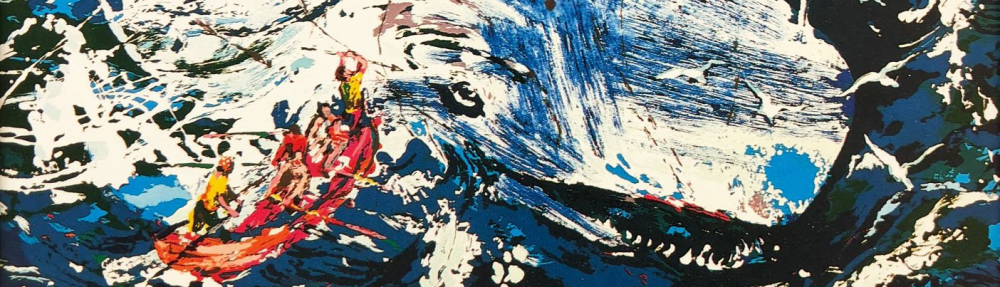
Imagine a dark ocean horizon where the Pequod sails forward under stormy skies, its sails strained against the wind. Captain Ahab stands on deck, gripping his whalebone leg and pointing his harpoon toward the turbulent waves. Below, the crew works tirelessly, their faces tense, reflecting both fear and loyalty. Suddenly, the massive white from of Moby Dick breaches the surface, scattering water like shattered glass. This dramatic clash of man and nature captures the epic struggle that defines the heart of the novel.

What “Moby Dick means to me”?

Moby-Dick means different things to me different levels. On the surface, it’s a grand sea adventure filled with danger, obsession, and mystery, but more deeply, it feels like a mirror of human struggle- how we often chase things bigger than ourselves, even when it risks our downfall. Captain Ahab’s obsession with the whale shows how destructive it can be when danger and vengeance consume a person, while Ishmael’s reflective voice remains me of the value of humility, learning, and survival. For me, Moby-Dick represents the constant push and pull between ambition and acceptance, reminding me to respect both nature and my own limits.