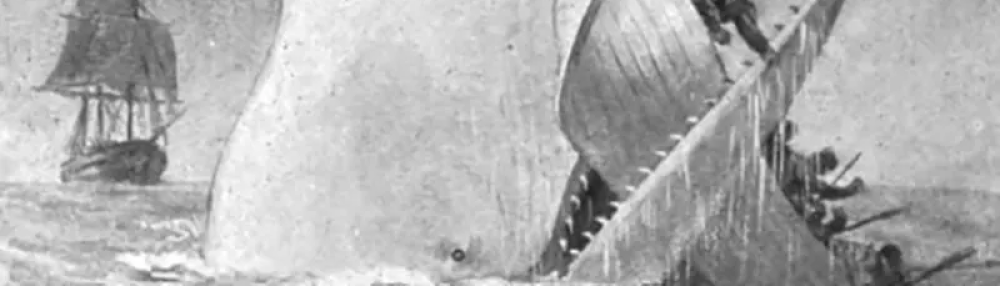
A Peaceful and Nourishing Moment by Zoe Olow

Essay Explaining My Painting (A Peaceful and Nourishing Moment)

In Chapter 87, The Grand Armada, Melville lulls us into a peaceful reverie by presenting a scene devoid of violence or obsession. Ishmael and crew come upon a pod of whales protecting a group of calves as they breastfeed. Despite a lack of female characters within the novel, there is a strong feminine presence in moments such as this that are scattered throughout Moby Dick. To draw attention to this scene and its importance, my creative project is an oil painting featuring the mother whale feeding her young, with the underside of the ship visible but not centered. These moments of feminine tranquility and tenderness serve a narrative purpose to show a mind-changing moment of peace and grace amongst the rest of the book, which is filled with rage, violence, and obsession. This shows that Ishmael’s views of the whales begin to change compared to Ahab’s monomaniacal focus on them, which leads him on this path. Although the presence of women is sparse in this book, Melville proves this with a moment of grace, a beautifully tender act of breastfeeding done by these creatures amid the violence they commit towards the whales throughout the rest of their journey aboard the Pequod.

As one reads through this large book, there is constant hatred, anger, and obsession seen through Ahab and Stubb aboard the Pequod as they traverse the vast oceans in search of Moby Dick. There are not many moments of grace or peace, where the characters are not ruthlessly killing these whales for profit, but Melville does give us this beautifully tender scene that takes the readers away from their manly obsession for a moment to show us peace and femininity amongst these men. “As human infants, while suckling will calmly and fixed gaze away from the breast, as if leading two different lives at the time; and while yet drawing mortal nourishment, be still spiritually feasting upon some unearthly reminiscence” (Melville 423). 

This moment shows us that these whales are not just dangerous animals that are hunted for a commodity, but they are amazing creatures that are very intelligent and nurturing, like some humans. The men can see the peace that the whales were showing; they see the human-like qualities that they exude in that moment as they look overboard.  “Human infants while suckling” and “drawing mortal nourishment” are descriptors of proving that the whale is breastfeeding, as a human child would. I wanted to illustrate the beauty of this scene that takes us away from the gruesome acts that these men were committing against the whales by making an oil painting of a mother sperm whale breastfeeding her calf, specifically using oil paint, as it used to contain whale oil back in the 19th century; they used every part of these whales to their advantage and this was one of them. A very feminine moment that the men aboard the Pequod get to see, which takes them away from hunting these beautiful creatures, to empathize with the whales for a moment before going back to killing them. Melville writes in the Grand Armada chapter, “For, suspended in those watery vaults, floated the forms of nursing mothers of the whales, and those that by their enormous girth seemed shortly to become mothers” (Melville 423). These whales were soon to be disturbed by Ahab and his desire as they drew near to this protective moment for them. It is peace amidst the storm of violence for these men to see this tranquil sight before their eyes. Seeing this act humanizes the whales to them as they can see that motherly act that a human would do, but it is the whale doing it for her calf. 

Melville is trying to show us some peace before the violent acts towards these whales. “Though surrounded by circle upon circle of consternations and affrights, did these inscrutable creatures at the centre freely and fearlessly indulge in all peaceful concernments; yea, serenely revelled in dalliance and delight ” (Melville 424). As they gaze down into the watery abyss, these whales exhibit the femininity they don’t have on their ship. A moment when they watch these creatures perform an act truly beautiful. This is where Melville and our perception change, giving us a moment to see these whales’ nourishing act. “In this moment, our narrator’s vision becomes everyone’s (“our eyes as we gazed over the side”), and we (the reader included) finally see whales not as prey, commodities, or monsters but as living, loving, nursing beings” (Pressman). Melville again showed us that there was a moment of admiration among the men for what the whale was doing before helping the whale that was in distress in the harpoon lines, before Starbuck had sprung into action to help the whale. He wants the reader to see the difference in how these men can act in the situation at hand. 

Throughout the entire book, Melville writes that there is a desire to gain as much as they can, and that way was through the whales, as they were seen as a big source of income within their capitalistic society. Only Ahab and his obsession with Moby Dick would stop them from making as much as they could. Philip Armstrong writes in his Leviathan is a Skein of Networks that, “Melville implies that these whales, even the mothers and newborn offspring, are simply resources waiting to be harvested. The comparison between cetacean and human reproductive and nursery habits, it has seldom been noticed that an economic imperative cuts violently through the idealized maternal imagery” (Armstrong). That brief moment of beautiful peace that the men saw would only be seen for a moment before they went after the whales again. Again, this moment of the mother whale breastfeeding her calf is showing us the beauty of what the ocean holds within, and that is what I wanted to capture with my art piece.

The shift of perception on these whales is what is crucial in this moment, the peacefulness, beauty, and tenderness of the whales breastfeeding before the violent acts committed against them for man’s desires. Melville shows that Ishmael’s view of these whales is changing, which can even include the reader’s as they continue the book. This small scene captures why these whales are so special and beautiful, which then goes back to the men hunting them down. This shows that something so beautiful won’t stop them from their progress of hunting these whales for profit; Capitalism does not stop for the vulnerable or the innocent. I wanted to capture that tender moment between the mother and baby whale in my painting, as it is a very important part of how one might begin to change their views on these misunderstood creatures that live in our world’s vast oceans. 

Works Cited

Armstrong, Philip. “‘Leviathan Is a Skein of Networks’: Translations of Nature and Culture in Moby-Dick.” ELH, vol. 71, no. 4, 2004, pp. 1039–63. JSTOR, http://www.jstor.org/stable/30029956. Accessed 9 Dec. 2025.

Melville, Herman, Moby-Dick, or The Whale. Penguin Classics, 2003. Book. Chapter 87, page 423 and 424

Pressman, Jessica. “Moby Dick and Breastfeeding.” Avidly, 27 May 2021, avidly.org/2020/08/20/moby-dick-and-breastfeeding/. Accessed 08 Dec. 2025.

What you learned in this class– final take-aways!

I never thought there would be a whole class just on the book of Moby Dick, which is why I was interested in taking it! I have picked up the book once before, but never finished it until taking this class. Dr. Pressman made this class very enjoyable with all of the knowledge that she has on the book and how she presented it to us. Throughout reading Moby Dick, I was lost at points, but I slowly started to get it! I really enjoyed all of the marine biology elements of the book that Melville included, which made me very interested in certain chapters.

I never really knew what close reading was until this class, and I will be using it moving forward when reading any sort of book that is a bit trickier to understand. I am glad she pushed us to actually write in the book because I just used little stickies to label certain parts, but I couldn’t write my full thought on it. After a while of doing that, I decided to just write in the book, which was my first time doing which I didn’t really want to do, but I did anyway, to really dive more into it to see how I was thinking as I was reading. This really helped me grasp the end of the book, and I want to go back to the beginning as well to write my thoughts in it! The group in class discussions, I definitely learned more from others and how they interpreted the selected reading for each week! I thought the smaller discussions were very useful, so that I can tell others what I got out of the reading to see if I am on the right track with it! There were many chapters I didn’t fully grasp until I came to class and heard what everyone was saying, and then it clicked more for me!

I am very glad I decided to take this class for one of my first English classes at SDSU, and I will be recommending anyone to take Dr. Pressman’s class in the future! Thank you for teaching me this semester!

Final Project Proposal

For my final project, I will be painting a scene of whales breastfeeding! I was inspired by chapter 87, The Grand Armada, and Professor Pressman’s article on breastfeeding to make this for my final project! I am currently almost done with the painting, I just need to add some final touches, and I could bring to to class on Thursday to show!

Along with the painting, I will be writing the paper explaining why I chose this subject in particular. I wanted to analyze the aspect of the feminine nature of the ocean and the beauty of the whales breastfeeding in this moment, as the rest of the book is filled with violence of harming these beautiful creatures for what they can get from them.

Thesis: Despite no feminine presence aboard the Pequod, the vast oceans hold some of the most beautiful feminine nature within. Seen in chapter 87, The Grand Armada, we read of a beautiful scene of sperm whales that even describes nursing whales exuding a beautiful, tender moment of a womanly presence and act, breastfeeding! Although the presence of women is sparse in this book, Melville does grace us with a motherly nature in the ocean seen by these misunderstood creatures amid the violence they commit towards the whales throughout the rest of the book.

Week 13: Blog Post

What you still need to learn/do for your final project:

I am hoping I can learn from all of the comments our Professor has left on both of my essays about close reading! I want to be able to close read 2 or maybe 3 passages for my final project to show why what I am creating matters! I have never done close reading to this extent before, so I want to put my all into this last project to prove my point for my creative project! I hope everyone will enjoy it as much as I have been enjoying making it! I hope my essay will show the importance of what I am making is very important to the story of Moby Dick.

Chapter 134: Seeking the Thing That Could Destroy

Towards the beginning of chapter 134 I read this part which had their impending doom coming for them. “Clinging to a spar with one hand some reached for the other with impatient wavings; others, shading their eyes from the vivid sunlight, sat far out on the rocking yards; all the spars in full bearing of mortals, ready and ripe for their fate. Ah! how they still strove through that infinite blueness to seek out the thing that might destory them.” This foreshadows what is to come of their fates in just one more chapter as they finally come across the whale.

These lines prove that these men were ready for what was to come upon them with this mission to find and kill this whale. “Clining to a spar” illustrates that these men were armed with the means to kill this whale with their harpoons. “Impatient wavings” shows that their are waiting to see this whale so they can kill him immediately and get this mission over so that they can get their money that Ahab promised them. Some of their other crewmates waited patiently as they were “shading their eyes from the vivid sunlight” showing that they were waiting for the sun to go down as they were in their positions waiting to see the whale breech in the water. They were very adamant about finding this whale as this was Ahab’s wish, to find and kill the whale even if it was dangerous. The line “all the spars in full bearing of mortals, ready and ripe for their fate” shows that these men were in a vulnerable position abord the Pequod as they were hunting down the thing that would surely destory them easily. They were all in their designated spots in case the whale was seen to that they can easily take him down. Ahab was so crazy that they did all of this for a whale that he was so passionate about killing that they “strove through that infinate blueness” the world’s many oceans so that he can take vengance against this whale. This Moby Dick is the most dangerous and powerful creature in this ocean and they wanted “to seek out the thing that might destory them” which again proves they would do all of this for money and passion.

Ahab and these men were so adamant about finding this whale that it does lead to their destruction in the end. This foreshadowing shows us that they are doomed in the end. They won’t return home, Ahab won’t get his victory, but they did so much to get to this point.

Essay #2: Life or Profit?

Herman Melville’s novel Moby Dick focuses on a very profitable industry during the time of the 1830s, the whaling industry. Melville writes characters that are driven by profit and greed, which can be seen through these capitalistic sailors. He shows that capitalism is a driving force, as one values profit more than the well-being of their fellow sailors. Stubb, in chapter 93, shows his true colors as Pip almost dies while they are in pursuit of a whale. “Stick to the boat, Pip, or by the Lord, I won’t pick you up if you jump; mind that. We can’t afford to lose whales by the likes of you; a whale would sell for 30 times what you would, Pip, in Alabama. Bear in mind, and don’t jump anymore.” Hereby, perhaps Stubb indirectly hinted, that the man loves his fellow, yet man is a moneymaking animal, which propensity too often interferes with his benevolence” (452). Human life is very crucial to the industry, and one needs these men so that they can make their living, but is profit more valuable than each other’s lives? Melville has stated his view on this, as he believes that human connection is valued less than the gain that the sailors will receive within this industry. As these sailors are out for profit from hunting these whales, one sees that they valued what they could receive over the value of human life, as they were surrounded by a world of capitalism. 

Whaling was a very profitable industry in the 1830s, which nearly led to the extinction of whales, as they were a large source of material and money that one could get from them. This whole novel is surrounded by this subject, and one can see how the profit that these whales could bring them will lead to greed and maybe not value other aspects of their career. The whaling industry is a very dangerous career as they risk death from many factors, like storms, diseases, tragic accidents, and even the whale attacking them, as they seek them out to kill them. Reading through chapter 93, one can see an instance of an accident like that which proves that these sailors cared more about the pursuit of a whale than the life of one of their comrades. Pip, a young African boy who was also aboard the Pequod with Stubb, had jumped overboard board amisdt hunting down a whale. He had gotten caught in the line, then Tashtego asked Stubb if he could cut him free, as he saw him struggling, and Pip was saved, but they lost the whale. This section truly shows that these men, particularly Stubb, value money more than the life of one of their comrades. 

“Stick to the boat, Pip, or by the Lord, I won’t pick you up if you jump; mind that” was the first command Stubb had said to Pip after pulling him back aboard the smaller boat used to spear and pursue the whale. Here, Stubb gives Pip a harsh command and a warning of what he will do next time if he jumps overboard. The whale clearly is the main goal in mind for him, not saving anyone who might go overboard. Stubb’s warning to Pip can be seen as a literal warning and as an existential meaning behind it, as he tells him not to do it again, or else he will be left at sea and no one will come back for him, as they have the whale, which is seen as more important. Stubb’s comment here shows the beginning of what drives them towards capitalism and favoring money over human life. 

Stubb’s morality and values are being questioned here by Melville, suggesting that he prioritizes profit over saving a life. “We can’t afford to lose whales by the likes of you” says Stubb, which also shows that Stubb was not willing even to save his life as the whale was seen as more important than he, then says, “a whale would sell for 30 times what you would, Pip, in Alabama. Bear that in mind, and don’t jump anymore.” Stubb had said this, which can be seen as proving that money is what he sought after in his pursuit of the whale and that, as Pip was a young African boy, he could be sold for less than what a whale would get him. This proves that money is what motivates them and exposes their true nature, in this instance, Stubb. He uses the imagery of how much he would get for a whale over what he would get for selling him into slavery, which he says would be “30 times what you would, Pip, in Alabama,” which shows that Pip’s life was not of much value to him compared to what the whale would get him. The whaling industry proves that people who pursued these whales were in it for what they could gain. As they did this, the value of human life versus profit became apparent as they realized the potential gains from this industry. 

Man’s value for what they could earn from hunting these whales is more evident when Ishmael says this about what Stubb had said to Pip. “Hereby, perhaps Stubb, indirectly hinted, that the man loves his fellow, yet man is a moneymaking animal, which propensity too often interferes with his benevolence.” Stubb does show some empathy towards Pip as he did save him, but he warns him that he isn’t the priority, as “man is a moneymaking animal” in pursuit of the whale for gain. Melville had even compared humans to animals, as they are even hunting down one that they will then use for profit. “Propensity too often interferes with his benevolence,” Melville writes, showing that they care about each other aboard the Pequod, but then, when money comes into play, it is different. All of the sailors aboard the Pequod had their hearts out for money, and they would do anything for it, which proves that man values profit over their fellow sailors’ lives. 

Stubb’s commentary after Pip had fallen overboard shows what Melville believes to be true amongst the sailors. They were consumed/addicted to this industry and what they could receive from it, rather than valuing someone else’s life. Capitalism controlled them while aboard the Pequod, which shows their true nature and values. Money came first in their line of sight, then their comrades’ lives as they traversed the deadly oceans in search of these whales. 

Chapter 110: Queeqeg Returned From the Grave!

As I was closing out reading chapter 110, I started to become concerned for Queeqeg and his health as he started to become very ill as he had requested for a coffin to be made for him so that he could be laied to rest at sea. As Queeqeg was not looking well at the beginning of the chapter but towards the end, we see that Queeqeg now wants to push through the sickness as he doesn’t want it to overtake him just yet. This highlights that internal strength which Queeqeg has over the course of nature which came over him. It shows Queeqeg’s beliefs as well that he will overcome what is happening to him.

“They asked him, then, whether to live or die was a matter of his own sovereign will, and pleasure. He answered, certainly. In a world it was Queequeg’s conceit that if man made up his mind to live, mere sickness could not kill him: nothing but a whale, or a gale, or some violent, ungovernable, unintelligent destroyer of that sort.” This shows that Queeqeg had dedicated his life to being on this boat now and that he would not be overcomed by nature yet, he wanted it to live his life as long as he could.

From Ishmael’s and the sailors perspectie, they had even questioned Queeqeg and how he had made this decision as he even prayed to his God, Yojo, for guidance as he was ill aboard the Peqod. He seemed so confident in his decision and he micraculously became better after that! He didn’t want a plain sickness to take him away from this world. He then proceeds to list what I am imagining he would prefer to take his life away like the whale, or a very harsh breeze that could blow him over board. Queeqeg appeared to want to go out some way that was not natural. He wanted something that was placed upon him like those things.

Yes he did get better but he still overcame what was put upon him. He overcame the sickness as he was wanting to push through to his very end as he knew that was not his true end of how he would live out his life, not by sickness.

Chapter 93- What is More Valuable: The Child or The Whale?

As I was reading through chapter 93, I found more of Stubb’s character and drive for his hunt for these whales as he was dealing with the adolescent young Pip. This might have been what a sailor might do in the persuit of hunting a whale but it really shows how Stubb values money over a human life. What is more valuable to a sailor, one of their shipmates lives or the profit they can recieve for their hunting of these ocean beasts?

” “Stick to the boat, Pip, or by the Lord, I won’t pick you up if you jump; mind that. We can’t afford to lose whales by the likes of you; a whale would sell for 30 times what you would, Pip, in Alabama. Bear that in mind, and don’t jump anymore.” hereby, perhaps Stubb indirectly hinted, that though man loves his fellow, yet man is a money-making animal, which propensity too often interferes with his benevolence.”

These whales are the motives for these sailors as they are in hot persuit of them across the oceans. They want to catch as many as they can so their profit can be large. This means they can’t afford to go back for anything, even a human who was aboard their ship. Pip had fallen overboard after getting tangled in the line which the whale was pulling which was cut so he could be let free so he wouldn’t drown. That act showed that Stubb does have some ounce of care in his heart but him saying that “I won’t pick you up if you jump” then comparing the price of him to the whale was a very interesting comparison. Stubb saying what he does shows his true colors as he is money driven to hunt the whales. He is alluding to selling Pip into slavery as he mentioned Alabama which was a slave state at the time of Melville writing this book. “We can’t afford to lose whales by the likes of you,” shows that Stubb values the money a whale could get him even if his shipmates that he loves lives or dies.

Stubb’s philosphy is to always continue the hunt no matter what which shows how hyperfixated he is on this persuit of hunting down and killing these whales for the profit he can gain. Pip wouldn’t have survived if Stubb did not stop his persuit of the whale and pull him back aboard the boat saving his life.

Chapter 80: A Whale’s Uniqueness for Profit

This section from chapter 80 made me step back to really look at how vast this whale truly is, as it described how large the head of this creature is. Though the brain does not fill the entire cavity, these whales are still very intelligent. These whalemen could tell these creatures’ intelligence by how the creatures might have grouped in formations and more, yet they still hunted them down. These whales were killed for money and were drained of what makes them unique for profit. Their profit from the whale’s communication and life is a big factor in their industry.

“The brain is at least 20 feet from his apparent forehead in life; it is hidden away behind its vast outworks, like the innermost citadel within the amplified fortifications of Quebec. So like a choice, casket is the secreted in him, that I have known some whalemen who peremptorily deny the sperm whale has any other brain than that palpable semblance of one formed by the cubic yards of his sperm magazine. Lying in strange folds, courses, and convolutions, to their apprehensions, it seems more in keeping with the idea of his general might to regard that Mystic part of him as the seat of his intelligence.”

Melville uses particular words to describe the vast leviathan creature and even to tell us how small the brain is amongst the massive skull. He exaggerates his description by telling us that the head of the whale is so big that the brain is so far back in its melon. The brain is very safe in that massive skull of the sperm whale; it is almost hidden in a way. He tells us it is like a very important part of a city being protected by thick walls surrounding it. Melville uses his own scientific knowledge of whales to show us that these creatures are immense but have a small brain compared to their large body.

The use of the word “casket” is not used how you might think; Melville is using it as a case, as the very valuable oil which they hunt for is in their braincase. These very smart creatures were used for their own gain. The sperm magazine is a description of where the spermaceti is stored, as they saw these whales as their money source. That is the substance which they use for candles, lubricants, and more. These whale heads were very important to the sailors, as that is where their money source comes from.

Again, the very large head of the whale is seen as their money source; they might not take into account how important these whales are to the ocean and how smart they are, as they do have large brains. These whales are killed for profit in the end, and were close to extinction during the worldwide whaling from the 1800s to the 1980s. Profit or the extinction of a majestic creature?