In chapter 79, Melville emphasizes the Sperm Whale’s god-like presence by bringing up its strange physical trait and how it elevates the whale’s reputation. He writes, “They deified the crocodile of the Nile, because the crocodile is tongueless; and the Sperm Whale has no tongue, or at least it is so exceedingly small, as to be incapable of protrusion. If hereafter any highly cultured, poetical nation shall lure back to their birth-right, the merry May-day gods of old; and livingly enthrone them again in the now egotistical sky; in the now unhaunted hill; then be sure, exalted to Jove’s high seat, the great Sperm Whale shall lord it” (Melville 380). Melville here highlights the Sperm Whale’s powerful presence and does this by bringing up the deification of the crocodile due to it being tongueless and this shows that people used to worship animals that had strange features– ones that elevated their power and status. And the Sperm Whale can also be worshiped the same because of its odd features. Due to the lack of tongues, means the animals are not speaking up. But this shows that these terrifying animals don’t need to say anything in order to be powerful– their presence is enough. Melville also points out the whale’s powerful presence by the mention of Jove and saying that the whale “shall lord it”. Jove is the Roman god Jupiter, who is the king of the gods. By comparing the Sperm Whale to a king of the gods shows that the whale has got the “it factor”. It possesses the authoritative and dominating abilities, allowing the whale to be seen as a god-like figure rather than just a creature of the sea.
Category Archives: Week 10: Chapters 58-86
Sweet suffocation
In chapter 78, Tashtego suffers an accident while harvesting from the whale’s head. He falls inside it and almost drowns as the head drops into the sea. Our (or should I say Ishmael’s, for he has claimed him as his own) Queequeg bravely jumps in the water and “delivers” Tashtego, both like in birth and from death. At the end of the chapter, Melville explains what would have happened were it not for these heroics. He says, “Had Tashtego perished in that head, it had been a very precious perishing; smothered in the very whitest and daintiest of fragrant spermaceti; coffined, hearsed, and tombed in the secret inner chamber and sanctum sanctorum of the whale” (377). In this passage, Melville is offering a critique of the American view that, sometimes, death and suffering can be seen as necessary and even sacred, mostly when it involves minorities. Death is the end all be all of human existence, the destiny we will all reach. But Melville uses language like “precious” and “sanctum sanctorum” which glorifies this specific type of death. It is also not coincidental that Tashtego, the only Native American out of the harpooneers, was the one who almost died “smothered in the very whitest and daintiest of fragrant spermaceti.” These details are meant to represent Native American suffering at the hands of imperialist white Americans and how this imperialism that leads to death is represented as sweet and even holy. Expansionism and Manifest Destiny where prominent at the time and anything horrific committed in the name of these beliefs was thought to be good and even guided by God. People who suffered from it should have considered themselves lucky to play a part in this great fulfillment of God’s will, even if their part only consisted of pain and death. The reality was that Native Americans, like many minorities, were considered to be sub-human so their lives never mattered enough to be protected. A parallel could also be drawn to war propaganda, as in America it has long been considered heroic to die for your country, when it is true that many times people do not really have a choice. White American society prided itself in its morality but they failed to recognize that they would also accept human suffering and literal death so long as it was the right kind of it, and they would do this by dehumanizing whatever group stood between them and their greed. Further, in this case, Tashtego’s death by suffocation in the spermaceti would have been the right kind of death for white Americans, because society had decided that a man’s life is worth less than the money that they would make with this prized substance. Finally, as Melville does in the last sentence of the chapter, we should ask ourselves how many people in our time have “likewise fallen into Plato’s honey head, and sweetly perished there?” And how many of these deaths are we currently benefitting from? And why are we okay with that?
Gods, Heroes, and Demi-gods (Chapter 82)
In Chapter 82, Ishmael starts to defend whaling profession in a passionately way and argues on how it deserves a great honor and respect. He starts to compare whalers to noble heroes, gods, demi-gods, and legendary figures like: Perseus, St. George, and Hercules who in their own stories fought monsters and other creatures. Ishmael also mentions that kings and noblemen have been connected to whaling throughout history demonstrating how it’s not a lowly job, but an act of courage and importance to society, hence being the source of the economy: oil, lamps, etc. Melville wants us to recognizes and defends whaling as an honorable glorifying job. In the quote,” The more I dive into this matter of whaling, and push my researches up to the very spring-head of it, so much the more am I impressed with its great honorableness and antiquity; and especially when I find so many great demi-gods and heroes, prophets of all sorts, who one way or other have shed distinction upon it, I am transported with the reflection that I myself belong, though but subordinately, to so emblazoned a fraternity.”(195), Melville uses this tone of admiration, he not only challenges class hierarchies that look down on manual labor, but he also changed the meaning of heroism by placing whalers next to divine heroes! This passage transforms whaling as a symbol of heroism, adventure, discovery and belonging.
Teeth
While Chapter 74 was based off the sperm whale’s head, the part that stood out to me the most was the ending of this chapter, when Ishmael talks about the teeth of the whale. Ishmael states “There are generally forty-two teeth in all; in old whales, much worn down, but undecayed…”(363) Pointing out that naturally the whales teeth wear down just like humans but yet they are still strong enough to not decay. In humans, decay on a tooth can be fixed with a filling which Ishmael critiques “nor filled after our artificial fashion.”(363) Ishmael uses tooth fillings as a critique of humans dependency for artificial attachment. By saying “our artificial fashion” Ishmael makes the reader aware that he is talking about humans and acknowledging the reoccurring obsession that humans have in terms of our form of fixations.
Finishing off his thought, he brings up the contrast of the use of the whales jaw that is cut into slabs “and piled away like joists for building houses.” Strong material is needed to build houses or else they would collapse. Ishmael points out this contrast, stating that even in the whales most natural and unaltered form it is still much stronger than humans with the help of artificial alterations.
Even though this was book was written so long ago, this is relevant today especially with the alterations humans make currently from surface body level such as injections/ supplements to create the desired body, leading up the use of AI. Ishmael critiques the way humans can be stripped away from their natural beings and indulge into the artificial obsession, all while still being at a disadvantage to the natural world.
Chapter 78: Queequeg the Midwife; or breech v. breach
This chapter was a welcome one, helping to liven Ishmael’s last few detailed chapters, where he pondered the sperm and right whales contrasted views. Here we regain some action, and are faced with the consequences of human clumsiness which leads Tashtego to fall in to the whales Tun. I was very fond of Ishmael’s description of Queequeg coming to the rescue, of a scene that quickly spiraled out of control: “The next, a loud splash announced that my brave Queequeg had dived to the rescue (375).”
Like the rest on board of the Pequod, I read on with bated breath, hoping this was not the end of Queequeg’s journey. Luckily he emerged with Tashtego in hand, and subsequently, through Ishmael, we were able to read of the nature of this rescue.
Much like we have discussed in class, this story is famously absent, but not completely devoid of women and their presence. For this reason, I bring attention to the fact that Queequeg, of all characters, who is symbolic of the defiance of all presuppositions of the intelligence, bravery and capability of non-westerners (non-Europeans), is the one to perform this act of assisted birth. Not only is he special for the connection he forms with Ishmael, or of his selfless act’s of bravery, but he is also a midwife; assisting in Tashtego’s watery rebirth from the Tun:
“He averred, that upon first thrusting in for him, a leg was presented; but well knowing that that was not as it ought to be, and might occasion great trouble;—he had thrust back the leg, and by a dexterous heave and toss, had wrought a somerset upon the Indian; so that with the next trial, he came forth in the good old way—head foremost. As for the great head itself, that was doing as well as could be expected (p.376).”
I’d like to note, that in terms of giving birth, the way that Tashtego was first positioned at the entrance of the Tun/womb, feet first, Is called a breech position, in which the baby is usually in danger of injury or death by suffocation. Even in modern medicine this is considered a difficult birthing position for the fetus and mother, often resulting in the injury of the mother and tearing of the cervix. A skilled midwife, or obstetrician, is capable of either carefully following through with this birth position, or helping to turn the baby. In other words, Queequegs delivery of Tashtego was a feat of obstetrics even for what is possible on land (and with human babies).
Ishmael, seems knowledgable of the naming of this breech position in medical terminology, and it’s contrasted meaning of the homophone breach, which means to break or split open, and which is commonly associated with describing whales breaking the surface of the water as they come up for air. Ironically, he notes, the great head of the dead whale is sinking, rather than coming up for air.
I bring back to attention Queequeg, and the fact that he is the one that conducts this emergency delivery. I think it say’s something of Queequeg’s knowledge that he was able to convey this delivery from the difficult position which he and Tashtego were placed in, both sinking (as the knowledge of gynecology we now know to be expanded upon the experiments on enslaved Black women in the United States).
However, it also says something about the limitations of man, and how their plunder of natural resources comes at the expense of the death and endangerment of Mother Nature, as childbirth is a consequence of the ability to give life, and which endangers the lives of the mother. There is more to be said about the connotations of the honeyed substance of spermacetti, which Ishmaels likens Tashtego’s close call with death, as a ‘very precious perishing’. For now, I leave it on the discussions of childbirth, and the dangers of giving birth, which the men of the Pequod are faced with, with the perils of harvesting whales, in a way most men never are with women’s bodies.
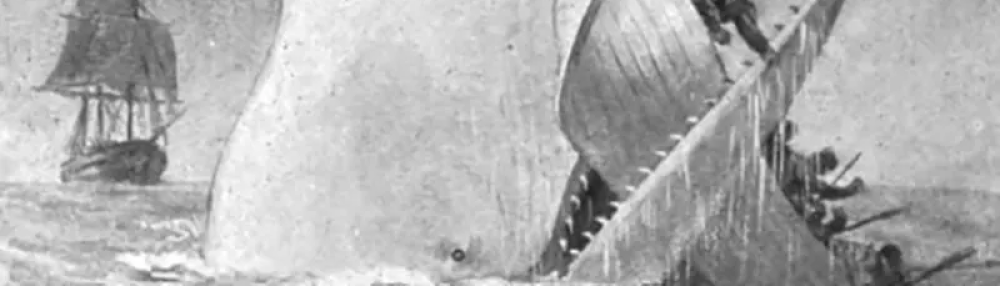
Chapter 78
Through reading the chapters for this week, I found myself constantly coming back to chapter 78, when Tashtego falls head first into the whale and is saved by Queequeg. This chapter was exciting after a few chapters that did not hold my attention, however, it still felt confusing and I could not figure out why it felt as if it had a deep importance. The passage that held my attention was “diving after the slowly descending head, Queequeg with his keen sword had made side lunges near its bottom…first thrusting in for him,a leg was presented: but well knowing that that was not as it ought to be and might occasion great trouble” (Melville 376). Melville writes an entire passage surrounding not just Queequeg saving Tashtego, but he focuses on how he does it, and he leans deep into this relating to a birth. After reading this passage and truthfully even now this felt strange and out of place to me. However, as I try to dissect what Melville could be doing here, it makes me think of him using the passage to show that rebirth can come even from the dark moments. The men on the Pequod are constantly surrounded by the danger of the sea, uncertainty of their captain, and threat of their own deaths. But this passage and its suggestions of a birth, may be representing second chances and new begins. It shows the level of humanity that is still present on the Pequod. Queequeg did not have to risk his own life to save Tashtego, however he did not haste to jump in after him. This moment feels as though even in the dark moments, there can always be a possibility of a rebirth or second chance. Overall, reading through this week’s chapters started off pretty slow, but was then extremely enjoyable for me. I am excited to hear everyone’s thoughts on these chapters. Specifically on chapter 78 and what you all have made of this passage because my brain has still not been able to fully wrap around why I keep coming back to it.
Ch 75 The Right Whale’s Head…
I don’t wanna to seem obsessed this idea, but the act of reading truly amazes me. It’s the act of reading within reading. We are reading the literal text, and then Melville tells us to read more through imagery. “But as you come nearer to this great head, it begins to assume different aspects, according to your point of view.” (364) Melville. We have to imagine we are on the ship, walking around this whale’s head. We are told to read these imagines because it’s important to understand the bigger picture that Melville wants us to understand. He makes our job to go deeper with text and figure out all the different aspects. It will take diligent study of these images that Melville is painting for us.
Week 10: Honey and spermaceti
After reading chapter 78, one part that stuck out to me was its ending paragraph where, after Tashtego is rescued by Queequeg from the head of the sperm whale, Ishmael imagines what dying in it would feel like:
“Now, had Tashtego perished in that head, it had been a very precious perishing; smothered in the very whitest and daintiest of fragrant spermaceti … Only one sweeter end can readily be recalled—the delicious death of an Ohio honey-hunter, who seeking honey in the crotch of a hollow tree, found such exceeding store of it, that leaning too far over, it sucked him in, so that he died embalmed. (Melville 377)
I thought this paragraph was interesting because even though we see this attempt at romanticizing death by drowning “in the very whitest and daintiest of fragrant spermaceti,” Melville also compares it to dying in honey. The mention of the honey-hunter can also be an allegory for greed: Melville reminds us that men have sought out precious things in the hopes that they’d grow more powerful if they have more of it, but what happens if you end up having too much of one thing?
Melville uses the unlikely scenario of the honey hunter and the tree’s honey trove as an example of how this desire for material wealth can result in one’s demise. In the passage above, the honey-hunter discovered the honey trove, but after “leaning too far over, [the honey] sucked him in, so that he died embalmed.” (Melville 377) Like spermaceti, honey is a sweet, viscous substance that is nearly impossible to swim in due to its viscosity, and it can certainly “smother” a person should they fall into it. Despite this, it is often sought out for its health benefits, just like how spermaceti is sought out for its versatility and high selling price.
The irony of it is that we tend to search for valuable things could place us higher in the social hierarchy, yet we don’t even realize its potential dangers because we typically only see it in small amounts. Spermaceti is like honey; sweet and harmless in small amounts, but suffocating and dangerous when there’s a pool’s worth of it. As demonstrated with Tashtego and the honey hunter falling into a pool of spermaceti and honey respectively, greed can often lead to a precious, “delicious death.”
Plato’s Honey Head
Chapter 78 is a nice change of pace, after all the musings once again and again afterwards. There were some quotes worth mentioning, but if I had to pick only one, it would be the last sentence, “How many, think ye, have likewise fallen into Plato’s honey head, and sweetly perished there?” (p. 377) On the surface, this is about the whale Tashtego fell into, but what struck me is the specific mention of Plato… and why “honey head”?
First, the phrasing “How many, think ye, have likewise fallen…” invites us readers to think how many people fell into the very fate Tashtego would have had if Queequeg hadn’t come to save him. But the addition of “Plato’s honey head” suggests some kind of treasure, so the people who were “embalmed” by the whale’s spermaceti died comfortably? Maybe one of the things Melville is trying to say is that the whale’s spermaceti feels like honey, and when one falls into the mouth, they feel no need to escape? The last phrase, “and sweetly perished there,” suggests a “delicious” death.
Wait, the mere mention of Plato has to mean something. Plato is famous for philosophy… perhaps his thoughts were attractive to people. But some of Plato’s theories were questionable, and perhaps these theories are the “honey,” or like the whale’s spermaceti. If this is truly Melville’s intent, this chapter is about the dangers of blindly following an ideal – what seems sweet and harmless could end up being the very thing you should avoid.
Week 10 : Chapters 74 – 90
Something that has truly stuck out to me through reading both last week’s and this week’s section of the novel was the way in which Melville utilizes similes throughout his descriptions.
In chapter 85, The Fountain he is describing the way in which whales breath and regulate the amount of time they can stay above or below water. When describing the windpipe, he says “as his windpipe solely opens into the tube of his spouting canal, as as that long canal – like the grand Erie Canal – is furnished with a sort of locks (like open and shut) for the downward retention of air or the upward exclusion of water”. To me, this simile is perfect for demonstrating the impact the similes that Melville uses have on his writing. His writing is already extremely vivid with every single word he writes, but his use of simile takes it to another level, allowing for the text to be even richer with description through comparison. Especially when he is describing the whale or features of the whale, he is so vividly descriptive and a massive part of the description is the similes he utilizes. This one in particular allows us as readers to truly think about how large just one part of the whale may be through his use of comparing it to something extremely massive. It sort of puts it into perspective a bit for us, while still bringing the text and the story back to the country of America and the land over there. His use of simile allow for the text to remain both symbolic and vivid.