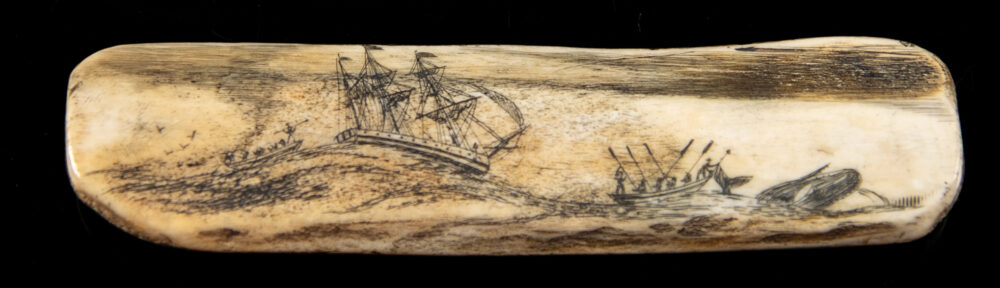
While a lot of the chapters from this reading went right over my head, I could not help but be drawn to the ending of Chapter 94. Ishmael is discussing the works of the blubber-room and the man who works beneath the deck. From this chapter reads the passage, “With this gaff, the gaffman hooks on to a sheet of blubber, and strives to hold it from slipping, as the ship pitches and lurches about. Meanwhile, the spade-man stands on the sheet itself, perpendicularly chopping it into the portable horse-pieces. This spade is as sharp as hone can make it; the spademan’s feet are shoeless; the thing he stands on will sometimes irresistibly slide away from him, like a sledge. If he cuts off one of his own toes, or one of his assistant’s, would you be very much astonished? Toes are scarce among veteran blubber-room men” (458). While it is quite gruesome to think about the loss of someone’s toes to a sharp object, toes are used to stabilize us on our feet. I would like to argue that, while the blubber-room and its men are apart of the Pequod, and the Pequod being referenced as its own nation state, that the act of sawing and cutting at blubberous commerce and even at the risk of one’s self, that the blubber-room and its men represents the self destruction of the people within the nation state. As America is at one of its worst points in history, clawing after the idea of white superiority at the expense of others, they are actively cutting through themselves and destabilizing the very foundation that they believe they have erected for themselves and the nation. With the tossing and turning of the nation, creating such an already unstable foundation, the mere acting of cutting down another object in turn leads them to cutting themselves down.
Category Archives: Week 11: Chapters 87-108
The Warmth of Work
In “A Squeeze of the Hand,” Melville takes one of the most routine jobs on the Pequod and reveals its deeper meaning. As Ishmael and the crew work together to turn the cooled sperm oil back into liquid, he is surprised by the comfort he feels in the task. The repeated motions, the soft feel of the oil, and the shared pace of the work seem to blur the line between body and spirit. What starts as simple labor becomes almost sacred, a time when loneliness gives way to a sense of community. Ishmael describes this change when he writes, “Squeeze! Squeeze! Squeeze! all the morning long; I squeezed that sperm till I myself almost melted into it” (456). In that moment, the work becomes a symbol of unity. The word “melted” does not mean he is tired, but that he lets go of himself and becomes part of something bigger and more human.
This passage stands out because it happens during one of the novel’s most unpleasant scenes. Melville shows men working with whale fat, but turns it into something graceful. When Ishmael realizes he is squeezing his fellow workers’ hands by mistake, it shows how shared touch can break down barriers. Even on a ship focused on violence and profit, there is a gentle kindness. The repetitive work feels almost like a prayer. It is a brief moment of peace before the Pequod returns to chaos, as if the ship remembers, for a moment, what it means to be human.
This chapter is memorable not because it praises whaling or the sea, but because it celebrates connection. In a simple task, Ishmael finds something that goes beyond its purpose. It reminds us that even in harsh situations, beauty can appear through care, routine, and touch. For Melville, the warmth found in this work is the truest kind of insight.
Chapter Ninety-One
In Chapter 91, “The Pequod Meets The Rose-Bud”, Melville presents a scene filled with irony, satire, and moral commentary that exposes the ignorance and exploitation inherent in capitalist systems. The Pequod encounters a French whaling ship, which is ironically named Bouton-de-Rose (Rose-Bud), which reeks of decay from two rotting whales tied to its side. The name “Rose-Bud”, which evokes beauty and freshness, stands in stark contrast to the foul stench that accompanies the ship. The ironic contradiction between the name and reality symbolizes how wealth and refinement often conceal decay and corruption. This irony deepens through the presence of ambergris, a substance found in diseased whales, which is used to create luxury perfumes. Through this grotesque transformation of waste into beauty, Melville critiques how capitalist societies turn death, exploitation, and decay into symbols of elegance and value. Melville highlights this critique through Stubb’s manipulation of the French sailors. The narrator notes, “Sounding him carefully, Stubb further perceived that the Guernsey-man had not the slightest suspicion concerning the ambergris. He therefore held his peace on that head. Otherwise, he was quite frank and confidential with him, so that the two quickly concocted a little plan for both circumventing and satirizing the Captain, without his at all dreaming of distrusting their sincerity.” (Melville 444) Stubb’s selective honesty, his decision to “hold his peace” while pretending to be “frank and confidential”, reveals the hypocrisy and deceit underlying capitalist exchange. His manipulation of the ignorant French captain mirrors a larger pattern of exploitation in which those with knowledge and power profit from those who don’t. Using the words “circumventing” and “satirizing” implies cunning and mockery, showing how Stubb treats exploitation as a game, a form of entertainment instead of a moral wrongdoing. This moment becomes an insight into how profit depends on secrecy and deceit, the same mechanisms that sustain colonial and capitalist hierarchies. The Rose-Bud becomes an emblem of society’s contradictions, a world that celebrates beauty while ignoring the gruesomeness that makes it possible.
“Seigfried” by Frank Ocean 1:53:00-1:59:00
Chapter 89 of Moby-Dick, “What are the Rights of Man and the Liberties of the World but Loose-Fish?” is Melville going full philosopher mode. He’s saying everything in the world including freedom, religion, ideas, even you, is up for grabs. Nothing is truly owned; it’s just held until someone stronger, louder, or luckier comes along to snatch it. It’s a little grim, but also, he’s not wrong.
The “Rights of Man,” “Liberties of the World,” religion, philosophy, he calls all of them “Loose-Fish.” Basically, he’s saying all the big things humans pretend are sacred or permanent are really just things floating around for whoever can grab them first. It’s the law of the jungle, but in 19th-century sailor talk.
And the last line, “what are you, reader, but a Loose-Fish and a Fast-Fish, too?” is the punchline. We’re all caught in someone’s net while trying to catch others ourselves. We think our own opinions, time, and life are ours? They’re not. We’re tangled up in politics, money, and social systems: all while trying to hold on to whatever we like is “ours.”
Melville’s not being moral or preachy here, he’s just calling it like it is. The world runs on whoever can grab and hold on the longest. It’s messy, unfair, and a little depressing, but also pretty honest. We’re all Fast-Fish, we’re all Loose-Fish, and the sea never stops churning.