Week 16 (:

This class has definitely been my favorite out of all that I have taken throughout college so far. It was certainly one of the most challenging classes I have taken, but that also made it one of the most rewarding. I know we say this all the time, but this book truly taught me how to read again. The main thing I learned throughout this class was how to effectively close read. At the beginning of the semester, I was terrified to jump into conversations and always had this feeling that I was not understanding the text as well as my classmates. However, as the semester progressed and I got to be a part of wonderful discussions with my peers, I developed confidence in my ideas and realized that the whole point was for us to have different opinions. I can truthfully say that I never really knew how to close read until this class and I am extremely grateful for the experience. 

I will also add that my favorite aspect of this class was the amount of group discussion. This course has taught me how important it is to have these discussions and see what parts of the text stuck with others and their ideas about a certain passage. Overall, I am beyond grateful for this class with all of the skills that it has taught me as well as the confidence it has given me to allow my voice to be a part of conversations. 

Final Thoughts

This class truly taught me a lot. I often leave courses feeling unsatisfied and feeling as if I wasted my time not having truly learned anything new. This class was the complete opposite. I came into this class with no expectations. i had never read Moby Dick before and was honestly just expecting to be in simply just another english class, but I truly couldn’t have been more wrong. This class opened my eyes in so many different ways. So often when I read I look at novels from such an objective perspective because that is the way in which I enjoy reading. However, this course truly made me develop such a profound appreciation for close reading an annotation. I think that appreciation came truly not from the novel, but from everyone in the class. The passion that Professor Pressman brought to the class was truly contagious and hearing the way people speak about chapters that I hadn’t even considered as important or impactful made me leave class every single day excited to come back. It has been quite an overwhelming semester for me with my workload both in and out of school and this course truly reinvigorated a spark that I thought was slowly dying. My love for reading has become rather intertwined and synonymous with my education every since I started college and that has been rather difficult for me. This class brought that love back because it essentially taught me to read again. It took me back to the start and made me fall in love with literature all over again. Thank you Professor Pressman!!

What I’ve learned this semester

This class has definitely been unlike any other English course I’ve taken before. Usually we read anywhere between 4-5 novels throughout the semester, not really giving us anytime to analyze and go into depth like we did in this class with Moby-Dick. To be honest I enjoyed this experience a lot more compared what I’m used to. I think that by focusing on one novel, a really intense one at that, it definitely gave me a chance to fully explore my thoughts and emotions on the book instead of just skimming through it and not really going in depth with it. Moby-Dick is also unlike any novel I have ever read before. Going into this semester I was intimidated by it, and I think throughout the semester it was still pretty intimidating, but there definitely was a point where I was able to embrace that and remind myself that this novel is like that for most people. I cannot think of a better way to learn and analyze a novel; by hearing from my classmates and having discussions about the novel, it gave me more insight and allowed me to view the book from multiple perspectives.

This class challenged me in a way I’m not used to, and I’m very glad that it did. In the end I’m now feeling like a better reader and writer, and I’ve definitely brushed up on my analyzation skills that haven’t really been used like this in a long time. I think that every English major, or any major in general, should take this course if they want to learn not only about a great novel, but about different perspectives on life. To read this timeless classic is to change your life, and I’m so glad that I was able to experience that for myself.

ECL 522 final thoughts

Wandering in this library of letters forming words forming sentences, reading Moby-Dick as a class has helped me improve my close-reading and critical thinking skills. It’s interesting to see the different perspectives people have with this novel, and I enjoyed hearing how people interpreted the text in an effort to uncover its larger meaning. The socratic format of this class has definitely facilitated my understanding of the book since I now know that there are other people who struggle on big books as much as I do when reading alone.

My final takeaway for this class is that close-reading can help us think beyond the medium, even if said medium is a smorgasbord of unrelated concepts vomited from the author’s mind. If you think about it, close-reading is merely psychoanalysis in book form. We take apart a passage to reveal its hidden, often larger meaning, then use our interpretations to help understand our world. Not only that, close-reading can also be a form of art, as seen in the adaptations of Moby-Dick from last week. The medium is a place where we can share our interpretations with other people, which encourages them to share their own interpretations about a work to others and build upon our existing knowledge.

I may be here again for the AI literature class next semester, and I am looking forward to apply what I’ve learned this class for that class as well. Until then, happy reading and good luck on your final!

Final week

Both of the classes I have taken with Professor Pressman have been so unique to my experience in English classrooms. Both times I have noticed tangible improvement on my writing skills and I get a better sense of my voice in academic writing. At the end of each semester I finish with a feeling that I have experienced a transformation in myself. This particular semester I also came to appreciate the collective work we all contributed to the classroom. My comprehension was expanded by hearing everyone’s different responses to the same text. I only wish that I can keep finding my way in classrooms like this one. I also have a desire to find and connect with people that also like to think and create meaning based on the art of others.

What I Learned in This Class

Gosh, what didn’t I learn in this class? I genuinely feel like I learned how to actually read in this course, which I didn’t think was possible. There were so many aspects of this novel that stand out to me now, looking back, that wouldn’t have been possible without the in-class discussions and textual analysis. I feel like my favorite moments in the course were when we sat together, discussing the passages we liked most. There was so much that I felt like I missed or was too stupid to understand, but it wasn’t that I was stupid; it was that group discussions are so monumentally important when trying to digest a big, complicated text. Everyone had a different perspective and opinion on various aspects of the novel, so when we came together, it created clarity that wasn’t possible if I had read Moby Dick on my own.

I look forward to rereading the novel in the future, using the basis that this class gave me. As we discussed last week, the reader’s version matters hugely to the interpretation of the text. I’m excited to reread Melville’s work in a year or two and see how different my opinion or analysis is from now. I truly do treasure my time in this class and with my classmates. If given the opportunity, I would definitely take this class again. Thank you!!

Reflection on Moby Dick

This class has been a huge learning experience for me that I would do again. I initially took this class because I saw Moby Dick as an important/constantly mentioned in pop culture and I wanted to see what it was all about. I am also ambitious and wanted to tell people I have read this book. Once class began, and the reading did too, I started to feel challenged by the ‘so-what’ push we have gotten all semester. I am used to reading something and liking it for aesthetic purposes, but I rarely questioned a line in a book and asked why it is important. This forced me to consider what I am reading in a larger context/include my own personal experience. But as the semester went on I really enjoyed making connections to the real world from a 1 or 2 sentence line, it forced me to think really deeply about single words.

Another thing that stands out to me is the class discussions that we would have. This would be an initial point of insecurity in the beginning of the class, I took it as an indicator that I was not ‘understanding’ the book in the same way other people did. But this was another thing that I had to shift my thinking about. These discussions pointed out so many amazing parts of this book that would reshape the way I initially read some parts. The sharing of interpretation was also helpful when I was genuinely confused in certain chapters. Overall I really liked taking this class and it taught me new ways to approach reading, thinking about literature and about feeling lost/confused when reading a book.

Week 16 – Final Takeaways/So What?

This class has definitely been a roller-coaster, yet one I have enjoyed every step of the way. Not only did this class enable me to further develop my skills in close-reading and reignite the fun of annotating books, but it has also helped my to read between the lines of a story. Not everything that makes Moby Dick what it is is stated outright in the novel, and yet, thanks to group discussions, everything seems so clear.

My final take away from Moby Dick and the class as a whole is the importance of interpretation and perspective. We are all approaching the novel from different angles, different backgrounds, forms of education, and the newest historical perspective. All of these factors are important as they shape the way an individual close reads a novel, whether having read it before or not, and what they might be drawn to within the book itself. Many of the parts I found extremely boring within the novel and left mostly unannotated were caked in notes and further developed in group discussions by others. It has made me value the importance of every interpretation, whether it be a scholarly critic or my classmate across the room. These different interpretations allow for different analysis of a specific text, creating a different approach to literary development and rhetorical analysis from not only an academic approach, but a cultural one as well. We have experienced a life that never before could have been imagined by people in the 1850s, and yet for the most part, the ideals that Herman Melville portrayed in his novel still have important relevance to all of us in 2025.

Learning to See the Light in Moby Dick

As the semester comes to an end, I’ve been thinking back about how this class changed the way I read Moby-Dick, but also how I read literature in general. When we started, the novel felt overwhelming to me because it was too big, too strange, too full of digressions about whales and ropes and blubber to make any sense. But somewhere along the way, I think through our weekly blog posts and close-reading exercises, I started to see that Moby-Dick isn’t a book you “get” in one go. It’s a book that teaches you how to read it as you move through it. And that process of learning to slow down, to focus on a single sentence, even a comma, ended up being one of the most valuable things I’m taking from the course.

One of the biggest skills I developed this semester was close reading. Before this class, I understood the concept in theory, but actually practicing it every week forced me to go beyond surface-level interpretation. I am (still) learning how to zoom in on a phrase and unpack it until it opens into a whole world of meaning. Whether I was analyzing Starbuck’s desperate moments or Ishmael’s reflection that the whaleman “lives in light” in Chapter 97, I realized that Melville’s writing rewards slow attention. The more I practiced explication, the more I started noticing how Melville builds entire ideas out of tiny details: the way the color white becomes terrifying, the way light turns both holy and hellish, and the way the ocean becomes a metaphor for the unknown parts of ourselves.

A huge part of that shift came from how this class framed Moby-Dick within Blue Humanities. I had never thought about literature through an oceanic perspective before, and Blue Humanities helped me see how Melville uses the ocean to rethink what it means to be human. Instead of centering land, stability, and certainty, he places us in water: fluid, unpredictable, and unknowable. The ocean in Moby-Dick becomes a space of connection and vulnerability. Seeing the novel through this lens made me appreciate the environmental undertones, too. When Ishmael describes the killing, boiling, and rendering of whales in such detailed but industrial language, it becomes impossible not to think about ecological violence and the human hunger for mastery over it. Blue Humanities gave me a way to understand these sections not as digressions, but as essential parts of the novel’s argument about power, exploitation, and the actual cost of human progress.

Thinking back on the blog posts we wrote throughout the semester makes me realize how much my relationship to the novel has changed. At first, I was kind of confused but interested, not fully sure how to approach such a massive, chaotic text. But each post forced me to commit to something specific. That practice taught me that meaning doesn’t come from “finishing” the book; it comes from engaging with the tiny details that build it. By the time we reached the final chapters, I wasn’t intimidated by Melville’s style anymore. Whether Melville is describing the ocean as a mirror of human consciousness or showing the consequences of obsession through Ahab, the book constantly asks us to look inward and outward at the same time. What I learned in this class goes far beyond Moby-Dick itself. I learned how to slow down, trust my observations, and use textual evidence to build ideas instead of relying on summaries or generalizations. I learned how to treat literature as something alive, something that reveals new meanings depending on where you point your attention.
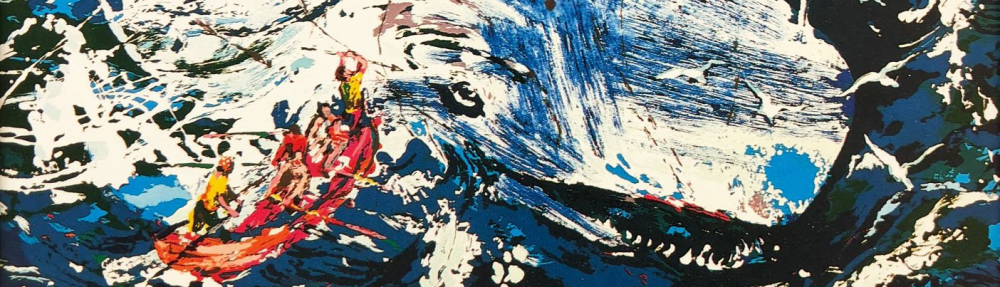
Week 16: Final Takeaways

This semester really flew by, and even though Moby Dick was such a long book, it seems not so long ago that we opened those first pages, ignorant to what would occur between the cover and the back. I really enjoyed getting back into the practice of close reading this semester. There were so many parts of the book I would have skipped over or not found relevant, but the structure of the class and discussion based part of the class allowed for me to see and explore parts of the book that I wouldn’t have on my own. I doubt I would’ve had the patience or motivation to read Moby Dick on my own, so reading it in a class and alongside others was helpful. I also really enjoyed hearing other people’s interpretations, and seeing how different backgrounds influenced people’s interpretations. 

This was an important book for me to read because, like many others, I have heard this novel classified as a great American book, a story of adventure, of hunting animals. And before this class, I accepted that as what the book was about. However, reading this book, and considering the historical and social contexts surrounding it, changed this idea for me. I am not sure what this novel is exactly, but understanding how these ideas of classic, adventure, canon are formed was important to me. It brings up the question of how any idea of anything important is formed and how and why we attribute value to the things we do. I think this is in part due to Dr. Pressman’s teaching style, since I felt the last class I took with her also prompted many questions in myself about how the world is formed and how little understanding we have of the things we think we understand as a society or within scientific domains.