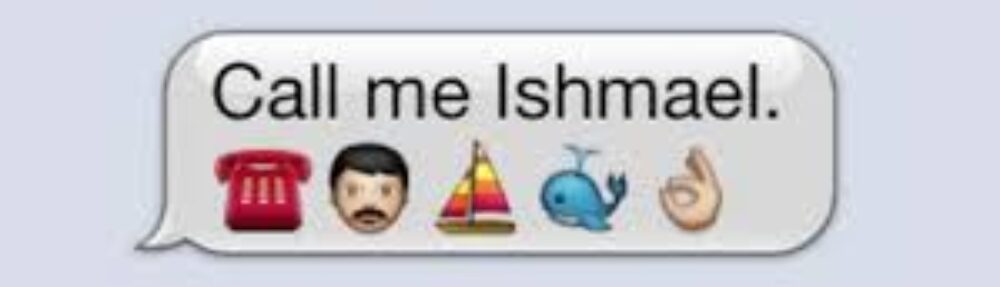
”What Moby-Dick Means to Me”

While reading Hoare’s article, it made me more eager to get started on Moby Dick. This man hypes up Melville and shows major appreciation for the novel. So, I am very excited to begin reading it. 

In Hoare’s article, he writes that Moby Dick should not be treated as a regular novel because it is more than just words on a page. It allows the audience to gain a better understanding of the relationship between man and nature. He says “It’s more an act of transference, of ideas and evocations hung around the vast and unknowable shape of the whale, an extended musing on the strange meeting of human history and natural history.” Moby Dick makes the reader conscious and encourages the reader to think deeper on what the whale exactly stands for, and what man’s relation with nature can be like. The relationship between man and nature can be seen as obsessive for example. But it is entirely up the reader to interpret the story and characters how they see fit. I know for me personally, figuring out what means what and trying to figure out the deeper meaning can be difficult sometimes. Another thing I wanted to add is, I find it interesting how Moby Dick is open for interpretation. In some previous English classes, while reading a book, the teacher usually gives us the main point or theme of the story and I had to find evidence to back that point up. However, I am interested in seeing how I navigate this novel and seeing what I take from it. 

Hoare also states that Moby Dick “stands both as a historical reference for the great age of Yankee whaling and as a work of imagination in which whales become avatars as much as they are real animals.” In the 19th century, whaling was a big deal and whale oil was a hot commodity. So, Moby Dick is also able to provide major historical context. Even though it is fiction, you can still get an idea of what whaling was like and of what sea life was like then. Also seen in this quote here, Hoare mentions using your imagination for the whale and seeing what they represent. And, while yes, Moby Dick is a work of fiction, the fictional characters can symbolize and mean much more rather than being seen as just an animal/person. 

What “What ‘Moby-Dick’ Means to Me” Means to Me

I know that this post falls after the deadline, but I’m writing it more to jot down my ideas and key takeaways from the readings and see if anyone else can relate. When Hoare wrote that “‘Moby-Dick’ is not a novel,” but “an act of transference, of ideas and evocations hung around the vast and unknowable shape of the whale, an extended musing on the strange meeting of human history and natural history,” it kind of clicked for me. It reminds me of our first day of the semester, when most of us were confessing to feeling overwhelmed before even starting the novel. Hoare’s comment connects to how Melville, as an author, didn’t write the novel as just a book, but a time capsule of the ideas of the 19th century. Emerson, whom we’ve talked about influencing Melville, urged 20th-century scholars to think for themselves and to work towards intellectual development constantly. This singular quote from this article began a domino effect on how to better approach Moby Dick as an intimidated reader. Instead of reading Moby Dick as a novel like Pride and Prejudice (where the details aren’t elaborated on too extensively and it’s very specifically plot-focused instead of detail-focused), it’s meant to be interpreted, not merely clicked off on my Goodreads “read” shelf.

Thinking about language

I love literature because it inevitably gets you thinking; about life, yourself, humanity, love, and so on. I also love it because the same work can mean entirely different things for two different people, or, on the flip side, help to people realize they had more in common than they thought. In that sense, reading Philip Hoare’s article makes me happy, because it shows his appreciation for this work. Phrases like, “Few books are so filled with neologisms; it’s as if Melville were frustrated by language itself, and strove to burst out of its confines,” prove my point. We don’t actually know if Melville was frustrated by language and thus invented a bunch of words, but the fact that he does is worthy of note. The invention of new words as a result of frustration is a cool concept and it gets me thinking about how language constrains our understanding of the universe. Language shapes the way we think, but it has limits; and even as someone who is bilingual, sometimes not even two languages are enough to express everything I think and feel. Anyway, I’m excited to learn some new words I’ve never seen before through this book, and hopefully they make their way into my vocabulary to help with that feeling of restriction I sometimes find myself experiencing in terms of language.

What “Moby-Dick” Means to Me

While reading through the article “What Moby-Dick Means to Me” it created a more comfortable space to start diving into this reading. Much like Hoare this book has been one that I have pushed to the side for years. For Hoare it was his watching of the 1956 John Huston film and feeling as though the intense adventure story that he imagined was replaced with a more dense and wordy story that he was unable to connect to. For me Moby-Dick always seemed intimidating, after hearing many people over the years explain what a life changing read it was I felt that I would never have the same experience. However, I began to feel a comfortability in the uncomfortable when Hoare stated “I didn’t know then what I do now: that “Moby-Dick” can be whatever you want it to be. It took me thirty years to discover what the book was—or what it was not” (Hoare). This book is not made to be perfectly interpreted, but rather it will take each of its readers on their own journey that will create a depth to their own reading. This makes me think about all of the different personalities we have in this class. How amazing it is that through all of our individual experiences we will be reading this novel together and be able to share our own feelings of love, excitement, and even confusion throughout this novel. The perspective that Hoare gave throughout this article changed the way that I have been looking at it and I couldn’t be more excited to dive deep into it with everyone! 

Another section of this article that drew my attention was how Hoare explained the book to feel both like travel back in time and also drastically modern. The article states “Sometimes I read it and I feel like I’m going backward, fast. It reads like something that was written before books were invented, yet it is utterly modern” (Hoare). One reason I have always loved literature is because it allows us to see the perspective of events that happened in the world during different eras first hand through these writers. An example of this being exactly what we talked about in class revolving around whaling. I had no idea what whaling was and learning how large and intense the industry was caused a shift for my understanding of depth that this novel will lead us into. This book will allow me to travel back in time to witness these different aspects of history while also being able to connect those aspects to modern ideas. The ability for a book to travel through generations and still be relevant to all those that read it is what makes up a true masterpiece. 

“The Blue Humanities”

I’m fascinated with this week’s reading, ” The Blue Humanities,” this article really stood out to me, especially this quote by: Jules Verne, who wrote: “The human mind delights in grand visions of supernatural beings. And the sea is their very best medium, the only environment in which such giants . . . can be produced and developed.” The fact that he mentions this on how the ocean can create such imaginative beings and creations of whatever comes to mind by the power of ‘nature’ is truly marvelous. Getting a bit off topic, as a child I was obsessed with anything of the ocean: animals, shells, sea creatures, mythical sea creatures, etc. Anything that involved the ocean I would write and create stories about it. Even as an adult I sometimes write and describe the ocean as an actual “human being” with emotions. The sea is full of mystery, wonder, power, curiosity in many aspects, and now being considered as a piece of art and inspiration to others for creativity and escape. Everyday people create stories and songs involving the power of nature to be used as an escape and appreciation, Melville being inspired by the ocean and thus came the creation of Moby-Dick, by wanting us to feel inspired by it.

Week 3: Moby-Dick still intimidates me

As a person who had a hard time reading past the first chapters of Moby-Dick, I still feel uneasy about getting into this novel. This behemoth of a story has an absurd amount of chapters, way more than expected for a typical novel, and its 800-page count is very intimidating for people who like to read medium-length novels like me. However, reading Philip Hoare’s article What “Moby-Dick” Means to Me at least eased these feelings of discomfort of having to read a difficult book in a class about reading a difficult book. Here are my thoughts while reading through the article:

Hoare frames Moby-Dick as “an act of transference, of ideas and evocations hung around the vast and unknowable shape of the whale, an extended musing on the strange meeting of human history and natural history.” instead of an actual novel. As of writing this (I got through Chapter 1 and part of chapter 2), I’d probably agree with Hoare. A good portion of the first few chapters of Moby-Dick is Ishmael monologuing about the city and his preparations before his whaling journey–at least, that’s what it looks like to the amateur reader. The book is more than 170 years old, and the English language has changed since then, and that probably explains why the book was difficult for its time. Either that, or this generation is not used to reading books as much as older generations do.

Moving on, Hoare talks about what reading Moby-Dick feels like to him: it feels like a drug that, when “taken” (read), makes him travel backward in time to the point where reading it is like reading “something that was written before books were invented” despite being modern. Reading that part of the article makes me even more curious as to why this work of literature is so acclaimed and influential. The first two chapters seem like Ishmael’s stream of consciousness, describing his surroundings as if they were parts of a painting. My opinion of this book may change when we all start reading it as a class later on.

Moby-Dick was definitely the novel of novels at its time, and reading about how the book had such an impact on a person’s life clued me in as to what to expect from a novel that’s split into many chapters and pages. The book is difficult, yes, but it’s a good way to challenge oneself especially after not reading for so long. Maybe when we start diving into the novel (no pun intended), we’ll see what Moby-Dick means to us.

Fear and Curiosity

What comes first? Fear or curiosity? Being curious over something could inspire you into learning more about it but the strength of the information could become fearful and push you away from further entertaining it. Or being fearful of something can overtime inspire curiosity in order to no longer have that fear.

John Gills backs up this idea in “The Blue Humanities” when stating that before the nineteenth century “The sea was portrayed as dangerous and repellant, ugly and unfit for literary or artistic representation.” At the time, many did not seem to think that the sea was anything to entertain or to be thought of aesthetically. How come? The waters are beautiful, the waves are satisfying to watch but people did not understand it, they did not feel connected to sea so they shunned it away as only a source of travel and food. It wasn’t until writers and painters looked at the sea with inspiration to create, being sensitive with the waters softened the viewing lens of others.

After learning that Melville was a whaler and seaman in class, Melville’s observation that “mediation and water are wedded forever” as pointed out by Gill does not come surprising since he crafted “Moby-Dick”. This is what Emerson was talking about in “The American Scholar” that we as scholars should not only be looking for the accomplishment of the perfect grades and the diploma but more so gain inspiration from the reading/ media you indulge in to create new thoughts and ideas. Maybe a new book, a new painting, a new song, etc., potentially inspiring curiosity into others to do the same regardless of fear. Just as I am nervous of a thick book like “Moby-Dick” but still curious enough to read the book from start to finish to understand why this book is a must read book.

When The Sea Became More Than Just Water

One of the most striking points in John R. Gillis’s essay The Blue Humanities is how recently we began to imagine the ocean as something more than a void. For much of human history, the sea was feared, crossed, and used, but rarely admired. It was simply a highway to somewhere else, a space you had to endure on the way to land. Art, both painting and literature, transformed the sea from a background setting into a powerful presence in human imagination.

Before the 19th century, seascapes were almost invisible in the Western artistic tradition. Artists might sketch ships or bustling harbors, but the water itself was rarely the subject. The ocean was considered too flat, too empty, or too dangerous to deserve attention. That changed when painters like J. M. W. Turner and Winslow Homer turned their canvases toward the waves. Turner’s furious storms pull viewers into chaos, and Homer’s quiet horizons make us feel the vulnerability of human beings against vast waters. Suddenly, the sea wasn’t just scenery. It was the story.

Literature took the same turn. When Melville wrote Moby-Dick, he didn’t just write about whaling; he gave the sea moods, tempests, and silences that felt as alive as the characters themselves. The ocean was a force that shaped every decision and every outcome. Later writers like Rachel Carson combined science and lyricism in The Sea Around Us, reminding us that the waves that seemed distant actually sustain life on Earth. Through these works, the ocean became less of a barrier and more of a mirror, reflecting both human ambition and human fragility.

What I find most powerful about Gillis’s argument is that art didn’t just change how we look at the sea, but it changed what the sea means. Once painters and writers showed us that the ocean had depth, power, and beauty, it became part of culture. It became visible. And visibility matters. We cannot imagine climate change, rising tides, or marine ecosystems today without drawing on the images and stories that first made the ocean real to us.

This is the essence of the “blue humanities”: they remind us that the ocean is not blank space at the edges of our maps, but a central part of human life and imagination. To see the sea differently is to see ourselves differently, small, vulnerable, and yet connected to something vast and enduring. Art painted and wrote the sea into being, and now we can’t stop seeing it.

Week 3: Reclamation of the Blue Humanities

From reading both articles, I now understand that Moby Dick is an extensive novel that exposes human greed. In other words, we categorize and label experiences based on our implicit biases and pride, whether we like to accept this factual statement or not. I feel that there is a working between outside events and subjective intake that has plagued the working class of the 19th century, because we cannot accept ideologies apart from Western ideology or societal principle.

The Blue Humanities article talks about how the symbolic features of the sea can be inadvertently used to justify uplifted status in the terrestrial land. ” It became a symbol of eternity, a comfort to those who, having lost their faith in divine dispensation of everlasting life, came to see in its apparently timeless flows evidence of nature’s immortality and a secular promise of life everlasting.(Gillis)” While this is indicative that there is co-existence that is present with the sea, the symbol of nature and the sea as “transcendent” bleeds into the human supremacy of the privileged groups on land. In a way, this metaphor for life and living becomes a danger for those unprivileged and marginalized groups in land. Consequentially, I think that Melville uses Moby Dick to call out the symbol within the Industrial Age.

On the contrary, the symbol of the sea works to articulate the invisible power of marginalized communities during the Industrial age, and gives a platform for those voices. Even though the experimental novel works to examine the romantic senses that is excessively capitalized in the Industrial Age, its spiritual symbol is so authentic to human culture, surpassing elite status or upper class society within the terrestrial land hierarchy. For example, the symbol is reflective of our behavior and brings back the sentiment of human contentedness and hope when comparing our labor to the immense infrastructure of the sea and what we don’t know.

Week 3: What Moby Dick Means to Me

What I found interesting in the reading this week was from What Moby Dick Means To Me. The concept of it being whatever you want it to be opens the door for projection and transference, in my opinion. I started the book, and the introduction presents similar ideas of taking the book as you want it, and that it isn’t and shouldn’t be forced into a box. I think this is an interesting way of looking at literature, a way that isn’t traditionally taught in schools, especially middle/high school. In my experience, teachers invite you to look at the book with a critical viewpoint, but they keep the idea that there’s a certain motif or central theme in the book that should be recognized. Whereas Moby Dick seems to go against that and invites this personal transference. As a psychology major, I find this interesting. Projection has such negative connotations around it nowadays, yet it is such an insightful tool and can have a positive impact when used the right way. 

Another way to look at this idea of projection is how it might change over time. This article also mentioned the book being used as a religious item in a time of religious uncertainty. How can we use this book now, and will we only use it in what is lacking or can we learn to use it as a tool for overall growth? This also reminds me of a lot of constitutional debates, and how what was written hundreds of years ago should be applied and interpreted nowadays. I have discussed this topic in many classes, and there’s never a straight forward conclusion because of all the different interpretations with their biases. 

I am excited to see all the different emotions and memories that Moby Dick evokes for people in the class. I believe a big part of who we are is shaped by experience; and how we perceive art such as literary text is deeply influenced by these experiences. I also think that looking at this book with different perspectives from different people in the class will allow for more open-mindedness toward ideas and interpretations.