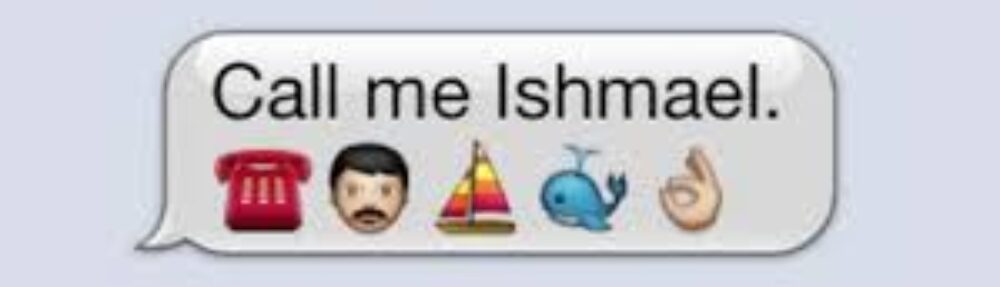
What Moby Dick Means To Me – W3

Hoare really makes a case to proving that Moby Dick is a hotshot of a book. I can immediately tell how passionate he is about it with every single word he uses to describe it. Simply calling it “good” seems a bit too simple, but I can’t necessarily judge it until I’ve obviously read it. His opening line is what really helped me form my initial opinion. “For years, ‘Moby-Dick’ defeated me.” I can already imagine not only the length of the book, but the boredom to get to me quickly in the midst of reading about a mutiny, a whale, and a dude named Ishmael. Even so, I think the way he puts Moby Dick on such a high horse pedestal sounds a little too far? Sure, a book can be life changing to this extent, but can I really expect this about Moby Dick?

Hoare mentions how “It’s barely a book at all. It’s more an act of transference, of ideas and evocations hung around the vast and unknowable shape of the whale…” and honestly, based off of my initial knowledge, I’d have to slightly disagree with that statement. A book is a book, and while a book could be different for someone else, it’s still something that tells a story. A story is already ideas, evocations, and unknowable to anyone but the author and intended audience. There’s no incorrect way to read something, but then again, why is a whale such a center part in the 1800’s? What’s missing other than sitting down and cracking the book open to dive right into the vast ocean? With the way Hoare speaks about it, I’m just sincerely hoping that the book really does knock my socks off. I’d kind of hate to be disappointed after being hyped up after reading his article. I hadn’t necessarily though about the book’s impact on others either, it just goes to show how lots of different pieces of literature stand the test of time.

“What Moby Dick Means To Me” week three response

To my mind, there are only two other works with which it bears comparison: Mary Shelley’s “Frankenstein” (1818), and Emily Brontë’s “Wuthering Heights” (1847). The former, in its own witness to one man’s obsessive interference with nature, was a direct influence on Melville, who acquired a copy on a visit to London in 1849, even as the whalish shades were beginning to swirl about in his imagination.

I want to talk about the section of the article, I talked about this in the last class with my group but this idea of studying nature and going to nature to heal isn’t a new idea, it’s just new to Americans. Melville’s response to the “American Scholar” is so funny to me but this idea of going into nature and finding yourself and going into nature to heal from something is not a new idea, the romantics have been teaching us the ways of going into nature and applying it to your pen.

Frankenstein by Mary Shelly is my all time favorite book and I honestly a huge inspiration to Moby Dick, a monster in the nature, going to hunt down the monster, and then learning during the journey. The monster will always be a reflection of some sorts. So as we learn about why Moby Dick was written, I have thought this the whole time so far of thinking how similar it was to Frankenstein and the romantic period. reading this, in the article was everything to me and made me feel validated.

Thank you Futurama!

One of my first interactions with Moby Dick was years ago while I was watching an episode of Futurama. It was a retelling of Moby Dick but taking place in space with an intergalactic whale. I was probably around 11/12 and I thought this was one of the cooler episodes. The thing that stuck out to me the most was how dark the episode got. The character Leela was Captain Ahab in the retelling and her obsession got everyone eaten by the whale. In the end, she does conquer the whale by befriending it, but I assume the original story does not have the same kind ending. 

Moby Dick has a huge cultural significance and it has been on my bucket list for a long time. This was always the book about whales and obsession to me, and there was a time where I tried to read it. It was intimidating and intriguing at the same time but I ultimately did not get far. Years later, I saw an opportunity to take a course dedicated to Moby Dick with a group of people to walk through this book together. Thinking of Moby Dick now, I associate it more with nature & power. This book is a play with the ocean as its stage. I can imagine the air and colors as I read it. I am excited to dive in and experience a piece of time that doesn’t really exist anymore. Moby Dick will always be the whale book to me due to my first associations, but I am looking forward to adding new ones as I continue reading. 

The New Yorker Hypes up Moby Dick

Philip Hoare’s article, What “Moby Dick” Means to Me, is an excellent read that creates a sense of excitement and anticipation for reading Herman Melville’s epic. Beginning where many of us have been, Hoare takes us through the defeat and the disinterest young readers may experience when first attempting to read the experimental novel, beginning his article with “For years, “Moby-Dick” defeated me.” As he began to describe the sensation of watching the movie, of the building anticipation around his successful reading of the novel, it incited a curiosity within me.

Hoare, towards the tail end of the essay states, “Now, as I pick up “Moby-Dick” again, prompted by Philbrick’s provocative book, I’m reminded of a salutary notion: that the whales that inspired Melville were around long before us, and may, with luck, outlive us, too.” Exactly how large are these majestic, eternal creatures that spawned an entire industry and later the first American novel? According to Wikipedia, in Moby Dick Sperm Whales are said to get 90ft in length, with titular whale being the largest they had ever seen. Let’s guess that means it is around 100ft.

A school bus is roughly 35 feet long. This would put Moby Dick at 5ft shy of 3 school buses in length. If that’s hard to conceptualize – some of us have not been near a school bus for quite a few years – then consider the size of the average movie theater screen. They range from 45 to 65 ft in length. On the smaller side, that would mean that Moby Dick would roughly be 10ft longer than two movie theater screens. From that standpoint, this whale would certainly command the presence and obsession of any man.

Beyond the whale, as large as it is, there is the beautiful prose that the novel inspires from Hoare to consider. With lines in the article such as, “Few books are so filled with neologisms; it’s as if Melville were frustrated by language itself, and strove to burst out of its confines,” is it any wonder that this novel has inspired the imaginations and fear of the world over? I just picked up my hold on Philbrick’s Why Read Moby-Dick? from the San Diego Public Library system and I am incredibly excited to find even more reasons to look forward to this semester’s central story.

American Imperialism

“A century and a half after it first played out, Ahab’s wanton chase was evoked in the ‘war on terror,’ and the attempts to pursue an apparently uncatchable foe, even as it sourced an epic designed to reflect America’s first imperial venture – the getting of the oil that lit and lubricated the Western world.” This quote from Hoare’s “What ‘Moby-Dick’ Means to Me” immediately put into perspective the cultural relevance this novel will have on us today. It also gave me a concrete example of why this is considered The American Novel. We were just discussing in class how the whaling industry was a way for the United States to spread it’s influence in it’s conquest of the ocean; since that industry died out, we’ve used different industries (mainly the military) to perpetuate our global influence. This aspect is really interesting to me because it is one of the most American things I can think of, constantly finding reasons and/or scapegoats to maintain our influence and control across the world.

https://www.thenewscholar.nl/index.php/tns/article/download/mobydick/mobydick/385 I found this essay comparing characters and events from Moby Dick to political figures and their missions during the campaign for the War on Terror (don’t read past the second page if you don’t want to get spoiled). Another quick thing I want to add is this quote Hoare highlights: “Does the Whale’s Magnitude Diminish? – Will He Perish?” Taking into account the relation to American imperialism, this quote could be a questioning of whether our country’s obsession with dominance will ever go away.

Maybe Moby Dick is for me? We shall see!

Reading the article on “What “Moby Dick” Means to Me” made me think of myself and how I hope to portray it now in my life. I remember starting this book in high schol and just not getting it and probably only had read a handful of chapters before my teacher changed what we were reading. All I could remember was that it was boring then and all I knew was that there was a giant whale in the book that did things to the men in the book. I didn’t have such a great view of the book from back then but now that I am in college I hope I can see this book with a new mindset.

Philip Hoare the writer of this article was even put off by the book when he was a kid and he even said that the book was “difficult” which I can agree with as well as many others. And as we grow older, so does our knowledge so we can see things with a new view. Hoare stated that Moby Dick is neither a book or a novel but, “It’s more an act of transference, of ideas and evocations hung around the vast and unknowable shape of the whale, an extended musing on the strange meeting of human history and natural history,” which I can totally agree with. At first when I read that line, I thought I knew what is he talking about but after processing it a bit more, I think Hoare is trying to tell us that the story has a lot of depth of thought and history within which can be complicated to understand. He even says later on when he had picked up the book again, he did not want to put it down and he was fully invested. It must have clicked for him and I can hope it can be like that for me as well.

From what I know so far about this book, I can see Moby Dick as a fictional story which can teach us lessons as we read the 800 page book about man, a whale and nature. I know I might get bored through out the book with descriptions of whaling and sorts, but I am very interested to see how this book plays out to understand why so many people and our professor love this book so much. I am excited to see how this book plays out and to disect the book with everyone.

What “Moby-Dick” Can Mean to Us

In Philip Hoare’s article, “What ‘Moby-Dick’ Means to Me”, he reflects on how his relationship with “Moby-Dick” has transformed over time and explains how a “difficult” text can transform into different meanings when approached at various periods of your life; he suggests that classic literature has less of a fixed meaning but instead has an evolving relationship between the text and reader. He admits, “I didn’t know then what I do now: that ‘Moby-Dick’ can be whatever you want it to be. It took me thirty years to discover what the book was – or what it was not.” (Para. 2) That is the beauty of literature; while words remain the same, how you perceive and interpret the text can change every time you read it, since you are constantly evolving. Hoare once dismissed “Moby-Dick” as “wordy worthiness” (Para. 2) compared to John Huston’s film, but later came to describe it as“an act of transference…a sui-generis creation, one that came into the world as an unnatural, immaculate conception.” (Para. 4) His transformation shows that the perception of the book can change depending on where you are in life. This is relatable to me. If you asked me to read “Moby-Dick” 5 years ago, I probably would not have batted an eye, but I feel like a different person than I was 5 years ago. I am more open to change and welcome new experiences and perspectives on life. Our life experiences are constantly changing us; classic literature has gained its enduring relevance by being able to be rediscovered at different times, offering a fresh meaning each time we reread it. As Hoare observes, “oceanic reach and perverse digression provide endless sources of inspiration and interpretation” (Para. 10) and that “Moby-Dick” “reads like something that was written before books were invented, yet it is utterly modern.” (Para. 9) As long as we constantly evolving as individuals, we will continue to gain new experiences and inspiration. This can be from nature or from the different forms of media that we are consuming. Like him, I see that great works are not static texts but companions that grow alongside us.