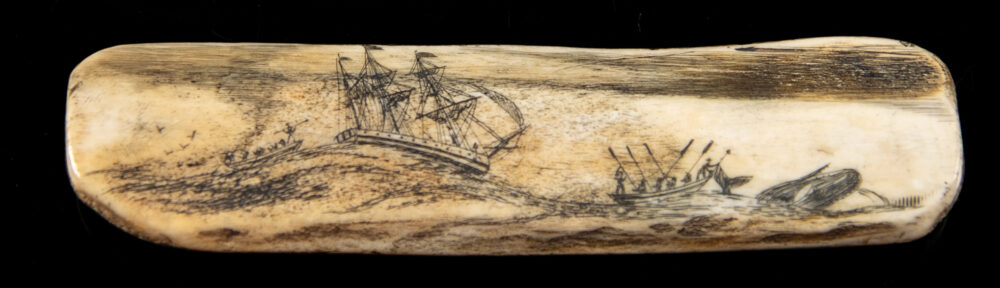
In Chapter 79, “The Prairie”, Ishmael decides to examine the head of the sperm whale from a physiognomic approach, the art of judging human character from facial features. Physiognomy is a race science theory, one that campaigns for the justification of slavery and the barbaric treatment of colonized people. This practice was used to develop proof of the superiority of Europeans over others, justifying their dominance. Melville exposes the absurdity of physiognomy by having Ishmael equate physiognomic analysis with the practice of old religions deifying animals through their physical features. Ishmael narrates “They deified the crocodile of the Nile, because the crocodile is tongueless; and the Sperm Whale has no tongue, or at least it is so exceedingly small, as to be incapable of protrusion. If hereafter any highly cultured, poetical nation shall lure back to their birth-right, the merry May-day gods of old; and lovingly enthrone them again in the now egotistical sky; in the now undaunted hill; then be sure, exalted to Jove’s high seat, the great Sperm Whale shall lord it.” (Melville 380) Through this irony, Melville uses a consistency argument through Ishmael’s narrative to argue that we might as well treat the sperm whale as a god if we are going to believe in something as ridiculous as physiognomy; Melville plays on the idea that modern society is no better than people before us who thought the crocodiles in the Nile were a divine creature.
Melville’s irony emerges in this passage’s tone. Ishmael speaks with a mock seriousness, slowly drifting into absurd conclusions. His proposal that the whale might one day be “exalted to Jove’s high seat” taunts the claims of theology and science. Ishmael stating that “the Sperm Whale has no tongue” becomes a metaphor for the silence of nature. Whales can’t “speak” their truth, every human attempt to interpret it becomes an act of projection. Melville turns this into a critique of arrogance, the desire to know and name the environment around us as a form of domination. The same impulse that once justified deifying animals now justifies hierarchies among people. In exposing this continuity, Melville dismantles the illusion of progress and underscores the enduring arrogance of human knowledge.
Great point and argument here: “Melville turns this into a critique of arrogance, the desire to know and name the environment around us as a form of domination.” I think you are particularly right to note how this section becomes a critique f man’s relation to the environment as domination, and I think you could explore this theme throughout teh novel… and understand why this novel is an origin point for many eco-critics. Nice work!