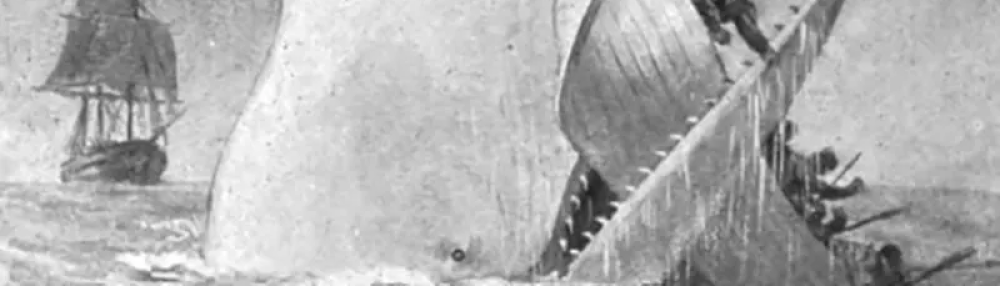
In Chapter 78: Cistern and Buckets, Tashtego falls into the tun of the whale while collecting Spermacetti. Ishmael describes his being rescued by Queequeg as a delivery, and thus the men of the Pequod are privy to the feminine line of work involved in birth, which men are often excluded from witnessing. This rare presence of femininity and work associated with women draws comparison between the difficulty of whaling and birth and delivery, two lines of work famously undervalued and yet foundations to society, one providing life, the other providing light.
In this chapter, where Midwifery and the whaling industry meet, the comparisons of the difficulty between these two professions create a moment of solidarity between feminine work, childbirth and the dangerous work of whale harvesting at sea, traditionally done by men. Tashtego is placed in his position due to negligence but is blamed for his falling into the tun “Whether it was that Tashtego, that wild Indian, was so heedless and reckless as to let go for a moment his one-handed hold on the great cabled tackles suspending the head; or whether the place where he stood was so treacherous and oozy; or whether the Evil One himself would have it to fall out so, without stating his particular reasons;(374)” Much like in childbirth, the fault of a difficult pregnancy or delivery is placed not first on chance, but on the negligence of the mother. Ishmaels blames Tashtego, when infact Stubbs, Starbuck, And Ahab, those in charge of the industry and work on the boat, are responsible for endangering and not securing their crewmen.
Queequeg, of all characters, who is symbolic of the defiance of all presuppositions of the intelligence, bravery and capability of non-westerners (non-Europeans), is the one to perform this act of assisted birth and rescue. Not only is he special for the connection he forms with Ishmael, or of his selfless acts of bravery, but he is also a midwife; assisting in Tashtego’s watery rebirth from the Tun:
“He averred, that upon first thrusting in for him, a leg was presented; but well knowing that that was not as it ought to be, and might occasion great trouble;—he had thrust back the leg, and by a dexterous heave and toss, had wrought a somerset upon the Indian; so that with the next trial, he came forth in the good old way—head foremost. As for the great head itself, that was doing as well as could be expected (p.376).”
The way that Tashtego was first positioned at the entrance of the Tun/womb, feet first, is called a breech position, in which the baby is usually in danger of injury or death by suffocation. Even in modern medicine this is considered a difficult birthing position for the fetus and mother, often resulting in the injury of the mother and tearing of the cervix. A skilled midwife, or obstetrician, is capable of either carefully following through with this birth position, or helping to turn the baby. In other words, Queequeg’s delivery of Tashtego was a feat of obstetrics even for what is possible on land (and with human babies). This feat of a delivery is acknowledged:
“And thus, through the courage and great skill in obstetrics of Queequeg, the deliverance, or rather, delivery of Tashtego, was successfully accomplished, in the teeth, too, of the most untoward and apparently hopeless impediments; which is a lesson by no means to be forgotten. Midwifery should be taught in the same course with fencing and boxing, riding and rowing(176).”
Midwifes, who hold a gendered job, done in seclusion with mothers in birth, and the difficulty of assisting in labor with the chance of two deaths looming over their heads, is acknowledged by Ishmael as a profession requiring as much bravery and braun as “fencing, boxing, riding, rowing” the lauded professions and past times of men. Queequegs delivery introduces the men onboard to the quick wit, and bravery required of a widwife, and for a moment, as they observe this wonder, the border between gendered labor, and those skills required in each are blurred, and the solidarity between these two professions is secured by the knowledge that both jobs are deserving of acknowledgment as heroic and legendary.