Week 13: Blog Post

What you still need to learn/do for your final project:

I am hoping I can learn from all of the comments our Professor has left on both of my essays about close reading! I want to be able to close read 2 or maybe 3 passages for my final project to show why what I am creating matters! I have never done close reading to this extent before, so I want to put my all into this last project to prove my point for my creative project! I hope everyone will enjoy it as much as I have been enjoying making it! I hope my essay will show the importance of what I am making is very important to the story of Moby Dick.

week 13

What you still need to learn/do for your final project

I want to first say, how I have never really tapped into close reading like this. This class has definitely made me learn a new set of skills when it comes to writing. I need to work on my defining moments in close reading. I have a clear idea of what I want to say, but I get lost in translation when I’m trying to express why it matters. So I think Dr. Pressman’s comments on both of my essays, I will be taking that to heart to make sure I am delivering the best final I can give to her.

I want my ideas to be fully clear because I have so much to say when it comes to my final idea.

Food for thought: articles to feed your mind

Hey Everyone,

So, I know that we are all deep in the trenches of trying to figure out what we want to do our final project on — I certainly am. I’ve found some really fascinating articles that I think might benefit more than just me, so I’m going to share a link to the Google Drive Folder so that others might benefit from my searching.

There’s a few that are articles about racism, about Melville’s intentions with his black characters, about how Melville plays with our perceptions to make us racially assign Ishmael as white, one that gives really interesting interpretations about the truth behind what Moby-Dick actually was, and a few more. They’re free to use, I just hope they help! I’ll keep updating the folder as I find more, let me know if you have any issues loading the link.

See you tomorrow!

-Kit Jackson

Late Halloween from the Brow

This is definitely a long overdue post but here it partially is, the whale made from a five dollar box from Target (which is a rip off in and of its own if you ask me but I had a vision.) I didn’t initially know what I wanted going into this, whether it’d just be some dead whale or Moby Dick itself, but I think that was part of the point now that I’m reflecting on it. In creating this thing, I’ve come to realize that the analysis of the brow/skeleton/head/cetology can apply to whatever whale came across that boat, dead or not. The scientific capabilities of the past really seem interesting, but it also shows how misguided and judgemental science could have been when understanding these animals. This was a passion project of a water bottle, lots of glue, screws and bolts, stained marker hands, and silly references. I hadn’t even actually known that sperm whales don’t have any top teeth, a mistake I almost made after having to rip off the row of top teeth I cut out for it. There’s a good chance this will end up as my final project, and in all honesty, I do feel a little attached to the thing as it sits on the floor of my bedroom. I wouldn’t say I’m as obsessed with it as Ahab is though.

Short Essay: Close Reading 2

In the beginning of Chapter 110, “Queequeg in his Coffin,” Melville writes of the crew of the Pequod doing a deep clean of the cargo hold. Looking for an oil leak, they take everything out from the bottom, where it looks like you could find traces of Captain Noah and placards “vainly warning the infatuated old world from the flood,” and spread the objects out on the deck. In page 519, Melville offers the reader a specific image of this, “Top-heavy was the ship as a dinnerless student with all Aristotle in his head. Well was it that the Typhoons did not visit them.” By using figurative language to personify the ship, Melville stresses the role of the Pequod as a nation state and a representation of young America, which he critiques for its naiveness and unreliable foundation. 

The term “top-heavy” is of importance here, because it refers to something that is excessively heavy at the top and in great danger of falling over. Although it is being used to describe the ship, it is not in a literal sense, as it makes no sense that a ship would topple over from many objects on its deck. However, Melville is referring to how the ship can be “top-heavy” when we are reflecting on its structure and ideals, which he argues are precariously built. Further, the term evokes the image of shallowness, as it is referring to the surface of the ship (it’s heavy at the top, but light at the bottom). In other words, it looks promising but it lacks substance. If we are to continue to think about the Pequod as a nation state and representation of America, as Melville has prompted us to do in the past, we can take these two ideas that spring from the term in question (how something heavy at the top topples over and a system that is superficial) and apply them to the young country Melville is living in; a country that has grown powerful at a rapid pace, a bustling, wealthy, energetic state that has many unaddressed cracks at its core. These fractures at the bottom though, Melville warns, will cause them to fall apart sooner rather than later. 

In the next phrase, Melville prompts us to look at the ship “as a dinnerless student with all Aristotle in his head.” This image points to the ship (and therefore the country of America) as a naive entity. A hungry student is often immature and disheveled but also hungry for knowledge and idealistic. Idealism, that unrealistic romanticism, is a central factor evidenced by Melville calling attention to the head (“all Aristotle in his head”). This young student (or young country) is well-meaning, but their worldview only goes so far and stays stuck in philosophy and abstractions, which brings us back to the lack of substance at the base. Furthermore, by specifically referencing Aristotle, one of the most important philosophers for Western culture, Melville is indicating that this critique is meant toward for this sector of the world; but the analogy being used is of a student (who is often a young person), which means he is specifically critiquing the United States, the newest country of the West, and the one he is living in. After the American Revolution, the country united under strong ideals such as freedom, democracy, and unalienable rights, but the remnants of oppression in colonial America were never addressed. Slavery was one of these heinous violations, and it was becoming a more pressing issue with every passing day as unrest grew in the country. In other words, there were these big, noble sentiments that were proclaimed as the base of our nation, but when one looked closely at them, it was clear they were not consistently applied for every person in the land. We declared life, liberty, and the pursuit of happiness, but in a tangible sense, these things were at best questionably exercised and kept at a very shallow level. The country was young and shaky, and for Melville it showed in its structure but also its inconsistent and undependable ideals. Preceding this idea with a reference to Noah’s Ark and the story of the flood, it is Melville making a warning about shaky foundations and the importance of heeding this warning in a timely manner, before we are destroyed.

This passage ends with a final warning disguised in a metaphor. Melville writes “Well was it that the Typhoons did not visit them then.” For the Pequod, or any ship for that matter, being hit by a Typhoon, a powerful force of nature, would have been catastrophic. He is saying that they were lucky they were not suffering from this dangerous event, but the word “then” implies that Typhoons will eventually visit them. In other words, catastrophe is imminent. As mentioned before, the issue of slavery in America was coming to a head at the time that Melville was writing his novel. The states are divided between slave and free states, but the recent Fugitive Slave Act was forcing every person in the country to be directly compliant with this structure (free states were complicit even before that as they benefitted from slave labor, but it was easier to ignore because it was less direct). The Typhoons that Melville is referring to are starting to brew on the horizon. Civil unrest is growing and division is more visible every day. This issue of blatant injustice would eventually burst into an all out war. The choice of using Typhoons as an analogy works because it implies that injustice will naturally erupt into chaos, a powerful force that we cannot fight. Melville is warning that the Typhoons are coming to our country, and with our naiveness and shaky foundation, we are ill prepared to receive them.

The tone of this passage is foreboding and admonishing, but it is also relatively gentle. Melville believes in his country and holds it close to his heart, which is why he compares it to a starving student rather than an entity of evil. It seems like he has hope in the good intentions of the American people, and their ability to change if they heed his warnings. This passage is highly relevant to the current climate of our nation. As Melville believes, it is important to recognize both our good intentions and failings as a country in order to directly address injustice and remedy it, lest it destroy us from within.
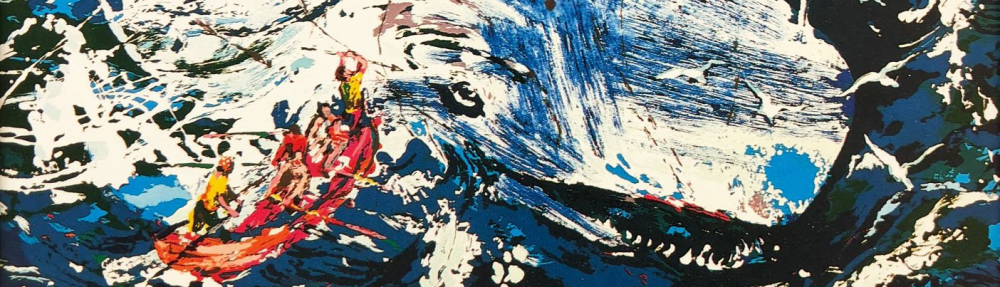
Chapter 135: The end of it all…

First of all, what the fudge!? How can it just end like that!? As I am happy that this journey of reading Moby Dick is over, I’ll kind of miss it. The ending of obsession for the whale and rage he filled up in his system for years caused it to be his doom. In Moby Dick’s final chapter, Melville transforms the Pequod into a tragedy, revealing on how Ahab’s obsession becomes a force that destroys not only himself, but his entire crew too. The quote, ” And his whole captive force, folded in the flag of Ahab, went down with his ship, which, like Satan, would not sink to hell till she had dragged a living part of heaven along with her, and helmeted herself with it”, (624) captures the intensity of this destructive power with such intensity. It demonstrates on how Ahab “captive force” suggest that the sailors are no longer in control of themselves, but of Ahab’s consuming will. Melville, also, compares the Pequod as Satan, a figure whose associated with rebellion and pride, just like in his own story on how he fell from the heavens through defiance, Ahab’s ship refuses to sink “till she had dragged a living part of heaven along with her,” suggest that his downfall is so intense that it contaminates everything that’s innocent and pure.

Melville’s fascination for using biblical and mythological imagery to portray obsession as a spiritual catastrophe amazes me every time I would read a chapter. I’ll probably (maybe no, maybe so) miss this weird, quirky book.

A blog from Chap. 133 Moby-Dick P. 596

“A gentle joyousness-a mighty mildness of repose in swiftness, invested the gliding whale. Not the white bull Jupiter swimming away with ravished Europa clinging to his graceful horns; his lovely, leering eyes sideways intent upon the maid; with smooth bewitching fleetness, rippling straight for the nuptial bower in Crete; Jove, not that great majesty Supreme! did surpass the glorified White Whale as he so divinely swam” (Chap. 133, P. 596). In this passage from The Chase-First Day, Melville describes the White Whale with and almost divine gentleness, comparing its movement to mythic scenes like Jupiter abducting Europa, by invoking classical imager and emphasizing the whale’s “mighty mildness of repose, “Melville transforms the whale from a mere animal into a majestic, supernatural presence that surpasses even the gods. The poetic rhythm, the rich mythological allusion, and the contrast between calmness and power elevate the whale into a symbol rather than a creature. This matters because it shows how Ahab’s hunt is not just a physical chase-it is a confrontation with something beyond human understanding, a force that exists outside normal categories of danger or beauty, The description reveals why the whale holds such psychological power over Ahab and the crew: it embodies mystery, divinity, and terror al at once.

Essay 2- It’s Madness Luv

In the novel Moby-Dick, Melville uses Ahab to highlight how having an unhealthy obsession can take over a person’s whole self and eventually lead to madness. Ahab’s intentions from the beginning of the novel with the great White Whale were pretty visible and as it went on, his insanity became more deranged and more evident. This can be seen in chapter 113, The Forge, when Ahab drenches his harpoon with blood that Perth upgraded to help him defeat the White Whale. Melville writes, “‘Ego non baptizo te in nomine patris, sed in nomine diaboli!’ deliriously howled Ahab, as the malignant iron scorchingly devoured the baptismal blood” (Melville 532). Ahab performs a reverse baptism by drenching the weapon in pagan blood rather than holy water. His upgraded harpoon goes beyond the function as just a weapon, it symbolizes Ahab’s madness– his dedication to vengeance. By transforming the harpoon into a ritualistic object, Ahab’s obsession can be seen reshaping his reality. What was once just seen as a simple hunting tool turns into a weapon of mass destruction– an embodiment of his growing madness.

Ahab thirsts for the chaos to the point that he has their blacksmith forge an upgraded weapon of death to use for the great White Whale. He needs the most upgraded parts to give his weapon more strength. This is similar to video games where you customize your character’s weapon to the max so they can deal more damage for the boss battle. Ahab had given personalized upgrades for his harpoon, he says “Here are my razors– the best of steel; here, and make the barbs sharp as the needle-sleet of the Icy Sea” (Melville 532). His harpoon is more than just a preparation for a hunt, it is an extension of his madness. His weapon at first did not have all the upgrades but as his obsession deepens, his weapon does get upgraded. His fixation is being put into the weapon itself showing how obsession does not stay contained, that it in fact grows and intensifies until it consumes everything around it. Ahab forges a harpoon that is as destructive and extreme as his obsession, creating a superweapon to not only kill an animal but to kill a divine force, revealing how his anger and vengeance steered him away from reality.

After Ahab’s weapon gets its upgrade, he blesses it in Latin and the translation of what he says is “I do not baptize you in the name of the Father, but in the name of the Devil.” Ahab does a reverse blessing, a satanic-like ritual and calls upon the Devil rather than calling upon God.  He would rather get help and protection from evil forces rather than God’s strength against the White Whale. His fixation runs so deep that he corrupted the most sacred of ideas and instead of using faith to keep vengeance out of his heart, he uses it to keep it within. He abandons all forms of faith and chooses to turn to darkness itself to help destroy the whale. This further reflects that Ahab’s obsession goes beyond emotional and physical form but also spiritual and how it reveals the destruction obsession causes.

The reverse blessing continues and Ahab uses pagan blood from Queequeg, Tashtego and Daggoo. By using the pagan blood, it seals the deal for the blessing and shows how obsession has corrupted Ahab entirely. He is fully transforming his hunting weapon into a satanic weapon. Ahab made the conscious decision to use blood for the ritual that “scorchingly devoured the baptismal blood.” He is rejecting the idea of the Christian faith and instead chooses to side with the Devil. This reveals that Ahab’s unhealthy obsession has soared into insanity because he uses the pagan blood and believes the idea of the Devil is strong enough to defeat the Whale– he believes spiritual corruption is the only way that will lead him to his goal. 

Ahab’s obsession with Moby Dick has consumed him to the point of spiraling. The thought of killing and getting revenge on Moby Dick has completely taken over Ahab’s body, mind and soul, leading to his downfall. By devoting all of his energy to the White Whale, Ahab loses sight of everything else around him such as his and his crew’s safety and his responsibility as a captain. Every decision, thought and action is planned out carefully to reach the overall objective of destroying the White Whale. However, as Ahab gives his all into achieving the killing of Moby Dick, he becomes more unrecognizable and increasingly disconnected from reality as he crafts a tool of destruction that mirrors his corrupted mindset. Melville uses Ahab to show when a person allows vengeance to dominate their life and how it leads to self-destruction.

Essay 2 – The Doubloon and the Limit of Ahab

In chapter 99, we watch as the doubloon transforms before our very eyes; from a piece of gold worth sixteen dollars as means of motivating the crew to more of a legend, similar to the painting in chapter 3. This painting is one that is muddled and soot-covered from years of smoking and lack of care, but the painting allows the audience to play with meaning and figure out how to read the novel. It is the same with the doubloon, however, less so with the novel itself and more with the characters’ morality and current mental state.Ahab in particular is fascinating, allowing the audience to peer into his beliefs, lining up with the descriptions Ishmael had heard about before ever having met the wayward captain. Ahab walks the deck, the same path daily, and yet it is here, it is now, in which he has a religious experience—one in which he is at its centre. “There’s something ever egotistical in mountain-tops… and all other grand and lofty things…”, Ahab states, “The firm tower, that is Ahab… the courageous, the undaunted, and victorious fowl, that, too, is Ahab…” (Melville ???). In these declarations, the audience sees a man who would fight the sun, the man who is god-like, the man who is Ahab. At what point does perception become reality? In not only the minds of the crew, but also in the captain’s mind, Ahab is omnipotent—how far reaching is this power when the whale takes from the Ahab?