I don’t wanna to seem obsessed this idea, but the act of reading truly amazes me. It’s the act of reading within reading. We are reading the literal text, and then Melville tells us to read more through imagery. “But as you come nearer to this great head, it begins to assume different aspects, according to your point of view.” (364) Melville. We have to imagine we are on the ship, walking around this whale’s head. We are told to read these imagines because it’s important to understand the bigger picture that Melville wants us to understand. He makes our job to go deeper with text and figure out all the different aspects. It will take diligent study of these images that Melville is painting for us.
Week 10: Honey and spermaceti
After reading chapter 78, one part that stuck out to me was its ending paragraph where, after Tashtego is rescued by Queequeg from the head of the sperm whale, Ishmael imagines what dying in it would feel like:
“Now, had Tashtego perished in that head, it had been a very precious perishing; smothered in the very whitest and daintiest of fragrant spermaceti … Only one sweeter end can readily be recalled—the delicious death of an Ohio honey-hunter, who seeking honey in the crotch of a hollow tree, found such exceeding store of it, that leaning too far over, it sucked him in, so that he died embalmed. (Melville 377)
I thought this paragraph was interesting because even though we see this attempt at romanticizing death by drowning “in the very whitest and daintiest of fragrant spermaceti,” Melville also compares it to dying in honey. The mention of the honey-hunter can also be an allegory for greed: Melville reminds us that men have sought out precious things in the hopes that they’d grow more powerful if they have more of it, but what happens if you end up having too much of one thing?
Melville uses the unlikely scenario of the honey hunter and the tree’s honey trove as an example of how this desire for material wealth can result in one’s demise. In the passage above, the honey-hunter discovered the honey trove, but after “leaning too far over, [the honey] sucked him in, so that he died embalmed.” (Melville 377) Like spermaceti, honey is a sweet, viscous substance that is nearly impossible to swim in due to its viscosity, and it can certainly “smother” a person should they fall into it. Despite this, it is often sought out for its health benefits, just like how spermaceti is sought out for its versatility and high selling price.
The irony of it is that we tend to search for valuable things could place us higher in the social hierarchy, yet we don’t even realize its potential dangers because we typically only see it in small amounts. Spermaceti is like honey; sweet and harmless in small amounts, but suffocating and dangerous when there’s a pool’s worth of it. As demonstrated with Tashtego and the honey hunter falling into a pool of spermaceti and honey respectively, greed can often lead to a precious, “delicious death.”
Chapter 74: The Sperm Whale’s Head
“But if his eyes were broad as the lens of Hershel’s great telescope; and his ears capacious as the porches of hearing? Not at all.—Why then do you try to “enlarge” your mind? Subtilize it.” (Melville 362)
I was interested in this quote because it comes about as Ishmael is pondering on the discrepancy between the size of the whale and the size of its sensory organs and wonders if they may be superior to humans for these differences. This quote makes the question philosophical in its nature; Does size equate to intelligence? The whale is certainly large in its scale, yet all it requires are eyes the size of a horse’s and an ear so small as to be overlooked by a less discerning eye. The whale’s design makes it clear that making these organs longer does not guarantee they will be more efficient. In a similar way, having a broad knowledge does not amount to much if we do not understand how to apply it effectively or how to pay attention to detail. Ishmael makes the observation that unless someone like a whaler gets up close and personal with a whale’s head someone with less experience might never find the ear. That is how small it is. It is not enough to have seen a drawing of a whale, or to have read all the books on cetology if when you stand before it you are unable to perceive such an important part of their physiognomy. Time and time again in this book, Melville continues to remind the reader do away with our preconceived notions of what makes someone learned and to consider the importance of direct contact and direct action.
Plato’s Honey Head
Chapter 78 is a nice change of pace, after all the musings once again and again afterwards. There were some quotes worth mentioning, but if I had to pick only one, it would be the last sentence, “How many, think ye, have likewise fallen into Plato’s honey head, and sweetly perished there?” (p. 377) On the surface, this is about the whale Tashtego fell into, but what struck me is the specific mention of Plato… and why “honey head”?
First, the phrasing “How many, think ye, have likewise fallen…” invites us readers to think how many people fell into the very fate Tashtego would have had if Queequeg hadn’t come to save him. But the addition of “Plato’s honey head” suggests some kind of treasure, so the people who were “embalmed” by the whale’s spermaceti died comfortably? Maybe one of the things Melville is trying to say is that the whale’s spermaceti feels like honey, and when one falls into the mouth, they feel no need to escape? The last phrase, “and sweetly perished there,” suggests a “delicious” death.
Wait, the mere mention of Plato has to mean something. Plato is famous for philosophy… perhaps his thoughts were attractive to people. But some of Plato’s theories were questionable, and perhaps these theories are the “honey,” or like the whale’s spermaceti. If this is truly Melville’s intent, this chapter is about the dangers of blindly following an ideal – what seems sweet and harmless could end up being the very thing you should avoid.
Week 10 : Chapters 74 – 90
Something that has truly stuck out to me through reading both last week’s and this week’s section of the novel was the way in which Melville utilizes similes throughout his descriptions.
In chapter 85, The Fountain he is describing the way in which whales breath and regulate the amount of time they can stay above or below water. When describing the windpipe, he says “as his windpipe solely opens into the tube of his spouting canal, as as that long canal – like the grand Erie Canal – is furnished with a sort of locks (like open and shut) for the downward retention of air or the upward exclusion of water”. To me, this simile is perfect for demonstrating the impact the similes that Melville uses have on his writing. His writing is already extremely vivid with every single word he writes, but his use of simile takes it to another level, allowing for the text to be even richer with description through comparison. Especially when he is describing the whale or features of the whale, he is so vividly descriptive and a massive part of the description is the similes he utilizes. This one in particular allows us as readers to truly think about how large just one part of the whale may be through his use of comparing it to something extremely massive. It sort of puts it into perspective a bit for us, while still bringing the text and the story back to the country of America and the land over there. His use of simile allow for the text to remain both symbolic and vivid.
Week 10: Chapter 74– Absolute Nothingness with Whale’s leftover remains
I felt very uncomfortable and tense at the end of chapter 74, where the whalers continue to carve the teeth out of the whale’s hung body by the starboard. ” This whale is not dead; he is only dispirited, out of sorts, perhaps;… so supine, that the hinges of his jaw have relaxed, leaving him there in that ungainly sort of plight…With a keen cutting spade, Queequeq lances the gums; then the jaw is lashed right down to the ringbolts…The jaw is afterwards sawn into slabs, and piled away like joists for building houses.(Melville 363)” Prior to this chapter, we already get a sense of the body’s current state and its passing of time while hung on the starboard. Interestingly, I think that the nauseating representation of its carcass and remains is critical to how Ishmael internally feels himself; after whaling, what will physically become of him? Through all the trauma and tragedies on the sea, while he is desensitized to physical danger, he becomes more and more receptively sensitive about stagnancy and the stillness of life. Because he is so wired to constantly defend the boat and maintain the lines, he fears of having no agency after whaling, equating to him being disgusted about his own self; and he has to come to terms of being human while he watches the whale’s remains, limb by limb, becoming absolute nothingness. Overall, as his journey comes into a close with the blade hitting the whale’s bone, he realizes his mortality and cannot hide in abstract stillness or the liminal space the sea offers him.
An old & glorious occupation, no more
Chapter 82, “The Honor and Glory of Whaling,” offers us a great insight into the history and mythology of whaling and stories of whales. One section that particularly stood out to me was when Ishmael said, “Nor do heroes, saints, demigods, and prophets alone comprise the whole roll of our order. Our grand master is still to be named; for like royal kings of old times, we find the head-waters of our fraternity in nothing short of the great gods themselves” (Melville 397). It truly shows the significance that whaling has had throughout history, it is stories both ancient Greek and Roman, it’s in the Bible, it’s in many different religions such as Hinduism, the impact and importance of whaling is something that has been lost in time as the book has gotten older. Now we look at whaling and we disagree with it, for a good reason of course, but back then it was heroic and it was something that the legendary men in myth, Hercules and Perseus, did.
I think that Melville wrote this chapter to show why whaling should have been considered a prestige occupation with a sort of righteousness that came with it; “when I find so many great demi-gods and heroes, prophets of all sorts, who one way or other have shed distinction upon it, I am transported with the reflection that I myself belong, though but subordinately, to so emblazoned a fraternity” (Melville 395). It seems like Melville is talking about himself here, and how he feels to be included in a group that is surrounded by legends and myths and religious figures, people’s whose stories have been around for millenniums. Another quote that stood out to me was, “Those were the knightly days of our profession, when we only bore arms to succor the distressed, and not to fill men’s lamp-feeders” (Melville 395). It shows how much whaling has change from the days of Perseus to when Melville was writing Moby-Dick, and now today were the whaling industry in America is dead.
This chapter definitely showed the historical and mythical significance of whaling. It’s incredible to think that something we now view as unethical and immoral was once viewed as heroic and glorious, however the purpose of whaling has changed significantly since those times. Mythical legends, Saints, Heroes, and gods all take up a seat in whaling, as Melville puts it; “Perseus, St. George, Hercules, Jonah, and Vishnoo! there’s a member-roll for you! What club but the whaleman’s can head off like that?” (Melville 398).
“A Mass of Tremendous Life”
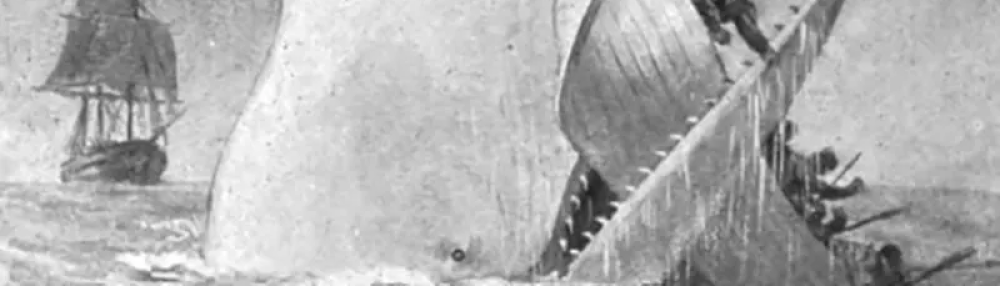
Ishmael studies the sperm whale’s head in Chapter 76, “The Battering-Ram,” using scientific methods and expressing a religious-like sense of amazement. He describes the front of the whale’s head as a lifeless wall which appears completely without sensation or perception. Yet, as he continues, that very lifeless surface becomes something sublime. By the end of the chapter, Ishmael describes the whale as “unerringly impelling this dead, impregnable, uninjurable wall, and this most buoyant thing within; there swims behind it all a mass of tremendous life” (370). The initial observation of body structure reveals a living force that exists beneath the appearance of immobility.
The passage captures Melville’s fascination with contradiction. The whale keeps its motionless forehead to protect its inner power and its vital life functions. The unknown depths of existence become visible through this symbol, which shows that life’s most powerful force operates through silent actions. The two words “dead” and “life” appear together in the same sentence to show how Melville unites physical and spiritual realms. Ishmael shifts his communication from scientific analysis to spiritual language because his whale research reveals the vast extent of his ignorance about the creature.
The scene matches Melville’s general comments about human ability to understand things. The whale’s “mass of tremendous life” fights against all attempts to apply logical thinking that Ahab, the scientist, and Ishmael would use. The effort to understand something of this scale reveals the extent to which our senses can only perceive so much. Nature created an enigmatic forehead shape on whales that humans cannot understand. The author concludes by showing that unknown forces govern the unbreakable wall, suggesting that the universe operates through mysterious ways rather than through direct control. The surface-level understanding we experience does not reveal the actual meaning, because the true process of understanding operates at a deeper level.
The Plain View of the Prairie (Chapter 79)
It took me a second to realize that Ishmael was referring to the whale’s forehead in this chapter. Part of me wondered as to why the chapter itself is named “The Prairie” mostly in the idea that a Prairie itself is an environment just full of grasses and wildflowers, much unlike the sea we’ve been on for the past however many chapters. I also had to search up what exactly “Physiognomist” and “Phrenologist” meant, and when I found that these were essentially terms for people who judged character based off of facial characteristics, then it started making a little more sense when I finished the chapter.
Ishmael is essentially trying his best to “read” the whale, rather, read the forehead of the whale despite the challenges. Most notably, he mentions “For you see no one point precisely; not one distinct feature is revealed; no nose, eyes, ears or mouth; no face; he has none, proper; nothing but that one broad firmament of a forehead, pleated with riddles; dumbly lowering with the doom of boats, and ships, and men. Nor, in profile, does this wondrous brow diminish; though that way viewed, its grandeur does not domineer upon you so.” (379)
I didn’t think this important at all at first, I found myself wondering why it is that a science like this even existed back in the 19th century, but it adds into the previous chapters explaining the sides of the head of the whale, that we have to understand, or at least try to understand the whale itself. The whales throughout a lot of the chapters have had a mythic quality to them, but I feel as if the chapters describing all of the anatomy and the process of “reading” this anatomy puts into perspective the idea that they’re also just creatures at the end of the day. Understanding, or trying to understand them, is a fruitless attempt. No features are offered on the “brow” or forehead of the beast, and it kind of makes this chunk feel pointless other than the line of “…thought that way viewed, its grandeur does not domineer upon you so.” Readers have to imagine what its like to be a whale to even fathom it, and Ishmael himself invites us to do so with the ending lines of “I but put that brow before you. Read it if you can.” (380)
It’s obvious in this day and age that we really can’t read it, a forehead is just a forehead, but the fruitless endeavor of trying to read the forehead of the whale just seems so symbolic of unknowingness despite Ishmael’s semi-knowledgeable self on cetology. It’s like a really frustrating paradox trying to figure it all out.
The Royalty of the Sea and Its Wildness
“…in which case you will take great interest in thinking how this mightly monster is actually a diademed king of the sea, whose green crown has been put together for him in this marvellous manner.” (Chapter 75, page 365).
It’s important to connect back to the historical context of this period of whaling and mankind’s ventures into the ocean. The sea, with all its mysteries, was considered a new frontier to be conquered and mastered, primarily through whaling and ocean fishing. It’s through these practices that people of the 19th century could not only establish themselves in the vast realm of the ocean, but wholly master it. Melville’s, or Ishmael’s, description of the whale as “a diademed king of the sea” with a “green crown” of slimy kelp and the rough edges of caked barnacles touches on this point. If whales are to be the kings of the sea, what does that say about the men who conquer and skin them on their boats? Or of Ahab, the crazed assassin of the sea who lives and breathes with Moby Dick staining the backs of his eyelids?
If we consider the ocean as both a thing to be conquered and a vast expanse capable of great destruction, whalers are prized assets to American imperialism in the 19th century. Yet, whalers are not always welcomed back to land with cheers and thanks, but disdain and disgust. Melville touches on this several times throughout our reading of the novel thus far, pointing out the bubbling hypocrisy of landsmen who beg for whale oil to light their reading rooms yet cover their ears at whaling stories.
Based on the quote above, to slay a king means either of two things, based on the broader context: the victory over a great leader who is said to own, whether literally or figuratively, an expanse of wealth or geography, or treason. Considering the first, this makes whalers who successfully kill and harvest all the whale’s assets victors over the ocean. However, the sea is a vast, violent thing full of various kings to be slain, pointing to a more profound message by Melville: man’s inability ever to understand or conquer the complexities of the ocean, despite all our efforts.