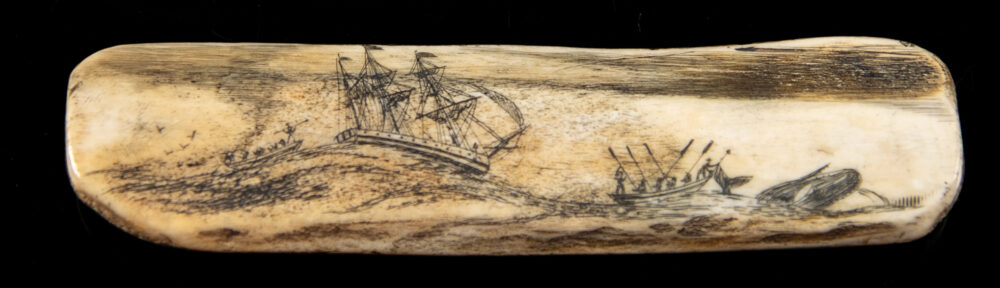
Ishmael finds himself entering a Whaleman’s chapel within this chapter, talking about his observations and feelings towards the idea of death. Part of me feels similarly towards his feelings about plaques, and while it is easy to imagine the countenance on the people he sees in the middle of mourning, I think this chapter puts into perspective on how people are supposed to understand and tackle the idea of a loved one dying. (Or anyone dying in general for that matter.) Ishmael himself doesn’t seem entirely bothered by the idea of death as we’ve seen, but he reflects this specific idea. “…yet lies antique Adam who died sixty round centuries ago; how it is that we still refuse to be comforted for those who we nevertheless maintain are dwelling in unspeakable bliss; why all the living so strive to hush all the dead…” (42) Ishmael seems baffled by the idea of people grieving loss at the idea of (Christian) heaven being a better place.
Additionally, he also makes a point about how those who embark for specific work or journeys are paid while others are not. There’s merit in how a man’s life is held. Going back to the plaques, I believe Melville’s intention of putting them in this chapter preface’s the idea that we are not necessarily supposed to feel anything at all. From Ishmael’s standpoint, there isn’t any sense of grief or personal connection. Why should these plaques take up a whole/half a page? Is there any true significance other than the idea that the whaling journey he is about to embark on might have him turn into nothing but a plaque as well? Is someone going to grieve him? Melville makes the chapter foreboding, and it changes the tone from the previous chapters before.
The Weight of Guilt
“Terrors upon terrors run shouting through his soul. In all his cringing attitudes, the God-fugitive is now too plainly known. The sailors mark him; more and more certain grow their suspicions of him, and at last, fully to test the truth, by referring the whole matter to high Heaven, they fall to casting lots, to see for whose cause this great tempest was upon them. the lot is Jonah’s; that discovered, then how furiously they mob him with their questions. ‘What is thine occupation? whence comest thou? thy country? what people?’ but mark now, my shipmates, the behavior of poor Jonah. the eager mariners but ask him who he is, and where from; whereas, they not only receive an answer to those questions, but like wise another answer ti a question not put by them, but the unsolicited answer is forced from Jonah by the hard hand of God that is upon him.” (pp. 51)
This moment in Chapter 9 of Moby-Dick hits harder than I expected for a book about chasing a whale. Melville tells the story of Jonah and it suddenly feels way too real. Jonah’s on a ship in a storm, everyone’s panicking, and they start casting lots to figure out who’s to blame for the chaos.
What’s wild is how Jonah reacts. The sailors only ask him basic stuff; who are you, where are you from, what’s your job? But Jonah doesn’t just answer. He confesses. He blurts out the truth they didn’t even ask for, like it’s been eating him alive. And that’s exactly Melville’s point.
This isn’t just about a guy running from God. It’s about how guilt works. You can try to hide, run, deny—but when it builds up inside you, it demands to come out. Jonah’s not undone by the sailors. He’s undone by his own conscience. It’s that moment when you can’t lie to yourself anymore, even if nobody else knows the full story.
Melville nails something super relatable here: the fear of being found out, but even more, the unbearable weight of knowing you’ve messed up. Jonah’s story becomes all of ours. We’ve all had that moment where guilt catches up, and the truth just spills out.
Week 6: Queequeg and Ishmael
The change that occurs between Queequeg and Ishmael, as well as the further development of their friendship, is worthy of note. In the beginning chapters, Ishmael constantly repeats the narrative that ignorance is the parent of fear and that he has underlying prejudices against Queequeg because he is a cannibal. That being said, later in our reading, it is written that, “[Queequeg] seemed to take to me quite as naturally and unbiddenly as I to him; and when our smoke was over, he pressed his forehead against mine, clasped me round the waist, and said that henceforth we were married…that we were bosom friends; he would gladly die for me…” (57). To see such a shift in their dynamic after a mere two days in each other’s company is conflicting, given the apparent observation. Whether romantic or platonic, their dynamic mirrors the ever-shifting relationship that people have with the ocean.
The ocean is constantly changing, and while there are various descriptions throughout the novel that highlight the world’s fascination with the ocean and the fear that it holds towards the depths and its inhabitants, there is always something that ends up luring them out into its vastness. Ishmael’s quick change towards Queequeg is representative of the change in attitude towards the ocean and its dangers; yes, Queequeg is a cannibal, but after finding the time to pick him apart and get to know his peculiar habits and behavior, Ishmael has developed a strong connection and understanding of his friend, having been lured in by his peculiarities and affection. With understanding and patience comes a sense of stability and safety, one that can be found alongside Queequeg, as well as traversing the unknown expanses of the ocean.
Where Comfort meets Discomfort: A Lesson in Opposites
In Chapter 11, “Nightgown,” Ishmael muses: “Nothing exists in itself. If you flatter yourself that you are all over comfortable and have been so a long time, then you cannot be said to be comfortable anymore.” (Melville 59) On the surface, this might be a casual observation about lying in bed, but the phrasing suggests something larger to me. Ishmael reveals that human experience is always relational. Comfort only matters when set against discomfort, just as light only has meaning when contrasted with darkness. This small moment becomes a window into Melville’s larger project: a novel that is less about fixed truths than about oppositions and tensions that define how we see the world.
For the book as a whole, I think that this insight resonates with the way Moby-Dick constantly frames the sea in these sorts of paradoxical terms. The ocean is vast yet suffocating, a space of both freedom and imprisonment, life and death. Just as Ishmael can only recognize comfort when he knows discomfort, he (and the reader) can only approach the meaning of the sea by holding together its contradictions. This shows that the novel is not about mastering or defining the ocean but about living within its shifting, relational nature. Ishmael’s comment in this chapter reads almost like a thesis statement for the entire narrative: nothing in this world exists as a single, stable entity. Everything takes shape through contrast, through relation, and through constant and fluid change.
This is why the moment with Queequeg is so significant. Ishmael’s newfound comfort sharing a bed with someone who once seemed strange or threatening underscores the novel’s interest in difference as a necessary condition for understanding. Without his earlier unease, Ishmael’s warmth with Queequeg would not stand out as meaningful. On a small scale, the line about comfort captures Ishmael’s transition from suspicion to intimacy. On a larger scale, it anticipates the way Melville’s novel demands that we hold opposites together, rather than separate and resolve them.
What makes this moment in Chapter 11 so powerful is how it condenses so many of the novel’s concerns into one simple observation. Ishmael isn’t just thinking about whether he feels warm and at ease in bed; he’s actually reflecting on how human life (and the ocean) can only be understood through contrast, tension, and change. The same principle applies to his friendship with Queequeg, to the sea that both unsettles and attracts him, and to the very shape and format of the novel itself, how it constantly weaves together opposites without trying to resolve them. By pausing on this line, I could see how Melville uses Ishmael’s everyday musings to point us to the larger philosophical questions that run beneath his story: how do we find meaning in a world defined not by its stability, but more so by its shifting contrasts?
Ishmael foreshadows a prominent future event.
Throughout these chapters, what I noticed, or I believe to be a foreshadowing event is when Ishamel slowly woke up from a nightmare. The passage states, “At last, I must have fallen into a troubled nightmare of a doze; and slowly waking from it half steeped in dreams—I opened my eyes, and the before sun-lit room was now wrapped in outer darkness. Instantly I felt a shock running through all my frame; nothing was to be seen, and nothing was to be heard.” (Melville 29). This passage is portraying a future event where Ishmael will be woken up from a nightmare, and instead of seeing his sun-lit room now wrapped in outer darkness, Ishamel will be seeing the vast ocean at night where darkness will completely swallow the whole ocean. He will experience the void of nothingness, where he felt shocked and trapped in the middle of nowhere. Ishmael’s dream of being the most promising port for an adventurous whaleman will be crushed due to the mysteries of the sea. We all know that every man who travels through the sea have hopes and dreams of being recognized due to their efforts, but once they experienced the true terror of the sea, they will realize that everything they have ever wished for were just a hoax, and that the terror is waiting for them on the other side of the earth. Another interesting point I wanted to make is that the way Ishmael and Queequeg act in front of each other is very suspicious. I feel like they both like each other, but at the same time, referring to themselves as ‘friendship’ feels a little off. My theory is perhaps back then, homosexuality was not recognized yet, so both Ishmael and Queequeg who liked each other’s company decided that it is just an intimate friendship, and that they were very close to each other. But the truth is they like each other, and want to spend time together like other couples do. Or perhaps I am completely wrong and my theory is literally me being delusional about it. I would love to hear everyone’s perspective on these chapters next week.
Civilized Savages
Oh Queequeg, our Bosom Friend. It’s hard not to be allured by his awkward civility, “neither caterpillar nor butterfly” (31). What’s great about him is that he’s just honest, more noble, and nowhere near as savage as some other so-called civilized characters. After his initial fears of Queequeg subside, we see Ishmael’s willingness to try this friendship out and we too are invited to change our minds (something hardly allowed and not easily done in the contentious, debate-brained climate we are plagued by). The passage I want to highlight is what I would say is the moment Ishmael, and us in turn, fully puts aside any differences and welcomes Queequeg with all his peculiarities:
“No more my splintered heart and maddened hand were turned against the wolfish world. This soothing savage had redeemed it. There he sat, his very indifference speaking a nature in which there lurked no civilized hypocrisies and bland deceits… And those same things that would have repelled most others, they were the very magnets that thus drew me. I’ll try a pagan friend, thought I, since Christian kindness has proved but a hollow courtesy” (57).
In shutting down the preconceived notions of the savage which sits before him, Ishmael pushes us to reflect on the true savagery of our own “civilized” society. In resisting the tribalism so often pushed upon us, meant to divide and pit one against the other, we can reserve our splintered hearts and maddened hands. This soothing savage has reconstructed our entire view of the wolfish/savage world. Melville’s juxtaposition in the “soothing savage” is very powerful here as the contrast paints a new image for what a savage can be, breaking away from the fearful connotation of the title; it certainly doesn’t align with the “other “cannibal” title previously attributed to him.
Ishmael then goes further and deconstructs our perceptions of what “civilized” entails. This savage has no lurking ill intent. In fact, he’s often the first to act when people are in desperate need while the “civilized” men will stand by. It’s very intriguing knowing that this was written just before the civil war; Melville saw the hypocrisy of civilization, many that can be compared to current events. Why should we be the civilized ones when there’s no end to the hypocrisies and bland deceits on every level? Wouldn’t the countless acts of violence in our country make us savage? Are we not run by a savage whose condolences are naught more than hollow courtesy when the next words out of his mouth are more hateful and divisive rhetoric?
Chapter 6: The Dull Puritanic Sands of New Bedford
As I was closing out reading chapter 6, I came across the last paragraph, which stood out to me reguarding the land where Ishmael currently resides in New Bedford, Massachusetts, as well as those who inhabit the native land. As Melville is describing the streets of the town and more, he then addresses the people who reside there.
“And the women of New Bedford, they bloom like their own red roses. But roses only bloom in summer; whereas the fine carnation of their cheeks is perennial as sunlight in their seventh heavens. Elsewhere match that bloom of theirs, ye cannot, save in Salem, where they tell me, the young girls breathe such musk, their sailor sweethearts smell them miles offshore, as though they were drawing nigh the odorous Moluccas instead of the Puritanic sands.”
Reading this, I picture what Melville was making us imagine with these metaphors and similes and actual places reguarding where the story takes place, New Bedford, and what the people of that land must crave more of. The women who want their men to come back from sea might have been the only sweet thing to come home to in their dull and dreary hometown in Massachusetts. He describes the women as being sweet like the spices that could be found on the islands that are called Moluccas, “The Spice Islands”, and that was their main motivation to sail back to their native land. The people there must crave a new and more interesting land as they keep going back to what they are used to in their hometown. The Islands of Moluccas were known for colonization, as the land was fruitful for many spices and the variety of animals, and more, which were plentiful there. Many countries fought for control over the land once they realized how abundant a lot of spices and other exports were, which they could make a living off of. The women who had to stay back in their musky, most likely not the most pleasant town, drew their sailor men back to them.
Overall, I can see how this can be taken as they crave and would like a sweeter place to live rather than the basic old town where they currently live.
Chapter Ten
In these chapters of Moby-Dick, Melville offers us a deeper look into the relationship between Ishmael and Queequeg. We could interpret their connection as more than a simple growing friendship; there are elements of a romantic bond, as described by Melville. This interpretation is particularly interesting given the cultural context of the 19th century, where queer relationships were rarely, if ever, represented openly in literature. Seeing such intimacy written in this novel, in this way, can show how people at that time resisted or ignored the possibility of a queer narrative. In modern day, we are more exposed to queer narratives and can easily point out when artwork is queer; unlike in the 19th century, when representation was kept minimal.
Chapter 10 especially emphasizes both the physical and emotional closeness between Ishmael and Queequeg. Ishmael describes how Queequeg “pressed his forehead against mine, clasped me around the waist, and said that henceforth we were married.” (Melville 57) The way that Melville worded this is striking, not only for its tenderness, but also for implying a relational permanency between the two with the term “married”. Later, Ishmael continues, “thus, then, in our hearts’ honeymoon, lay I and Queequeg — a cosy, loving pair.” (Melville 28) These scenes show the intimacy between the two sailors, hinting at a relationship rooted in devotion to one another.
What makes this chapter especially significant is not only the intimate dedication between Ishmael and Queequeg, but also the way their bond has been understood—or dismissed—over time. Some readers see their relationship as purely platonic, reflecting the deep companionships sailors often formed, while others interpret the affectionate and even erotic language as evidence of a queer connection. How readers respond to these passages depends greatly on the cultural lens of the time. In the 19th century, queerness was rarely acknowledged; the term “homosexuality” itself was not coined until the late 19th century, as early as the 1960s, according to the Stanford Encyclopedia — about 10 years after the release of Moby-Dick. This does not mean that queer relationships did not exist, but rather that society lacked the language and openness to recognize them. Reading Moby-Dick today, in a time when queer relationships are more visible and celebrated, allows us to see possibilities in Ishmael and Queequeg’s intimacy that may have been overlooked in earlier years. This contrast across time highlights how literature can be reinterpreted by different audiences, reflecting changed understandings.
Etymology and Extracts – Moby Dick
For this week’s reading, I understand all the warnings now about how Moby Dick is a difficult and boring read. I could not really grasp the entirety of what I was reading, but I am sure that as I continue on, I will better understand it.
From what I could gather from the readings, the way the Etymology sections starts off creates an important question as to the lack of inclusion on all matters of whaling and the ocean, and whether that assists in the lessening of the significance of either. Melville’s telling of whaling and exploring the sea, while not entirely non-fiction, but also not entirely fictional, may create a gap in the reader’s understanding of the extent of the dangerous and unintentionally frivolous travels of the ocean. The quote, “While you take in hand to school others, and to teach them by what name a whale-fish is to be called in our tongue, leaving out, through ignorance, the letter H, which almost alone maketh up the signification of the word, you deliver that which is not true” by Hackluyt announces the importance of the accomadations made towards important areas of information for the benefit of assisting our learning of it in our own language. While somewhat off topic, we can see this in translations of many other texts, for instance: The Grettis Saga, which has been translated into various different languages. In the beginning of each of these books there is a disclaimer made by the translators that the significance and the grammatical choices made in the origonal texts are often lost through translation, making the texts become modified and in theory, un-truthful in their translation of the original accounts.
Week 5: Etymology & Extracts
I’ve been sitting re-reading the entire introduction, etymology, and extracts to fully comprehend on the whole deal about what makes Moby Dick special ( in some ways) and what caught my attention right away wasn’t even the actually story, if not the etymology section of the book. Melville starts with words, finding “whale” through dictionaries, Latin, and other languages. It kind of reminded me of the ocean because we are navigating and discovering these words before we dive into the book. Then he dives into the extracts, so many quotes from poems, stories and some I can’t even recognize, but were super interesting to read. The way he pulled those quotes it created an arrange of voices all trying to define or capture the whale. I saw a references to the Bible, “And God created great whales”( Genesis), “Now the Lord had prepared a great fish to swallow up Jonah,” (Jonah), “There go the ships; there is that Leviathan whom thou hast made to play therein.” (Psalms) and etc, so it made me question on to, why the Bible would reference so much the word “whale” in their verses? It just makes me more excited to read the book now! Wanting to uncover more and who Ishmael is!