Final Project Proposal

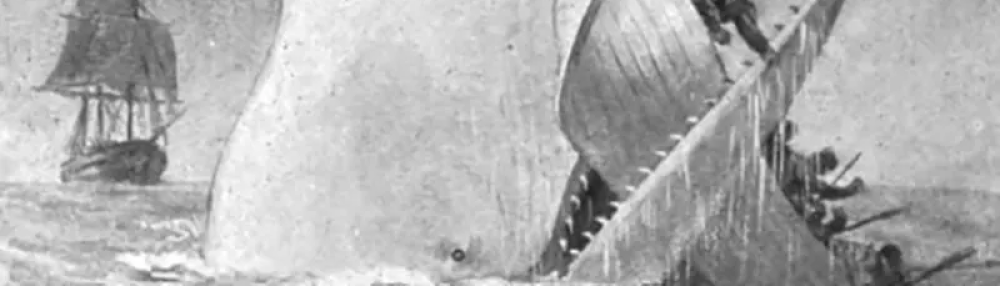
Final Project proposal: I will be elaborating and extending my second essay regarding chapter 64 of Moby Dick, titled “Stubb’s Supper”, during which Stubb begins making his meal of their whale while thousands of sharks can be heard simultaneously attacking what remains of the whale below him in the water.

 My thesis is going to argue that this scene is meant to symbolize the consumerist society they live in and what becomes necessary to survive in this capitalist system. In order to participate in this capitalist society, it becomes necessary for an individual in the workforce to become violent themselves in order to survive this type of system.

I will be demonstrating this through an essay accompanied with an illustration or poem [still deciding] that symbolizes and demonstrates this violent relationship in regard to capitalist adventures. 

The trap of consistency

In “The Anatomy of Melville’s Fame,” O.W. Riegel presents the facts around the reception of Melville’s Moby Dick by the world of literary critics, these figures that hold so much power in their relatively anonymous positions simply with their opinions. A section of the article I found particularly interesting was in page 3, where Reigel is specifically discussing the reception of the British critics when the novel was first published. He writes, “They tested Moby Dick by the canons of unity, coherence and emphasis and found it wanting…Ill feeling, national pride, and a patronizing attitude toward America help to explain the severe condemnation by the English of Melville’s ‘Yankeeisms’ and ‘Go-ahead method.'” This discussion of the so called “canon”, an ever-elusive concept and yet the thing we use to judge the value of every work of art, captured my attention. This book is a prime example of the fact that the goal posts are always changing, however gradually, on what is “valuable” or “good” art, and that the standard is dependent on the subjective perceptions of a small but powerful group of people. This is true not only of art, but of societal structures and norms throughout history. In this case, the British held the power of determining the standard in western literature, and we can see that their judgement stemmed from a sort of prejudice against Americans. This simple ill feeling caused them to discredit the rich work of art we now recognize Moby Dick to be. It was also the fact that the novel was experimental that added to their reasons to devalue it. The “canons of unity, coherence and emphasis” were simply aspects that at the time people had decided represented a “good” novel, and they are all aspects that notably favor a type of consistency in narrative. It is the novel going against this pre-established order and Melville daring to do something new and different that rubbed critics the wrong way. It is not uncommon for things that challenge the status quo or are considered different to produce a negative reaction from the powers that be, a reaction that stems from a type of fear. It reminds me of Emerson’s quote in his essay “Self Reliance,” where he comments that “A foolish consistency is the hobgoblin of little minds.” It is this stubborn way of clinging to consistency that kept society from recognizing the value in Melville’s Moby Dick for a long time, but ironically, it is now what keeps it a part of the so-called canon of literature, and where I expect it will stay for many decades to come.

Slightly Belated Final Project Proposal – Oops, my bad!

I realized that, belatedly, I had posted both my post about what I need to learn for the final project and my project proposal into one. To remedy that, here’s the isolated bits:

For the creative project, I found a beautiful set of book ends that are the head and the tail of a sperm whale. I am taking the head and using Paper-mâché to envelop it in every page from Chapter 42, along with the literary sources I’ve pulled from for my essay and some additional items; I have the forehead read “It was never about a whale,” having the audience read the brow of the creature for the central interpretation of Moby-Dick. I will have them as the literal book ends on a copy of Moby Dick – as though the whale itself and the meaning inscribed within it is too big for the novel to even contain. This works as a kind of physical manifestation of what people perceive Moby-Dick to be about, wrapped in the chapter that is the most well known of the book.

Through this project, I argue that Melville uses the whale to critique the expectations readers bring to the symbols – showing that the whale is never simply a whale, but a surface onto which meaning is compulsively imposed. The whiteness that terrifies Ishmael arises not from the animal itself but from the human impulse to project significance onto what fundamentally resists understanding. By wrapping the whale in the physical text of Chapter 42, my artwork materializes Melville’s insight that the White Whale’s terror is generated through the very act of interpretation.

My two scholarly sources are Mary Blish’s The Whiteness of the Whale Revisited and Michael C. Berthold’s Moby-Dick and the American Slave Narrative. Both of these sources play with the concept that “Whiteness” is wholly interpretive yet also rife with pre-existing interpretations of the time. Nothing can be divorced from the history surrounding it.

Nathaniel Philbrick knows how to hook you in

For this extra credit assignment, I elected to read Nathaniel Philbrick’s Why Read Moby-Dick?, a short collection of essays that act as a tour through the information imperative to readers of Herman Melville’s novel. Much like the introductory slides from this course, or even the introduction to Moby-Dick itself, this book contextualizes Moby-Dick in ways that are simply important for our understanding of it. Sprinkled throughout are these little nuggets of love that Philbrick clearly has for the novel, bits of information that show a kind of sincerity that dry, academic essays lack such as the fact that Chapter 85, The Fountain, begins with a precise look at when Melville was writing this particular chapter of the novel – fifteen and a quarter minutes past one o’clock P.M. of this sixteenth day of December, A.D. 1850. It was only after publication that the date was changed to 1851 in the novel.

Something that struck with me was in the second chapter, Landlessness, when Philbrick explains the circumstances of how Melville first learned of the Essex. While on a whaling voyage, they met up with another whaleship, the Lima, which had Owen Chase’s son aboard. This son lent Melville his copy of Owen Chase’s account of the Essex – which he read – near the latitude that the Essex sank at. He was there – on a whaleship of his own – in the place that it happened while he read about the tragedy. I can completely understand why this would have “a surprising effect” on him (12), as I’ve had an adjacent experience.

For the holidays in 2019, I was gifted a book called Mass Effect Andromeda: Annihilation. The story follows the journey of the quarian-led ark ship, Keelah Si’yah, which is carrying colonists from various Milky Way species which were not part of the other four ark ships seen in Andromeda. While enroute to its destination, a disease outbreak is discovered among some of the colonists placed in cryo-sleep. This disease is able to infect all species aboard the ark, it is an airborne pathogen, and it is highly deadly. I read this novel in January 2020, working at a restaurant chain that sells soups while my coworkers were all getting sick from some mysterious virus that was putting us all out of commission. It was not until March 2020 that we learned exactly what this mysterious virus was, but that novel truly terrified me. I have not reread it since.

Taking my own experience into consideration, the writing of Moby-Dick feels inevitable for someone like Herman Melville. How could he not be moved to do something with his experience? This book provides ample other insight into the life of Melville, into the inner workings of his mind that lead to the creation of this great American classic. If anyone is at all interested in re-reading the novel, I would recommend reading this book first. It’s a scant 127 pages long, broken up into 28 chapters, well worth the time and fully available for free at the San Diego Public Library.

Moby Dick Holds a Mirror Up

The criticism that was given towards Melville’s works differed by country, with English critics focusing on Melville’s stylistic choices while American critics rejected much more aspects of his works. I thought this was so interesting in relation to the hype Moby Dick gets as being the ‘Great American Novel’. There is definitely pride nowadays in Moby Dick and the fact it centers America, even if it is a critique on the events happening during Melville’s time. 

It was also interesting to think about why certain works are popular and valued during certain time periods, obviously Melville was critiquing much of the way the United States functioned, e.g. slavery, amongst his critiques against capitalism and tyranny. It makes sense that people did not like it at this time because it was not something most people were willing to see about their own society and taking accountability for their roles in perpetuating everything Melville critiques. In reading this week’s readings, I definitely got the impression that literature is reflective of people and it’s important to ask ourselves what types of literature, or in a modern sense media, is being popularized and valued. More importantly, it’s important to ask ourselves what types of works are being ignored or hated, is it because people cannot admit that they see themselves in the things being called out?  It’s not an easy ask for people to do, but after taking this class and learning about the journey of Moby Dick going from an ignored novel to a masterpiece I think it’s essential to question what we see when we consume popular literature/media today and what we see when we come across ignored works. 

Final Project Proposal

For my project, I would like to focus on the how this Whale, this object of Ahab’s desire, can be read in a similar way to that of the whale described to Ishmael in the chapter containing the sermon. This tale of Jonah and the whale, to me, feels like larger statement within the novel, especially as the Whale is not a main player, if you will, despite being the driving force for this journey that the novel details. This essay would be the lengthy one, at six to eight pages, rather than a mixed medium with a creative project and a show essay attached. In these pages, I hope to explore and explain this connection to the best of my abilities.

Final Project Proposal

For my final project, I will be discussing about the psychological tension, obsession, trauma, and inner conflict, specifically, in these three characters: Ahab, Pip, and Ishmael who go through massive evolutions of trauma and psychological problems in the story. I have always being interested on how the mind works in mysterious ways and just discovering on how mental health was back centuries ago and not fully understanding it makes me astonished.

Thesis: Herman Melville uses Ahab’s obsessive monomania, Pip’s traumatic experience psychological break, and Ishmael’s existential crisis to explore how unaddressed mental health struggles not only shape that person’s inner conflict. Melville illustrates three different psychological responses to suffering, eventually suggesting that mental health struggles form the moral and narrative course of Moby Dick. 

Propaganda? Tangent Time!

Reading the article “Melville Reborn, Again and Again,” nothing particularly stood out to me. I read the entire piece, reflected on the points that Wills made, and then moved on. However, the end made me curious:

“…O.W. Riegel (1903-1997) was renowned as an expert on propaganda who amassed a world-class collection of propaganda posters over his long life.”

Why was a renowned expert on propaganda focused on Moby Dick? Was there any aspect of the novel that leaned into propaganda or served as a vessel in some way?

The novel was written as a response to Emerson’s call for American national identity. Melville writes, in significant detail, about the dying art of the whaling industry. It is through Melville’s work that the American whaling industry and its success are encapsulated in time and can be meticulously recreated through his meticulous detailing. While propaganda experts obviously have other interests and topics they focus on, this made me wonder about the connections between Melville’s depiction of American identity and propaganda. As members of this course and students who closely read every single critique and subtle sociopolitical commentary, we understand the many radical positions that Melville took throughout the 624 pages of Moby Dick, but to others, who take this novel at face value or entirely miss the not-so-subtle jabs at the American political system, could the novel be taken as American propaganda?

Personally, I started by saying, “No way, it is not American propaganda,” but then I thought about it a little more. The Pequod represents American identity, with a strict hierarchy of order and authority. While one could argue that the hierarchy of the Pequod represents a democracy focused on diversity, propaganda doesn’t have to be accurate in any sense. Still, it does have to portray the primary focus in a positive light. This is a fantasy realm that stars a fake sense of American unity, both politically and socially. Additionally, Ahab’s complex character could portray the ideal American identity, one that prioritizes individuality and ambition over reason, almost a romanticization of transcendence and vision. He’s mythocal, he’s so unbelievable and mysterious that he seems made up, yet he exists entirely as himself.

Even after these reflections, I was still doubtful that it could function as American propaganda until I considered what propaganda truly is. Propaganda doesn’t have to end with a win for the intended country, but it’s based on the myth of the cultural ideals and suggestions. Moby Dick could be argued to be a piece of cultural propaganda just as much as someone could say that it isn’t. While I was initially quick to shut the idea down, the more I think about it, the more it grows.
Ordinary Readers

Reading O.W. Rigels, “The Anatomy of Melville’s Fame”, at the end of our reading of Moby Dick was perfect because it gave us more information as to why Moby Dick did not do very well. A part of the article that really stood out to me was Rigels point on “The extent of the interest in Melville among the reading public can never be determined accurately, because the opinions of readers do not find their way into print…”(197) The “ordinary readers” are readers like us students, whose opinions do not reach to the extent of publication. Of course there is a chance that most of the ordinary readers could have actually enjoyed the book and understood what Melville was trying to say but we wouldn’t know of that today. Rigel follows this with a list of Melvilles admirers, his small following, which were of course important to his writing career and popularity. They were the voice of the praise or lack of praise towards Melvilles work so it must have been so important for them to think well of him because he depended on the support of them.

Final Project Proposal

For my final project, I will connect Melville’s Moby Dick to Ralph Waldo Emerson’s “American Scholar” by exploring their call-and-response relationship through a creative poem that incorporates direct quotes from both sources. The form and structure of the poem will represent the relationship between Emerson’s call and Melville’s response, making my project both a textual and visual answer to the final project prompt. Though the messages braided into Melville’s text stand individually as institutional critiques, it is through the novel’s perspective as an answer to a larger call for American national identity that Moby Dick clicks into place. By revisiting and reordering both Emerson’s “American Scholar” and Melville’s Moby Dick, the relationship between the two becomes poetry in its own right, an ebb and flow of the American Renaissance, and a historical preservation of exemplary American identity.