Week 9

In chapter 44, Melville highlights the negative effects obsessing over the past has on a person’s mental health by Ishmael’s narration of how Ahab’s obsession over the whale is causing him to spiral more into madness. Ishmael says, “God help thee, old man, thy thoughts have created a creature in thee; and he whose intense thinking thus makes him a Prometheus; a vulture feeds upon that heart for ever; that vulture the very creature he creates” (Melville 220). Here, Ishmael is observing the fact that Ahab’s obsession of killing the whale is consuming him from within. Ahab is a monster in the making right in front of everyone’s eyes. This suggests that Ahab’s fixation on revenge has shaped his inner self, how his thoughts became the very reason for his suffering. Melville here is showing how when the mind is trapped in an endless cycle of vengeance, it becomes a saboteur of the individual.

Prometheus is from Greek Mythology and his story was he defied the gods and his punishment (which is what’s mentioned) is he was chained to a rock where a bird would eat his liver which would then regenerate overnight, only for the same thing to keep happening. And with the comparison to Prometheus, Melville shows how Ahab’s obsessive thoughts are becoming his own punishment, one that feeds at him endlessly. Ahab’s torment is self created and it is causing him to spiral more into insanity. When one cannot let go of the past, it can become their own destroyer. As seen with Ahab, his obsessive thoughts are ruining his mental state and physical state. His bad state is so noticeable that his crewmates, like Ishmael, are able to point it out. Also seen in earlier chapters, other crewmates also point out Ahab’s madness. This shows how people are able to recognize the negatives of obsessing over the past and how it leads to self destruction

How Cautious is to Cautious? – Ahab in Chapter 44

In Chapter 44 on page 218, Melville writes, “Not in the cautious comprehensiveness and unloitering vigilance with which Ahab threw his brooding soul into this unfaltering hunt, he would not permit himself to rest all his hopes upon the one crowning fact above mentioned, however flattering it might be to those hopes.” This passage reveals a crucial stage in Ahab’s descent into obsession. Melville’s language, especially phrases such as “brooding soul” and “unfaltering hunt” illustrate how Ahab’s entire being has become consumed by his pursuit of the white whale – to the point where he wouldn’t trust other’s maps. Specifically the words “brooding” and “unloitering” suggest a restless intensity, otr, an inability to detach himself from the obsession that now defines him. Even as Ahab tries to maintain a sense of caution and rationality, the passage shows that his vigilance has transformed into a form of mania. His “cautious comprehensiveness”, for example, does not symbolize prudence. Instead it represents the totality with which his mind revolves around vengeance and revenge.

Also, the line “he would not permit himself to rest all his hopes upon the one crowning fact” implies that Ahab is aware of how dangerous his obsession is, but he continues to feed it. It is an addiction – an addiction to violence. This tension captures the tragedy of his character: he recognizes the irrationality of staking his entire existence on revenge, but he cannot resist doing so. Through this quote, Melville portrays Ahab as a man who has surrendered to the illusion of control, believing that through sheer will and vigilance he can master fate itself. Ultimately, this moment reflects the heart of Ahab’s insanity: a soul that can no longer separate determination from destruction. His obsession with Moby Dick has consumed every trace of balance, turning his intellect and willpower into instruments that eventually become his own undoing.

Chapter 44: A Whale and Vengeance Obsessed Man

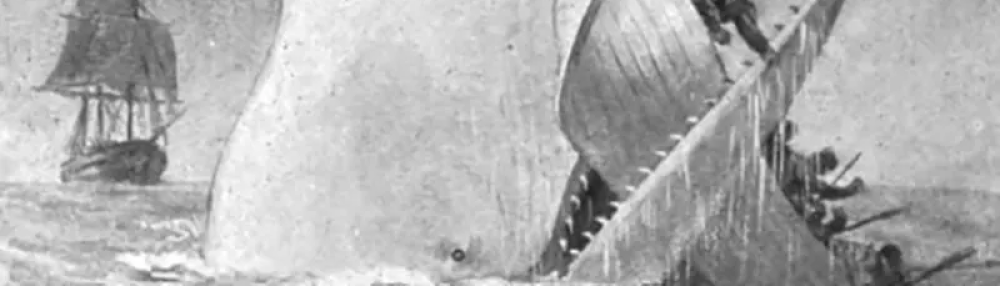
As I was reading through chapter 44, I came across this passage, which perfectly encompasses how much Ahab was truly obsessed with the whale he calls Moby Dick. Ahab describes the whale as if he knew the whale personally, and I thought that this bit shows how he has truly made hunting down this whale his entire personality and part of his life.

“That in the broad boundless ocean, one solitary whale, even if encountered, should be thought capable of individual recognition from his hunter, even as a white-bearded Mufti in the thronged thoroughfares of Constantinople? No. For the peculiar snow-white brow of Moby Dick, and his snow-white hump, could not be unmistakable. And have I not tallied the whale, Ahab would mutter to himself, as after poring over his charts till long after midnight he would throw himself back in reveries-tallied him, and shall he escape?” Chapters 44

Amidst the vast ocean, Ahab was in sight of one whale, which caused him to lose a part of himself, which then caused him to want to take vengeance upon the massive creature for the pain that he went through. That piercing whiteness of the whale, he will never forget, and will be part of how he can identify Moby Dick out traversing the seas. He knows the anatomy of this whale whale so well that it has been haunting him ever since. This causes him to even believe that he can spot the menacing white whale even if he is trying to blend in with other sperm whales that could be traveling nearby.

He details the anatomy of the whale, which he could spot from and knows is his nemesis, in the blink of an eye. The vengeance that is built up in him as he has traveled the oceans seeking out Moby Dick, with the marks he has left on him in the past encounters, to identify the creature to hunt him down to kill him. Ahab, with his charts, knows where this whale has gone, and he can still know this whale apart from the rest, and the image of this large ocean creature has not left his mind since that first sighting.

Ahab has shown us that his dedication to seeking out Moby Dick to kill him has the same mentality as when someone says I put my heart and soul into it. He has dedicated his life to hunting down this whale, and now he has encouraged his crew of the Pequod to help him seek out his ocean nemesis.