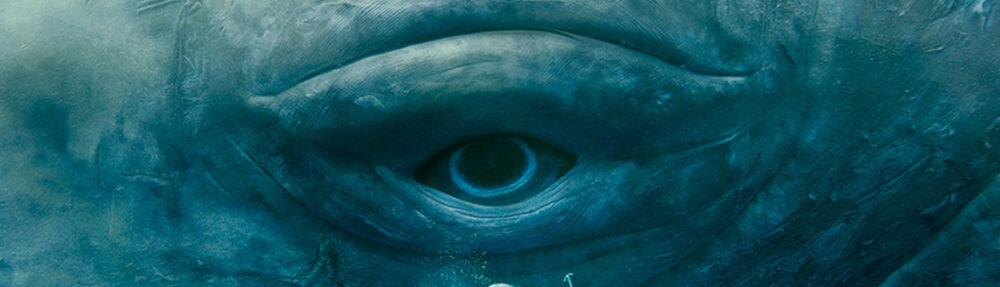
Essay Explaining My Painting (A Peaceful and Nourishing Moment)
In Chapter 87, The Grand Armada, Melville lulls us into a peaceful reverie by presenting a scene devoid of violence or obsession. Ishmael and crew come upon a pod of whales protecting a group of calves as they breastfeed. Despite a lack of female characters within the novel, there is a strong feminine presence in moments such as this that are scattered throughout Moby Dick. To draw attention to this scene and its importance, my creative project is an oil painting featuring the mother whale feeding her young, with the underside of the ship visible but not centered. These moments of feminine tranquility and tenderness serve a narrative purpose to show a mind-changing moment of peace and grace amongst the rest of the book, which is filled with rage, violence, and obsession. This shows that Ishmael’s views of the whales begin to change compared to Ahab’s monomaniacal focus on them, which leads him on this path. Although the presence of women is sparse in this book, Melville proves this with a moment of grace, a beautifully tender act of breastfeeding done by these creatures amid the violence they commit towards the whales throughout the rest of their journey aboard the Pequod.
As one reads through this large book, there is constant hatred, anger, and obsession seen through Ahab and Stubb aboard the Pequod as they traverse the vast oceans in search of Moby Dick. There are not many moments of grace or peace, where the characters are not ruthlessly killing these whales for profit, but Melville does give us this beautifully tender scene that takes the readers away from their manly obsession for a moment to show us peace and femininity amongst these men. “As human infants, while suckling will calmly and fixed gaze away from the breast, as if leading two different lives at the time; and while yet drawing mortal nourishment, be still spiritually feasting upon some unearthly reminiscence” (Melville 423).
This moment shows us that these whales are not just dangerous animals that are hunted for a commodity, but they are amazing creatures that are very intelligent and nurturing, like some humans. The men can see the peace that the whales were showing; they see the human-like qualities that they exude in that moment as they look overboard. “Human infants while suckling” and “drawing mortal nourishment” are descriptors of proving that the whale is breastfeeding, as a human child would. I wanted to illustrate the beauty of this scene that takes us away from the gruesome acts that these men were committing against the whales by making an oil painting of a mother sperm whale breastfeeding her calf, specifically using oil paint, as it used to contain whale oil back in the 19th century; they used every part of these whales to their advantage and this was one of them. A very feminine moment that the men aboard the Pequod get to see, which takes them away from hunting these beautiful creatures, to empathize with the whales for a moment before going back to killing them. Melville writes in the Grand Armada chapter, “For, suspended in those watery vaults, floated the forms of nursing mothers of the whales, and those that by their enormous girth seemed shortly to become mothers” (Melville 423). These whales were soon to be disturbed by Ahab and his desire as they drew near to this protective moment for them. It is peace amidst the storm of violence for these men to see this tranquil sight before their eyes. Seeing this act humanizes the whales to them as they can see that motherly act that a human would do, but it is the whale doing it for her calf.
Melville is trying to show us some peace before the violent acts towards these whales. “Though surrounded by circle upon circle of consternations and affrights, did these inscrutable creatures at the centre freely and fearlessly indulge in all peaceful concernments; yea, serenely revelled in dalliance and delight ” (Melville 424). As they gaze down into the watery abyss, these whales exhibit the femininity they don’t have on their ship. A moment when they watch these creatures perform an act truly beautiful. This is where Melville and our perception change, giving us a moment to see these whales’ nourishing act. “In this moment, our narrator’s vision becomes everyone’s (“our eyes as we gazed over the side”), and we (the reader included) finally see whales not as prey, commodities, or monsters but as living, loving, nursing beings” (Pressman). Melville again showed us that there was a moment of admiration among the men for what the whale was doing before helping the whale that was in distress in the harpoon lines, before Starbuck had sprung into action to help the whale. He wants the reader to see the difference in how these men can act in the situation at hand.
Throughout the entire book, Melville writes that there is a desire to gain as much as they can, and that way was through the whales, as they were seen as a big source of income within their capitalistic society. Only Ahab and his obsession with Moby Dick would stop them from making as much as they could. Philip Armstrong writes in his Leviathan is a Skein of Networks that, “Melville implies that these whales, even the mothers and newborn offspring, are simply resources waiting to be harvested. The comparison between cetacean and human reproductive and nursery habits, it has seldom been noticed that an economic imperative cuts violently through the idealized maternal imagery” (Armstrong). That brief moment of beautiful peace that the men saw would only be seen for a moment before they went after the whales again. Again, this moment of the mother whale breastfeeding her calf is showing us the beauty of what the ocean holds within, and that is what I wanted to capture with my art piece.
The shift of perception on these whales is what is crucial in this moment, the peacefulness, beauty, and tenderness of the whales breastfeeding before the violent acts committed against them for man’s desires. Melville shows that Ishmael’s view of these whales is changing, which can even include the reader’s as they continue the book. This small scene captures why these whales are so special and beautiful, which then goes back to the men hunting them down. This shows that something so beautiful won’t stop them from their progress of hunting these whales for profit; Capitalism does not stop for the vulnerable or the innocent. I wanted to capture that tender moment between the mother and baby whale in my painting, as it is a very important part of how one might begin to change their views on these misunderstood creatures that live in our world’s vast oceans.
Works Cited
Armstrong, Philip. “‘Leviathan Is a Skein of Networks’: Translations of Nature and Culture in Moby-Dick.” ELH, vol. 71, no. 4, 2004, pp. 1039–63. JSTOR, http://www.jstor.org/stable/30029956. Accessed 9 Dec. 2025.
Melville, Herman, Moby-Dick, or The Whale. Penguin Classics, 2003. Book. Chapter 87, page 423 and 424
Pressman, Jessica. “Moby Dick and Breastfeeding.” Avidly, 27 May 2021, avidly.org/2020/08/20/moby-dick-and-breastfeeding/. Accessed 08 Dec. 2025.


