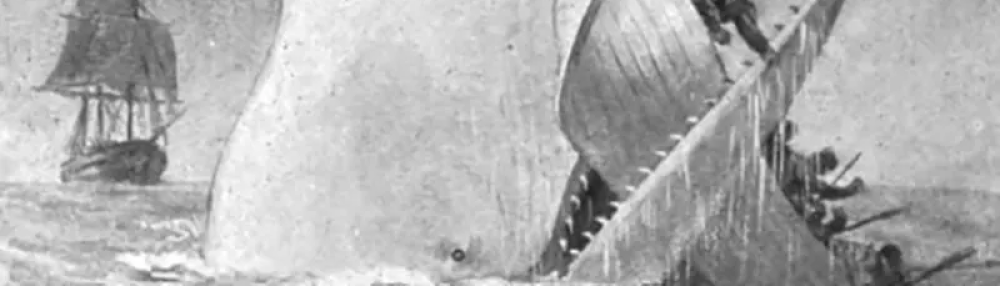
It is interesting to see the different extracts presented at the beginning of the novel and to see that various ways that humans try to understand the sperm whale. One quote that stood out to me states: “Mad with the agonies he endures from these fresh attacks, the infuriated Sperm Whale rolls over and over; he rears his enormous head, and with wide expanded jaw snaps at everything around him; he rushes at the boats with his head; they are propelled before him vast swiftness, and sometimes utterly destroyed.” (Currents and Whaling. U.S. Ex. Ex., 49) Every description of the whale in these extracts depicts it as a violent monster, even though the whales themselves are not inherently dangerous creatures – it is humans that bring out the worst in them. These extracts show us insight on what men were struggling with: the very idea of the whale.
In reality, these creatures are usually calm and placid, spending most of their time in the deep ocean, rarely interacting with humans. It is also important to consider early 19th-century whaling practices, which were both an economic necessity and a dangerous pursuit to men. They depended on these creatures to provide for them but also feared them, which can be contradicting. Humans go out of their way to hunt for these creatures then act shocked when they retaliate, painting them as a vicious monster when, in truth, it is humans who embodied monstrosity. This can be seen as a form of projection: men frame the whale as the aggressor rather than acknowledge int their roles as intruders, which reveals more about human arrogance than it does about fear of the whale itself.
This contrast between the whale’s natural behavior and the monstrous image that humans impose on the creature can possibly show a reflection onto what “Moby-Dick” has to offer. It will be interesting to see how humanity’s fear of the unknown and our tendencies to project violence onto the natural world plays a role throughout the novel.