Before Moby-Dick begins, Melville immerses the reader in a complex assemblage of borrowed voices that collectively attempt, yet ultimately fail, to define the whale. The Extracts contain scripture alongside scientific texts, poetic works, and folkloric material, which exist as an unordered collection of documents. The first chapter fails to explain the whale because it demonstrates how meaning develops through opposing concepts, yet people choose to place their anxieties onto objects. The whale exists as a cultural creation that emerges from the combination of broken language and human mental imagery. The different voices present their arguments, but none establishes absolute control; their combined statements demonstrate that people understand mysterious phenomena through the accumulation of stories rather than through personal encounters. The epistemological method that emerged in the nineteenth century continues to shape how society represents whales, oceans, and natural environments across various visual media, as exemplified in the modern Extracts of this project. The Extracts function serves as an innovative starting point that facilitates the acquisition of enduring knowledge through the ongoing addition of information, rather than by seeking complete accuracy.
The Extracts section serves as an introduction, examining the core elements that define knowledge. Melville unites biblical texts, scientific writings, and poetic passages to create a vessel that reflects human curiosity across historical periods. The three quotations work to establish the whale’s stability by attempting to classify it and by creating mythological narratives. The two sets of voices create opposing forces, thereby diminishing their credibility. The growing collection shows how language becomes ineffective at conveying its intended message when it tries to do so. Meaning arises not from any single perspective, but from the interplay and tension among them. In Melville’s work, the whale is defined through his method, which presents it by highlighting its differences and opposing elements, helping readers understand it through its resistance to clear interpretation.
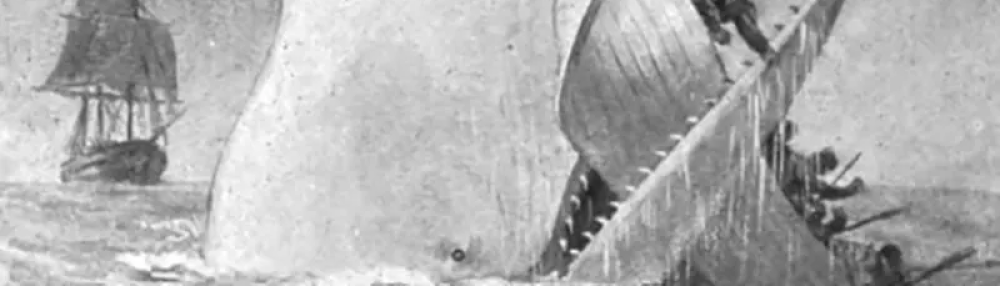
A particularly notable moment in the Extracts occurs in Miriam Coffin or the Whale Fishermen, where the whale momentarily emerges from the accumulation of language as a manifestation of pure force. The passage, “Suddenly a mighty mass emerged from the water. Shot up perpendicularly into the air. It was the whale” (Melville, l), condenses the whale’s presence into a sudden display of motion and weight. The abrupt, fragmented syntax mirrors the shock of the encounter. The phrase “mighty mass” emphasizes the whale’s scale rather than its identity, while the terse statement “It was the whale” functions less as an explanation and more as an instinctive response, suggesting that language follows awe rather than precedes it. In this instance, description does not confer mastery but instead reveals its limitations. The whale is depicted as a force that briefly disrupts the surface before returning to obscurity, enacting an encounter with the sublime where observation falters and naming becomes an expression of astonishment rather than comprehension.
While Miriam Coffin depicts the whale as a sudden eruption of physical power, Whale Song transforms that power into an object of reverence. The passage begins with the exclamation “Oh, the rare old Whale” (Melville, li), immediately shifting the tone from shock to awe. The transition from prose to verse alters the perception of the whale; rhythm and repetition elevate it from a mere animal to a symbolic presence. Verses such as “A giant in might, where might is right, / And King of the boundless sea” present the whale as a sovereign figure whose dominance is portrayed as both natural and justified. Here, power is equated with legitimacy. What was once overwhelming is rendered dignified, as language shifts from expressing fear to expressing admiration. Positioned at the conclusion of the Extracts, the song does not seek to explain the whale but to honor it, indicating that when language reaches the boundaries of comprehension, it turns to praise rather than certainty.
Taken together, these extracts chart a progression from confrontation to myth, illustrating how human language transforms the unknown into something bearable. The whale transitions from a manifestation of raw physicality to a figure of sovereignty, from a destabilizing presence to a symbol of order. The different voices in Melville’s work create an orchestral composition that produces meaning through their combined effects rather than through exact factual information. Comprehension develops from emotional and cultural elements rather than through direct knowledge acquisition. Language functions to do more than describe natural events, as it allows us to create narratives about enigmatic phenomena, which we arrange into significant patterns based on our personal experiences of wonder.
Melville’s fragmentary approach parallels the epistemological perspective advanced by Ralph Waldo Emerson in The American Scholar. Emerson rejects knowledge derived from the passive reception of inherited systems, arguing that understanding arises from personal experience with diverse sources of information (Emerson). The Extracts demonstrate this principle through their organized structure, which follows a logical sequence. The whale becomes a subject that demands intellectual humility rather than mastery because Melville avoids using a single explanatory framework. The knowledge system operates on provisional information, which people construct by piecing together different parts rather than seeking certainty through official authority.
Resistance to this method is both theoretical and historical. As O. W. Riegel observes in The Anatomy of Melville’s Fame, early critics evaluated Moby-Dick by strict standards of unity and coherence, deeming it deficient precisely because it defied these expectations (Riegel). What unsettled readers was not merely Melville’s subject matter, but his rejection of interpretive closure. The Extracts contravened critical desires for order, demonstrating that meaning is not found in tidy forms but in the reader’s ability to navigate instability. Riegel’s analysis indicates that Melville’s approach anticipated a broader cultural shift toward understanding knowledge as contested and provisional rather than absolute.
A similar logic underpins the modern Extracts compiled in the video. The current media depictions of whales in films, television shows, video games, and animated content present conflicting images that combine fear and respect, violence and admiration, but fail to create a unified reality. The whale remains unclear in these representations because they reveal the cultural factors that shape its interpretation. The inclusion of titles and dates in the fragments establishes their historical context, demonstrating that media formats change, yet people continue to create myths about the unknown.
Collectively, Melville’s Extracts and their contemporary counterpart demonstrate that the whale continues to serve as a projection surface for humanity’s uncertainties regarding nature, power, and knowledge. Instead of providing clarity, both collections emphasize instability, reminding audiences that understanding arises not from domination or categorization, but from an awareness of the limitations of human perception. By maintaining contradiction rather than eliminating it, the Extracts encourage sustained engagement with the unknown, fostering an interpretive process that resists closure.
Works Cited:
Emerson, Ralph Waldo. The American Scholar. 1837.
Melville, Herman, and Andrew Delbanco. Moby Dick, or, the Whale. Penguin Books, 1992.
Riegel, O. W. “The anatomy of melville’s fame.” American Literature, vol. 3, no. 2, May 1931, p. 195, https://doi.org/10.2307/2919779.
