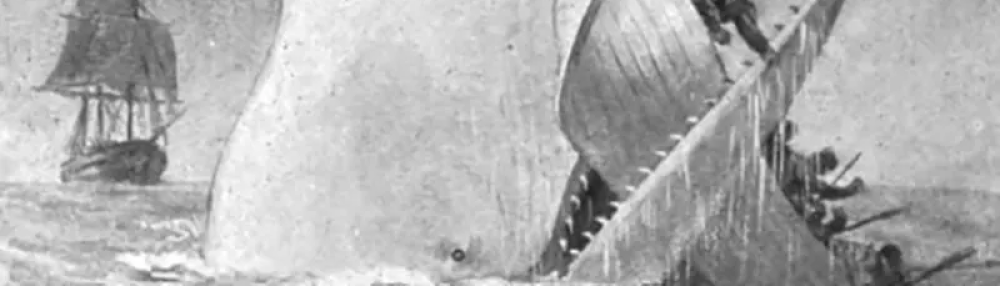
Considering the Loose-Fish doctrine and the whiteness of the whale acting as a blank canvas for Ahab to project upon “all that most maddens and torments… all evil” (200), you can see how vain and piteous Ahab’s final curses upon Moby Dick are: “Towards thee I roll, thou all-destroying but unconquering whale; to the last I grapple with thee; from hell’s heart I stab at thee; for hate’s sake I spit my last breath at thee” (623). Having finally arrived at the expected point, watching his ship perish without him, knowing his death is imminent, he, for the last time, resigns himself to the obsession that set him on this voyage because it is all he knows. Even though we, along with Starbuck and other characters, don’t view the whale as malicious but rather as a dumb brute, Ahab is firm in his declaration that Moby Dick is “all-destroying but unconquering.” This refusal to be “conquered” in his final moments is Ahab’s last attempt at claiming Moby Dick as his Loose-Fish. If Ahab convinces himself that he is righteous in this endless hunt, which he has done throughout the entirety of the novel, he is justified in his own mind to continue walking down the doomed path, no matter the deaths he is responsible for. By piercing Moby Dick with his final curses from hell’s heart for hate’s sake, Ahab willingly condemns himself as a martyr; but Ahab is no martyr in the way he desired. Rather, he is a warning to America of this unrelenting chase towards one thing built upon a vain justification. Ironically, Ahab has become the Fast-Fish, fastened to the whale, tied to “all evil” (his own words), even after death.
Tag Archives: Fast-Fish
Fast-Fish, Loose-Fish
“I. A Fast-Fish belongs to the party fast to it. II. A Loose-Fish is fair game for anybody who can soonest catch it” (433).
In the chaotic business of whaling, it’s necessary to have the code of Fast-Fish and Loose-Fish to avoid disputes over who deserves the claim of killing whichever whale. Melville applies this whaling code of Fast-Fish and Loose-Fish to “the fundamentals of all human jurisprudence” to show us how weak our justifications of possession are. Melville starts with: “What are the sinews and souls of Russian serfs and Republican slaves but Fast-Fish, whereof possession is the whole of the law?” (434-35). He is directly arguing against the claim that “possession is half of the law” by giving multiple examples that contradict it, the first being the serfs and slaves that are literally bound to their masters, serving as their property. The Loose-Fish doctrine is even more applicable as the chapter ends presenting more abstract ideas as Loose-Fish:
“What are the Rights of Man and the Liberties of the World but Loose-Fish? What are all men’s minds and opinions but Loose-Fish? What is the principle of religious belief in them but a Loose-Fish? What to the ostentatious smuggling verbalists are the thoughts of thinkers but Loose-Fish? What is the great globe itself but a Loose-Fish? And what are you, reader, but a Loose-Fish and a Fast-Fish?” (435).
With all of these being Loose-Fish, fair game for whoever can soonest catch it, it raises questions about their legitimacy. If the Rights of Man and Liberties of the World were just up for grabs, we need to know who caught them and whether they had some bias in crafting them. If our minds, opinions, and beliefs are Loose-Fish, we need to be aware of whoever laid claim first, because they can often shape our entire thoughts and belief systems. Melville calls out the “ostentatious smuggling verbalists” as they seize “the thoughts of thinkers” to manipulate for their own purposes as though they were Loose-Fish. The globe itself has repeatedly, throughout history, been viewed as a Loose-Fish for colonial powers and empires to claim for themselves behind their Loose-Fish justifications of divine right or Manifest Destiny. Then we have Melville directly asking us readers to view ourselves as both Fast-Fish and Loose-Fish, fastened to the systems we are born and raised in, yet fair game to whatever outside influence we let catch us. If we should be both, then we should also be weary of the distinctions of Fast-Fish and Loose-Fish applied to others, realizing how absurd it is to blindly follow the claims to land, property, thoughts, and people.