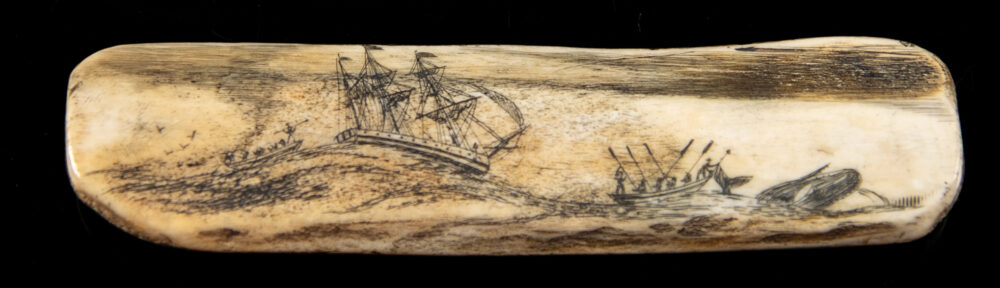
Power. Intention. Madness 

In the chapter leading up to the chase, it’s evident that Ahab is slowly becoming more and more maddening as time passes and they have yet to complete their mission. However, at the very sight of the whale, the object of his desire, he seems almost more insane than before. 

“And did none of ye see it before?” cried Ahab, hailing the perched men all around him. “I saw him almost that same instant, sir, that Captain Ahab did, and I cried out,” said Tashtego. “Not the same instant; not the same—no, the doubloon is mine, Fate reserved the doubloon for me. I only; none of ye could have raised the White Whale first. There she blows! there she blows!—there she blows! There again!-—there again!” he cried, in long-drawn, lingering, methodic tones, attuned to the gradual prolong-ings of the whale’s visible jets.

In this sentiment, Ahab displays his erratic behavior in the manner that he speaks, continuously repeating himself in tandem with the whale. Almost as if he’s formed a parasite-like relationship to the whale itself, even claiming that “Fate” had a hand in their coming together again. This one-sided connection he feels to the beast shows the depth of his obsession. Leaving the world of the physical all together, when attributing this mission to “Fate.” 

In addition to this madness, there is also Ahab’s power and intentions to consider. At the beginning of the ship’s departure of their original mission to Ahab’s–the appeal in such a turn in monetary terms. Ahab offers them money and glory in return for their service, using this driving competition to fuel their mission.

However, once they finally come upon the beast, Ahab claims the find as his own, with the intention of keeping the doubloon for himself, claiming “fate” as the result of this action. In this scene it’s clear that Ahab never really did have the intention to pay someone to kill the Whale, instead it was utilized as a ruse in order to get them to follow his order. Using the promise of money as power, but in this scene that is unraveled by this confession. Through the illusion of power, Ahab was able to trick them into doing his own bidding and effectively leading them to their deaths. 

Blame God

Reading Starbuck’s last plea to Ahab in “The Symphony” was very disheartening because we know that Ahab couldn’t be swayed from his crusade. Starbuck, the voice of reason, or our symbol for “we the people”, is practically begging to change course back to Nantucket, but his words fall on deaf ears as “Ahab’s glance was averted; like a blighted fruit tree he shook, and cast his last, cindered apple to the soil” (592). Ahab can’t even bother to look at his first mate during his request, “blighted” by whatever this force is that keeps him on his mission, the “last, cindered apple” of any hopes of salvation now gone from him. We had the first confrontation in the Cabin just last week, but this is the final moment when the captain turns his back on his people, hardly listening to them as he leads the Pequod to their doom. I know it was present throughout the novel, but this scene of Ahab’s final soliloquy before The Chase felt the most like Shakespearean tragedy as we, with Starbuck, just want him to stop, but we know it won’t happen, and can only watch as he broods over his so-called fate, questioning whether he even has any agency or he’s just a puppet of God:

“Is Ahab, Ahab? Is it I, God, or who, that lifts this arm? But if the great sun move not of himself; but is an errand-boy in heaven; nor one single star can revolve, but by some invisible power; how then can this one small heart beat; this one small brain think thoughts; unless God does that beating, does that thinking, does that living, and not I” (592).

In giving up his agency, claiming that it may just be that God is moving him on this path, Ahab is reassuring himself that this is just the way it has to be. If the great sun that allows us to live doesn’t have control over it’s actions, then why should Ahab’s small heart and brain have any power? So Ahab assigns himself to what he believes to be his fate, despite the consequences it will have for the people he is responsible for. Placing the responsibility on a higher being is a way for him to excuse his actions that he knows will not bear the fruit he wants (where have we seen that before?) Despite the countless warnings and pleas from other ships (and Starbuck) and ill omens and prophecies, Ahab, or rather God, in his eyes, cannot be moved. By assuming divinity, Ahab prevents any alteration towards a better outcome for the nation state of the Pequod, leaving the people “blanched to a corpse’s hue with despair” (593).