Final Project Proposal

For my final project, I think I have finally decided on utilizing my second close reading essay and expanding on the themes and ideas of complicity that exist throughout the novel. My argument is going to revolve around the way in which Melville presents complicity through the characters and how he uses it in a way that is so representative of the complicity that resides within the American population.

At the moment, I think I am going to just be writing a 6 – 8 page essay, however, I really do want to do something creative so if inspiration hits me that might completely change.

Final Project Proposal

Final Project Proposal: I really want to elaborate on my second essay about illumination and how Melville uses whale oil and whalers to reflect on the actual cost of what humans are doing. The contradictions between whalers bringing the light to society while living and acting in the darkness. The whalemen are shown to be both creators and destroyers, and Melville shows quite clearly (ironically enough) that the line between these two is often quite blurry and hard to distinguish.

My thesis is going to argue that a whaleman’s very “life of light” is both his glory and his doom, always tied closely together. I will show this not only through the actual content of the novel but also through the physical grammar and syntax that Melville chooses to use through its structure and rhythm. “What begins as just a factual observation about whale oil, which happens to be the literal “food of light,” expands into a moral and metaphysical reflection on the cost of illumination itself. Melville’s language transforms physical light into a spiritual metaphor, complicating the whaleman’s apparent purity by revealing the violence and destruction that make such light possible in the first place.” 

Through this creative project I will be demonstrating this argument in an expanded essay of at least 6-8 pages with multiple sources such as Steve Mentz’ articles on the study of blue humanities. I chose this format because it gives me enough space to trace Melville’s symbolic patterns and connect them to broader environmental and ethical questions.

Slightly Belated Final Project Proposal – Oops, my bad!

I realized that, belatedly, I had posted both my post about what I need to learn for the final project and my project proposal into one. To remedy that, here’s the isolated bits:

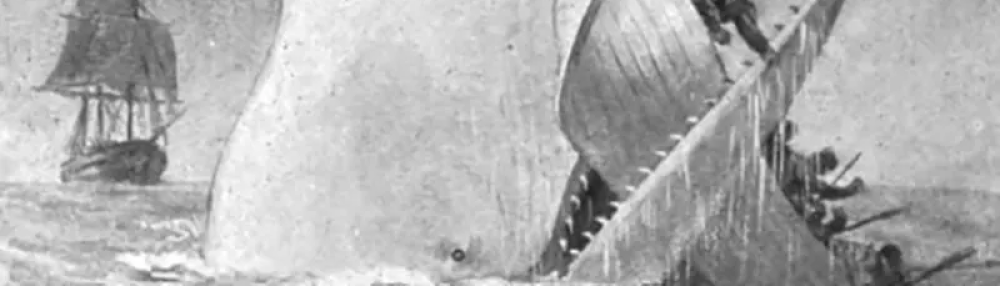
For the creative project, I found a beautiful set of book ends that are the head and the tail of a sperm whale. I am taking the head and using Paper-mâché to envelop it in every page from Chapter 42, along with the literary sources I’ve pulled from for my essay and some additional items; I have the forehead read “It was never about a whale,” having the audience read the brow of the creature for the central interpretation of Moby-Dick. I will have them as the literal book ends on a copy of Moby Dick – as though the whale itself and the meaning inscribed within it is too big for the novel to even contain. This works as a kind of physical manifestation of what people perceive Moby-Dick to be about, wrapped in the chapter that is the most well known of the book.

Through this project, I argue that Melville uses the whale to critique the expectations readers bring to the symbols – showing that the whale is never simply a whale, but a surface onto which meaning is compulsively imposed. The whiteness that terrifies Ishmael arises not from the animal itself but from the human impulse to project significance onto what fundamentally resists understanding. By wrapping the whale in the physical text of Chapter 42, my artwork materializes Melville’s insight that the White Whale’s terror is generated through the very act of interpretation.

My two scholarly sources are Mary Blish’s The Whiteness of the Whale Revisited and Michael C. Berthold’s Moby-Dick and the American Slave Narrative. Both of these sources play with the concept that “Whiteness” is wholly interpretive yet also rife with pre-existing interpretations of the time. Nothing can be divorced from the history surrounding it.
Final Project Proposal

For my final project, I will be discussing about the psychological tension, obsession, trauma, and inner conflict, specifically, in these three characters: Ahab, Pip, and Ishmael who go through massive evolutions of trauma and psychological problems in the story. I have always being interested on how the mind works in mysterious ways and just discovering on how mental health was back centuries ago and not fully understanding it makes me astonished.

Thesis: Herman Melville uses Ahab’s obsessive monomania, Pip’s traumatic experience psychological break, and Ishmael’s existential crisis to explore how unaddressed mental health struggles not only shape that person’s inner conflict. Melville illustrates three different psychological responses to suffering, eventually suggesting that mental health struggles form the moral and narrative course of Moby Dick. 

Final Essay Proposal

For this project, I will argue that Herman Melville constructs the Pequod as a microcosm of nineteenth-century American society, a confined world where racial diversity, economic ambition, and hierarchical authority collide. Using Ishamael’s description of the ship as “a Quaker ship manned by races the most dissimilar”, this essay will show how Melville compresses the contradictions of American democracy, capitalism, and power into the ship’s tight social structure. By compressing these contradictions into the tight space of a single ship, Melville suggests that the forces shaping American life—its diversity, its capitalist motives, and its susceptibility to authoritarian power—are internal structures individuals carry with them, making the ship’s eventual destruction a symbolic warning about the nation as a whole. The purpose of this essay is to demonstrate how close reading can reveal the political and cultural stakes embedded in literary form, especially when texts use constrained spaces, i.e the Pequod, to model larger social dynamics. I plan to present this work as a traditional written essay. This project reflects my ongoing interest on how literature critiques systems of power and represents social complexity. 

Final Project Proposal

For my final project, I will be painting a scene of whales breastfeeding! I was inspired by chapter 87, The Grand Armada, and Professor Pressman’s article on breastfeeding to make this for my final project! I am currently almost done with the painting, I just need to add some final touches, and I could bring to to class on Thursday to show!

Along with the painting, I will be writing the paper explaining why I chose this subject in particular. I wanted to analyze the aspect of the feminine nature of the ocean and the beauty of the whales breastfeeding in this moment, as the rest of the book is filled with violence of harming these beautiful creatures for what they can get from them.

Thesis: Despite no feminine presence aboard the Pequod, the vast oceans hold some of the most beautiful feminine nature within. Seen in chapter 87, The Grand Armada, we read of a beautiful scene of sperm whales that even describes nursing whales exuding a beautiful, tender moment of a womanly presence and act, breastfeeding! Although the presence of women is sparse in this book, Melville does grace us with a motherly nature in the ocean seen by these misunderstood creatures amid the violence they commit towards the whales throughout the rest of the book.

Final Project Proposal

For my final project proposal, I wanted to analyze the symbolism of the fossil whale, or the whale as an artifact and history, through an essay. As stated in the asynchronous peer review, I’ll discuss the implications of Ishmael’s description of the whale as an archaeological site, both as living and as dead (fossil). My focus will be on ch104: The Fossil Whale. I want to emphasize the conversations on history that are had in this book, the deconstruction of what counts as history, what gets told, and what gets tossed under the rug of time.

Thesis: Ishmael discusses the validity of the ‘American’ historical canon through the body of the whale, or “the fossil whale”. Whales have a deeper connection to the scope of American history as a continent, especially to the original hunters before colonization (the spear found in a whale). As a fossil, the whale is borderless, traversing the watery world, and leaving its print among the land, part of a momentary recession of the waterline. The whale, in this sense, dismantles the American idealism of permanence and ownership over a continent during an age of border expansion.

Final Project Proposal

I’ve not yet managed to reword my thesis, but the basis behind the final essay revolves around questions of how to “read.”

Thesis: Through the use of (my creative project) and a passage from chapter 79 “The Prairie”, the grand animal encapsulates the incapability of the human mind to decipher the creature. Melville utilizes the whale and its brow as a symbol of unknowingness. This then poses a criticism towards flawed sciences and a reconfiguration of philosophy.

Essentially, what I am trying to convey is the way Melville talks about the sciences and philosophies behind “reading.” We’ve come to understand that phrenology is a flawed science from this era, but in addition to that, there is also the science behind animal classification. I plan on utilizing the whole “read my brow” section within The Prairie chapter. Alongside my Halloween costume (yes I’m sure you all know the one), it made me think about the fact that we’re still actively kind of “reading” things. How do we know what a whale is, how do we assume to know what a whale thinks, does the whale’s brow mean anything to it, it’s questions like these that make it seem like Melville has something more at play despite the short chapter. The novel has a focus on the inscrutable and unreadable towards nature, and I think it makes a statement that science and philosophy is not a perfect thing. It’s flawed and still actively changing, even now. Albeit, many people still stick to the popular customs and rules of either practice because that is just the grander consensus.


Final Project Proposal

For my final essay/project, I am going to discuss the issues of coerced obedience and vain unity within Moby Dick. I have not fully collected all of the chapters/sections I will be pulling from, but I know I will be using Ahab’s monomaniacal leadership and the idea of the Pequod as a “nation-state” as part of my evidence. Using these important themes throughout the novel, I intend to tie Melville’s underlying themes about the eroding democracy of the United States and the rise of extremist, centralized thinking within the states that leads to a greater division amongst the North and the South (and Africans and Europeans).

I am still deciding whether or not I just want to write a formal essay about my proposal or if I should bother with a creative piece to tie into it. I tend to take too much time on the creative aspects of a project rather than the writing itself, but I think a creative piece will really tie into my argument how the novel comes across to the reader, especially a reader of color who was both directly and indirectly affected by the horrendous acts of the United States during the late 19th century and somewhat (because this is a close reading and we are not focused on the now) how some of the themes are very applicable in current day.