Philip Hoare’s article, What “Moby Dick” Means to Me, is an excellent read that creates a sense of excitement and anticipation for reading Herman Melville’s epic. Beginning where many of us have been, Hoare takes us through the defeat and the disinterest young readers may experience when first attempting to read the experimental novel, beginning his article with “For years, “Moby-Dick” defeated me.” As he began to describe the sensation of watching the movie, of the building anticipation around his successful reading of the novel, it incited a curiosity within me.
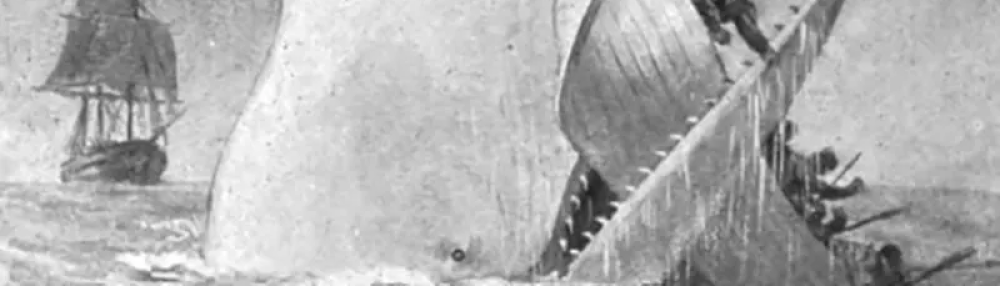
Hoare, towards the tail end of the essay states, “Now, as I pick up “Moby-Dick” again, prompted by Philbrick’s provocative book, I’m reminded of a salutary notion: that the whales that inspired Melville were around long before us, and may, with luck, outlive us, too.” Exactly how large are these majestic, eternal creatures that spawned an entire industry and later the first American novel? According to Wikipedia, in Moby Dick Sperm Whales are said to get 90ft in length, with titular whale being the largest they had ever seen. Let’s guess that means it is around 100ft.
A school bus is roughly 35 feet long. This would put Moby Dick at 5ft shy of 3 school buses in length. If that’s hard to conceptualize – some of us have not been near a school bus for quite a few years – then consider the size of the average movie theater screen. They range from 45 to 65 ft in length. On the smaller side, that would mean that Moby Dick would roughly be 10ft longer than two movie theater screens. From that standpoint, this whale would certainly command the presence and obsession of any man.
Beyond the whale, as large as it is, there is the beautiful prose that the novel inspires from Hoare to consider. With lines in the article such as, “Few books are so filled with neologisms; it’s as if Melville were frustrated by language itself, and strove to burst out of its confines,” is it any wonder that this novel has inspired the imaginations and fear of the world over? I just picked up my hold on Philbrick’s Why Read Moby-Dick? from the San Diego Public Library system and I am incredibly excited to find even more reasons to look forward to this semester’s central story.
