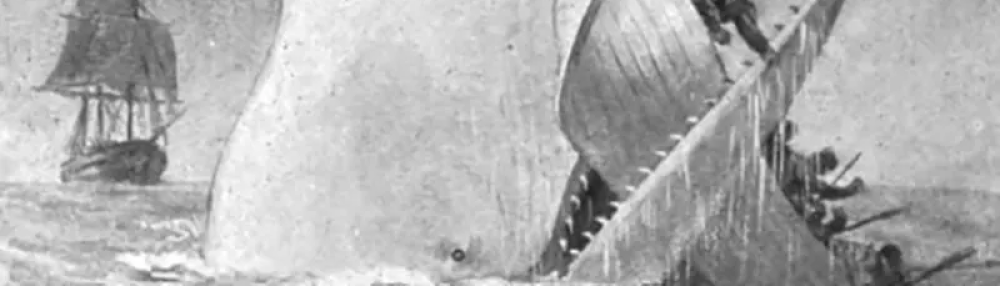
It was through the tireless efforts of whaling and the pursuit, harvesting, and selling of whale bodies, namely spermaceti, that the newly born United States grew to be an economic and worldly powerhouse. Upon the worn wooden decks of American whaling ships, held sailors who, dedicated to the opportunities that a successful chase ensued, waited with bated breath and watched with eager, sea-splintered eyes for victims. The excitement of the hunt dominates the majority of the focus throughout Herman Melville’s Moby Dick, whether it is through a detailed depiction of the harpooning process or the loud, moment-to-moment account of the happenings of each person; the chase is narrated in rushed, keen tones. However, while the pursuit of a whale ends in profit, in the jars, pots, and head-topped boilers, it also ends in death and loss – the negative consequences that are often left unaddressed and unconsidered.
When it is considered, the losses that occur in the pursuit of whales and profit, it is hardly done with an emphasis on the whale or the victim. This part of whaling, the cost of life that is required for human profit and capitalistic pursuit, is hardly acknowledged, except for one moment. In chapter 87, titled “The Grand Armada,” the Pequod encounters an extraordinary “armada” of whales and, in the tireless pursuit of the hunt, gets trapped in the very center of the group, emerging in a still, gentle calm. Beyond the depiction of this massive grouping, or school, of whales as a naval battalion organized and ready to fight, Ishmael looks down, interrupting our maritime warescene and taking a breath. It’s in Ishmael’s recognition of “the women and children of [the] routed host” of this whale formation that Melville deliberately pauses, taking the reader’s focus away from the battle drum of the great Leviathans and instead, peering into the watery realities of female and young whales (Melville 423). At this moment, Melville encourages readers to reflect on the cost of whaling and its impact on those affected, touching on and critiquing the broader moral implications of humanity’s capitalistic pursuits through reflections on motherhood, youth, and the consequences of loss.
It is in the chase of whales and the drumbeat of the pursuit that Melville forces the focus away from the single considerations of the possibilities for monetary gain from killing and harvesting a whale to not only reflect on the water around them, but make eye contact with the very beings that exist in it. Almost as if, in this moment, Melville is encouraging the reader to remember that it is a life that you are pursuing, and to recall its origins and how it came to be. Remember that it too has a mother and children, that it lives a life bigger than being the pursee of opportunistic capitalist gain. This reflective moment is not a stance against whaling or capitalism as a whole, but rather a radical encouragement of empathy and awareness in consumption.