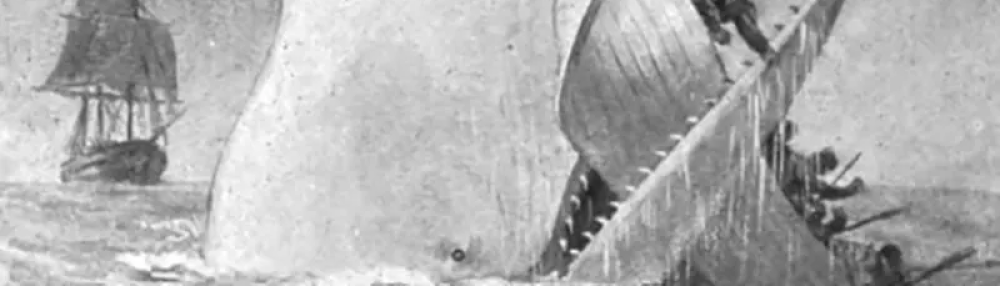
In chapter 100 of Moby Dick, there is an introduction of another captain who also lost a limb from the whale Moby Dick. In his case however, the limb that he lost was his arm not his leg like Ahab did. During the discussion of the infamous sperm whale, it becomes evident to the other captain and outsiders that Ahab’s anger towards the whale is very irrational and crazed. Melville uses the contradiction of the two captains who share a similar experience but yet have a different reaction towards the whale as a learning lesson. In which two people can go through the same experiences yet the mindset in which they have will be determined from how they feel they were affected but that experience.
To begin, Melville introduces another captain, Captain Boomer, as a man who also lost a limb from the Moby Dick as well. However for this character, the lost limb is from the upper half of the body. Losing an arm is different from losing a leg, both tragic of course, but imagine being pushed down without a leg? It would be quite difficult to get up without help. Now imagine being pushed down without an arm. It would seem to be a lot easier to get back up because the strength from your other limbs will help in returning back to stability. That is exactly what Ahab lost, stability, not only physically but mentally. During the discussion of the capturing of the sperm whale he asks the captain boomer if he was able to catch him the second time he saw him, to which he responds, “Didn’t want to try to; ain’t one limb enough? What should I do without this other arm?”(481) Captain Boomer cannot fathom why he would want to try again because he could risk losing another arm and to be without one arm is already bad enough. He emphasizes this to Ahab as is it something that he can relate to and is wondering why he should jeopardize himself like that again for he knows that in comparison to the bite of a whale, he simply cannot compete.
Captain Boomer continues with, “And I’m thinking Moby Dick doesn’t bite so much as he swallows.” (481) Boomer believes that the bite form the whale is not within the same context of satisfactory as it might be for other animals and as it is for humans when eating their favorite food. If the whale had wanted to hurt a human with intention it would have gone in for a second bite, it could have easily devoured the human considering the difference in size. With the back up of his crewmate Bunger saying “…it is quite impossible for him to completely digest even a man’s arm? And he knows it too. So that what you take for the White Whale’s malice is only his awkwardness.”(481) Bunger further attests to the belief that the whale’s bites are not ill intended, for his “awkwardness” is just being a whale. It is part of being a whale and should have been taken into consideration when whaling. Apart from adapting to the ocean, whalers are to consider the living beings in their home. The ocean is the home of the whale and the men on the boat are invading their boundary by not only being there but in their attempt to capture them for human benefit.
The difference between these men and Ahab’s beliefs is evident through their conversation and during the end of the conversation Ahab still insists that “But he will still be hunted, for all that. What is best alone, that accursed thing is not always what least allures.”(482) Ahab feels a huge amount of anger towards “thing” and is compelling him like a magnet to find him and punish the whale. For Ahab to say “still be hunted, for all that.” even after the other captain shared his experience with the whale it shows that the conversation did not have any affect on him. He did not get any clarity to stand back on his revenge, if anything it only amplified it for him. Ahab decided to add the loss of limb from another captain to the mental list of reasons why is seeking this whale. His anger is so strong that Bunger even points out, “this man’s blood—bring the thermometer!—it’s at the boiling point!—his pulse makes these planks beat!—sir!”(482) These men are terrified to even see the anger vibrating off Ahab just from talking about the creature. The captains do not see eye to eye in regard to this situation and while one of them shares compassion for the whale and is at peace with not pursuing the capture of Moby Dick, Ahab is not on the same page. Melville captures the feelings on paper in a way to make the readers understand just how much of a difference the circumstance can be for each individual regardless of a shared experience.
There is an irony of this chapter where humans express pushing the boundaries of the beings that live in water and when they face the consequences such as the bite, a naturality of being a whale, some feel angered while others don’t. Even though the two characters went through similar experiences does not mean that they will react the same to the situation. Especially considering the circumstances for Ahab who lost a leg and cannot stand on his own without the help of someone else or with his ivory leg whereas Boomer can stand on his own even with the loss of his arm. The instability is evident not only in Ahab’s physical but also his mentality. Disability is a very difficult matter to deal with and it can evidently take a toll on one’s mental health, driving them to madness and anger.