”What Moby-Dick Means to Me”

While reading Hoare’s article, it made me more eager to get started on Moby Dick. This man hypes up Melville and shows major appreciation for the novel. So, I am very excited to begin reading it. 

In Hoare’s article, he writes that Moby Dick should not be treated as a regular novel because it is more than just words on a page. It allows the audience to gain a better understanding of the relationship between man and nature. He says “It’s more an act of transference, of ideas and evocations hung around the vast and unknowable shape of the whale, an extended musing on the strange meeting of human history and natural history.” Moby Dick makes the reader conscious and encourages the reader to think deeper on what the whale exactly stands for, and what man’s relation with nature can be like. The relationship between man and nature can be seen as obsessive for example. But it is entirely up the reader to interpret the story and characters how they see fit. I know for me personally, figuring out what means what and trying to figure out the deeper meaning can be difficult sometimes. Another thing I wanted to add is, I find it interesting how Moby Dick is open for interpretation. In some previous English classes, while reading a book, the teacher usually gives us the main point or theme of the story and I had to find evidence to back that point up. However, I am interested in seeing how I navigate this novel and seeing what I take from it. 

Hoare also states that Moby Dick “stands both as a historical reference for the great age of Yankee whaling and as a work of imagination in which whales become avatars as much as they are real animals.” In the 19th century, whaling was a big deal and whale oil was a hot commodity. So, Moby Dick is also able to provide major historical context. Even though it is fiction, you can still get an idea of what whaling was like and of what sea life was like then. Also seen in this quote here, Hoare mentions using your imagination for the whale and seeing what they represent. And, while yes, Moby Dick is a work of fiction, the fictional characters can symbolize and mean much more rather than being seen as just an animal/person. 

What “What ‘Moby-Dick’ Means to Me” Means to Me

I know that this post falls after the deadline, but I’m writing it more to jot down my ideas and key takeaways from the readings and see if anyone else can relate. When Hoare wrote that “‘Moby-Dick’ is not a novel,” but “an act of transference, of ideas and evocations hung around the vast and unknowable shape of the whale, an extended musing on the strange meeting of human history and natural history,” it kind of clicked for me. It reminds me of our first day of the semester, when most of us were confessing to feeling overwhelmed before even starting the novel. Hoare’s comment connects to how Melville, as an author, didn’t write the novel as just a book, but a time capsule of the ideas of the 19th century. Emerson, whom we’ve talked about influencing Melville, urged 20th-century scholars to think for themselves and to work towards intellectual development constantly. This singular quote from this article began a domino effect on how to better approach Moby Dick as an intimidated reader. Instead of reading Moby Dick as a novel like Pride and Prejudice (where the details aren’t elaborated on too extensively and it’s very specifically plot-focused instead of detail-focused), it’s meant to be interpreted, not merely clicked off on my Goodreads “read” shelf.

Thinking about language

I love literature because it inevitably gets you thinking; about life, yourself, humanity, love, and so on. I also love it because the same work can mean entirely different things for two different people, or, on the flip side, help to people realize they had more in common than they thought. In that sense, reading Philip Hoare’s article makes me happy, because it shows his appreciation for this work. Phrases like, “Few books are so filled with neologisms; it’s as if Melville were frustrated by language itself, and strove to burst out of its confines,” prove my point. We don’t actually know if Melville was frustrated by language and thus invented a bunch of words, but the fact that he does is worthy of note. The invention of new words as a result of frustration is a cool concept and it gets me thinking about how language constrains our understanding of the universe. Language shapes the way we think, but it has limits; and even as someone who is bilingual, sometimes not even two languages are enough to express everything I think and feel. Anyway, I’m excited to learn some new words I’ve never seen before through this book, and hopefully they make their way into my vocabulary to help with that feeling of restriction I sometimes find myself experiencing in terms of language.

Melville was a genius (and maybe a time traveler)

After reading the article, “What ‘Moby-Dick’ Means to Me” by Philip Hoare, I’m convinced that Herman Melville was a genius who was way ahead of his time (which is why he could also be a time traveler). This article really gave me great insight into the novel and Melville himself, and learning of the influence that the novel has far after Melville passed away shows that his work has clearly reached across many different generations. It was fascinating to learn that a prow had to be built on the pulpit in the New Bedford Bethel because of how many people were expecting it to be there after reading Moby-Dick. The amount of detail that is contained within the novel is also something I’ve heard so much about, both in this article and in class, and it really shows how much effort Melville put into his piece of art.

In the article, Hoare writes, “To my mind, there are only two other works with which it bears comparison: Mary Shelley’s ‘Frankenstein’ (1818), and Emily Brontë’s ‘Wuthering Heights’ (1847). The former, in its own witness to one man’s obsessive interference with nature, was a direct influence on Melville.” Obsession with nature and the idea of conquering it has been and always will be in human nature. I’m sure Melville’s own experiences bled through the novel, and there’s no doubt that his work in a way served somewhat as a response to his journeys on the sea.

I think what fascinated me most in this article, was learning about how Moby-Dick wasn’t truly appreciated until decades after Melville’s death. “In 1923, D. H. Lawrence published his idiosyncratic, if not faintly crazy, ‘Studies in Classic American Literature.’ Lawrence proclaimed Melville to be ‘a futurist long before futurism found paint,’ the author of “one of the strangest and most wonderful books in the world.” The words “a futurist long before futurism found paint,” really stick out to me as it shows how Melville was able to write a novel whose words can be reached long after it’s publishing year. To learn about his genius and his ability to create work that can be appreciated for over a century, as well as seeing themes of his novel still being prevalent in the modern world, really excites me to begin reading Moby-Dick.

Man’s Obsessiveness with Nature in ‘What Moby Dick Means to Me’

What caught my eye in this article by Hoare, were the two novels compared to Moby Dick: Frankenstein and Wuthering Heights.

He says: “…the former (Wuthering Heights) in its own witness to one man’s obsessive interference with nature, was a direct influence on Melville…)

I agree with Hoare’s choices on novels here. It is true that Shelley and Brontë introduce us to worlds where man’s unrelenting obsession with the natural world can both serve as a tool to further understand the “sublime” or for worse, to arrive at the merciless wilderness where only the strong survive. In short, nature contains the potentialities for savagery but also grace. I also think it is interesting that all three novels were conceived at a time period between “the primeval old and and the impossibly new, between an abiding sense of certitude and the dissembling future.”

I found a compelling passage from Matthew Arnold’s “Dover Beach”:

…For the world, which seems
To lie before us like a land of dreams,
So various, so beautiful, so new,
Hath really neither joy, nor love, nor light,
Nor certitude, nor peace, nor help for pain

This points to the pessimistic view of the world that Victorians had as they tried to understand the natural world but arrived at a strong notion of uncertainty, closely tied to the understandings of faith and nature.

This article is an eye-opening for Moby-Dick.

After reading What ‘Moby Dick’ Means to Me, written by Philip Hoare, I discovered a lot of interesting points that needed to be addressed in this blog. The first point I want to make is how the writer mentioned Moby-Dick is not just a book, but rather how one interprets the text. Hoare wrote: “I didn’t know then what I do now: that “Moby-Dick” can be whatever you want it to be. It took me thirty years to discover what the book was—or what it was not.”. When I read this particular quote, it makes me ponder the possibilities of the book being more than just texts, and you have to pay really close attention to how these phrases create meanings. And when I first read this quote, I thought to myself: “Thirty years is probably a little bit of exaggeration”, but then it hit me, with a book being that size, thirty years is needed to be able to explore the possibilities of the meanings inside this book. The careful consideration and dedication were probably put into dissecting the true meaning of these texts. Another interesting question that caught my attention is when Hoare asks: “Could Melville have ever imagined that his book would travel so far, and find such unlikely readers?”. My answer to this question is probably not. The reason why I think of it this way is because I have learned that Melville was quite depressed during his time of writing because Moby-Dick was not the reader’s favorite as he thought it would be, and that hit him hard. My guess is that Meville accepts the idea of a book not being famous, but it is still one of his signature marks that he left behind for future generations. He accomplished finishing a book, and I believe he went out knowing that his work is still there even if he is gone for a long time. It will find its way to the readers, and even if it is not, then at least he wrote something that he himself believes he could write. I haven’t read the book yet, but after reading these articles for the past couple of weeks, I have to say that I am eager to read Moby Dick, and I am very excited to listen to our discussions about the book. 

No, I Am Not Paying $1 And Risk Forgetting to Cancel

As the title said, I’m not putting my information on a newspaper website just to gain access to content I can get in 30 other articles for free. But because I have to read this particular one, I had to do a super pro gamer move called “quick-scan” where the further I have to scroll down, the more I gamble if the next screenshot I take is after the next paragraph, something new, or if I’ve been screenshotting the same paragraph for the past 20 attempts!!!! I found this was efficient as the website would always block my access after 2 seconds or less of reading.

For the little I was able to read, it looked like Hoare grew a sort of appreciation for the book. After comparing it to Frankenstein and Wuthering Heights, he mentioned it was as if “it reads like something that was written before books were invented, yet it is utterly modern—pre–postmodern perhaps. It is part of its own prediction, as if it and its characters had been there all along, and had only been waiting to be written.” I found this particularly enticing: it’s a notoriously boring book on-par with two of the most known novels, written like a timeless artifact. Based on the latter sentence, it seemed the book was written with a mix of outlining and pantsing, which makes it an “experimental” narrative, as Melville possibly wrote with not much direction and clear direction simultaneously.

What Moby Dick Means To Me – W3

Hoare really makes a case to proving that Moby Dick is a hotshot of a book. I can immediately tell how passionate he is about it with every single word he uses to describe it. Simply calling it “good” seems a bit too simple, but I can’t necessarily judge it until I’ve obviously read it. His opening line is what really helped me form my initial opinion. “For years, ‘Moby-Dick’ defeated me.” I can already imagine not only the length of the book, but the boredom to get to me quickly in the midst of reading about a mutiny, a whale, and a dude named Ishmael. Even so, I think the way he puts Moby Dick on such a high horse pedestal sounds a little too far? Sure, a book can be life changing to this extent, but can I really expect this about Moby Dick?

Hoare mentions how “It’s barely a book at all. It’s more an act of transference, of ideas and evocations hung around the vast and unknowable shape of the whale…” and honestly, based off of my initial knowledge, I’d have to slightly disagree with that statement. A book is a book, and while a book could be different for someone else, it’s still something that tells a story. A story is already ideas, evocations, and unknowable to anyone but the author and intended audience. There’s no incorrect way to read something, but then again, why is a whale such a center part in the 1800’s? What’s missing other than sitting down and cracking the book open to dive right into the vast ocean? With the way Hoare speaks about it, I’m just sincerely hoping that the book really does knock my socks off. I’d kind of hate to be disappointed after being hyped up after reading his article. I hadn’t necessarily though about the book’s impact on others either, it just goes to show how lots of different pieces of literature stand the test of time.

What “Moby-Dick” Means to Me – Week 3 Response

For this week’s reading, I will be responding to “What ‘Moby-Dick’ Means to Me” by Phillip Hoare. I chose this reading specifically because, as a lot of us have mentioned, we either take little or renowned interest in Moby Dick, or have struggled to read it in the past. Despite this, we have all ended up in this class together, determined to get through the novel and understand it from a new perspective. In Hoare’s article, he refers to Moby Dick as “not a novel…barely a book at all.” I found this interesting, given that there are several definitions of what a “book” could be. Oftentimes, a book does not need to meet literary guidelines; it could be made up of the most sappy, stomach-flipping, agitating nonsense and still be cleared off the shelves. I compared Hoare’s first opinion of Moby Dick to those in our class; he claims the novel “defeated” him the first time around, and I feel as though our read through of the novel might result in the same for many of us.

Even so, the uniqueness of the novel is what inspires us, like Hoare, to come back and read it once more. Whether we are in it for the facts (real or imagined by Melville) about whaling, the homoerotic relationships created throughout the novel, the dangers of sailing the open sea, cannibalism, or much, much more, Moby Dick is only what we make it out to be. I believe this is why so many people fall short of enjoying or understanding the novel their first time around. Might it be from a lack of comprehension of what Melville discusses, or the boring length of the book and the chapters that draw on endlessly, if the reader is not picking up on certain parts of the novel and the individual uniqueness of each part, and how they all tie in together, then they are ultimately losing the whole purpose of reading the novel. No wonder it took Phillip Hoare practically 30 years to finally enjoy Moby Dick!

The New Yorker Hypes up Moby Dick

Philip Hoare’s article, What “Moby Dick” Means to Me, is an excellent read that creates a sense of excitement and anticipation for reading Herman Melville’s epic. Beginning where many of us have been, Hoare takes us through the defeat and the disinterest young readers may experience when first attempting to read the experimental novel, beginning his article with “For years, “Moby-Dick” defeated me.” As he began to describe the sensation of watching the movie, of the building anticipation around his successful reading of the novel, it incited a curiosity within me.

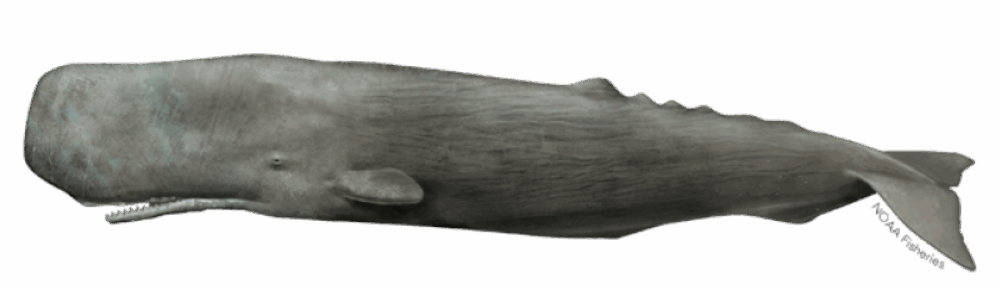
Hoare, towards the tail end of the essay states, “Now, as I pick up “Moby-Dick” again, prompted by Philbrick’s provocative book, I’m reminded of a salutary notion: that the whales that inspired Melville were around long before us, and may, with luck, outlive us, too.” Exactly how large are these majestic, eternal creatures that spawned an entire industry and later the first American novel? According to Wikipedia, in Moby Dick Sperm Whales are said to get 90ft in length, with titular whale being the largest they had ever seen. Let’s guess that means it is around 100ft.

A school bus is roughly 35 feet long. This would put Moby Dick at 5ft shy of 3 school buses in length. If that’s hard to conceptualize – some of us have not been near a school bus for quite a few years – then consider the size of the average movie theater screen. They range from 45 to 65 ft in length. On the smaller side, that would mean that Moby Dick would roughly be 10ft longer than two movie theater screens. From that standpoint, this whale would certainly command the presence and obsession of any man.

Beyond the whale, as large as it is, there is the beautiful prose that the novel inspires from Hoare to consider. With lines in the article such as, “Few books are so filled with neologisms; it’s as if Melville were frustrated by language itself, and strove to burst out of its confines,” is it any wonder that this novel has inspired the imaginations and fear of the world over? I just picked up my hold on Philbrick’s Why Read Moby-Dick? from the San Diego Public Library system and I am incredibly excited to find even more reasons to look forward to this semester’s central story.