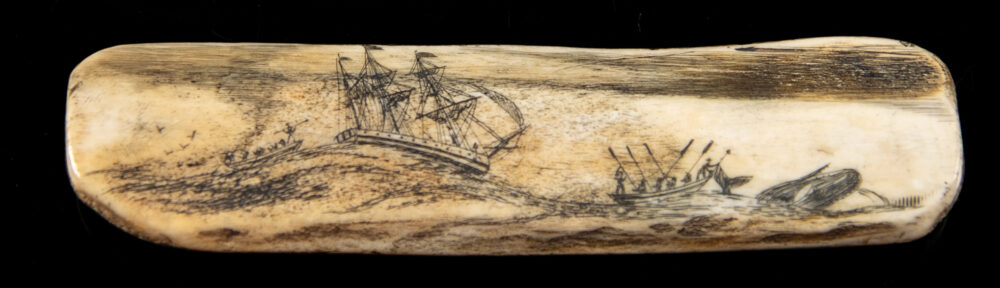
In Herman Melville’s Moby Dick, a unique relationship takes forms between the crew, the captain and the ship itself out on the vast sea. In this lawless landless place, the Pequod becomes their new “homeland,” with the captain functioning as a form of ruler of this new “estate” and the crew functioning as the workers. By viewing the interactions of different characters on the ship in relation to the role they play in the hierarchy, we are able to understand the society of the 19th century on a more intimate level.
In this essay I will argue that Melville intentionally intended for the Pequod to symbolize the state of America during the 19th century in order to critique the capitalist system of consumerism whose primary industry relied on exploiting the working class—who were typically members of minority races—in order to supply luxuries products to the upper-class members of society.
Through analyzing specific relationship dynamics, Melville is able to characterize aspects that are intended to represent consumerist society as violent, lazy and cruel in contrast to the working class whose characterization stresses the importance and value of workers in the hopes of sparking change in the social hierarchy.
Additionally, I will demonstrate this argument through an illustration titled The Fruit of Thy Labor, that will symbolize this capitalist society in the scope of violent exploits of this consumerism system.
However, to fully grasp the extent of this metaphorical state and its critique of the current system, we need to firstly understand the historical context of the time period in which it was written, and its direct influence on the narrative.
During the 1800s, as the United States was emerging with a newly formed government, there were contrasting political debates on how to run the country after being newly separated from the British Empire. The United States system of government decided to shift away from the monarchy to form a democratic party and build a new empire resulting in the transpiring of Manifest Destiny with the purpose of expanding democracy and capitalism.
To prevail they needed the means of industry to further this expansion—which led to the debate over the state of labor leading to the eventual Compromise of 1850. Prohibiting the expansion of slave labor in the new states and the integrating the Fugitive Slave Act (Heimert, 1963).
In Melville’s novel, Manifest Destiny is constantly brought to the forefront of the narrative’s journey as a direct result of Melville’s awareness of the moral dilemmas of 19th century politics. These often involved divided debates that questioned the power structure of the system of the states in terms of, class, labor, and race.
In chapter 64 of Moby Dick, titled “Stubb’s Supper,” class, labor, and race are represented through the interactions and dynamics of the characters; Stubb, Daggo’s Fleece, and the sharks—with each playing a specific and intention role in relation to each other in order to represent the current state of society and demonstrate why it should change.
In this part of the novel, the Pequod had just made their first whaling kill and were in the process of hulling in the exploits from their venture. During the transportation of these various items, Stubb specifically requests Daggo to cut a piece from the whale, then he has Fleece cook him up an individual steak. As Stubb finishes ordering him men around, he eats his meal in the midst of night, while thousands of sharks can be heard simultaneously attacking what remains of the whale below him in the water. In this particular scene, the sharks play an interesting dual role of representing and criticizing both aspects of consumerism culture of the upper class while also simultaneously the middle-class work force.
Initially, there is a distinct power-dynamic being enacted by Stubb that is mirrored through the actions of the sharks. The sharks in this scene are currently ravaging the remains of the Whale they had nothing to do with—reaping the benefits of a free meal from the labor of the crew on the ship. Similarly in the way that Stubb has Daggo fetch the meat while having Fleece be the one to cook it for him. In no significant way did Stubb contribute to the work besides giving the orders and dishing out critics—yet he still is the only one who ends up with a stake.
The sharks are purposefully in juxtaposition to Stubb’s while doing this same action in order to represent the competitive and unstable state of consumerism culture itself—framing Stubb’s consumption of meat as something that is simultaneously violent, and lazy, inadvertently framing consumerism as being such qualities.
By having Stubbs literally consume a product [the whale] and correlating it to the shark frenzy created a gruesome visual that represents the brutal nature of the society they are a part of and their roles in the hierarchy [as consumers]. By making the idea of consumerism “undesirable,” Melville is indirectly asking for change from the current rhetoric characterized by this laziness and violence.
However, the sharks don’t just represent the consumers of society, but also the workforce as well, creating a unique relationship between the two by bringing them into the conversation.
“Cook…Don’t you think this steak is rather undone?…Don’t I always say to be good, a whale steak must be tough? There are those sharks now over the side, don’t you see they prefer it tough and rare? What a shindy they are kicking up! Cook, go and talk to ‘em they are welcome to help themselves civilly and in moderation, but must keep quiet” (Melville, pg. 320).
In this excerpt, Stubb directly compares himself to the sharks, by indicating that he prefers his steak in the same manner “tough and rare,” however he does something even more interesting when he asks Fleece [Cook] to literally talk to the sharks. Now, the sharks in this scene are no longer simply a background but actual characters in conversation with both characters. The significance of having both Stubbs, and Fleece in conversation with the shark, is because it situations the consumer [Stubb] and the workforce [Fleece] in conversation with each other—connecting and revealing the truth of their current society. With the consumer having more power in the hierarchy over the workforce regardless of if they can be in conversation with each other.
This is further reinforced by the context of the conversation in itself. Although Stubb is talking to Fleece, it seems more like he is talking at him—not allowing him to get a word in and then making demands and orders for Fleece to follow. The way he talks establishes a relationship whose dynamic is more reflective of an employer and worker dynamic. The specific word choice of “welcome” and if they are “civil and in moderation,” was also to reiterate this dynamic in the hierarchy by reiterating the limits and restraints of workers in this system. Being “welcome” implies that they can easily be unwelcomed and “civil and in moderation” means there is a specific way one must act in order to successfully participate in this system and there is only a certain level they can aspire to or “moderate”.
This dynamic between Stubbs, Fleece and the Sharks can be interpreted as how the effects of capitalism can be dehumanizing for not only the workforce but also for the consumer itself. In this situation, they both may be able to be represented by sharks, but only one is a Great white and the other is a pygmy.
However, despite this distinction, there seems to be a sort of necessity for Stubbs to belittle him in order to reinforce his higher status in the hierarchy. This is tied directly to their class distinction but also exhibits larger racial connotations.
After the Compromise of 1850—that divided the nation on the issue of slavery, conflict arose about the status of new territory on how to go about capitalist adventures in a newly free-market. It was during this era that the term “wage slavery” gained traction which “suggest a permanent condition of wage labor from which there was no chance of rising to economic independence…where, in Eric Foner’s words, “slavery was an immediate reality … the small producer still a powerful element in the social order, and the idea still widespread that the wage-earner was somehow less than fully free.” (McGuire, 2003).
Although slavery was now illegal under law, the effects and conditions of slavery were still present and lingering on the people of these communities. The linger effect situating them in a state of disadvantage [poverty]—which puts them in the terrible position to be exploited. The condition of poverty, albeit an improvement, is still just another form of oppression in the form of exploitative labor.
In the context of Moby Dick, Melville is writing this novel at the same time the nation is shifting and trying to reform their structure of government in terms of race, class, and labor. As a result, certain characters become representative of this society through their role and dynamic relationships on the ship. The most prevalent example is the organization of roles on the ship, in relation to their status and their pay.
On the Pequod, there is a main established hierarchy according to the workstation that goes as following; The Captain, the 1st, 2nd & 3rd mate who function as officers commanding their own whale boat, the harpooners and the sailors. In terms of whaling, the harpooners have the riskiest job—having to actually pursue and kill the whale—yet they get significantly less money than that of the officers who are just supervising. As high-ranking officers, they receive a substantial amount of the profits for their ability to control their subordinates and reinforce this balance of the hierarchy they established. However, Melville does something incredibly clever, situating the different cultural and racial background of the characters in tandem with their positionality on the boat’s hierarchy, to show a direct reflection of 19th century society and the inequalities of this system on a smaller, more understandable scale.
“The harpooneers…who so “generously” supply “the muscles… are representatives of the three races on which each of the American sections…had built its prosperity in the early nineteenth century. Stubb’s squire is an Indian; Star-buck’s comes from the Pacific islands. And Flask, perched precariously on Daggoo’s shoulders, seems, like the southern economy itself, sustained only by the strength of the “imperial negro” (Heimert 1963).
In the wake of free labor in the new free-market economy brought growth to the American people—including the minority population. Although they now have better opportunities, these opportunities are still not equal or substantial in the same way the dominant race and culture receive them. Going back to the concept of wage slavery—there is a lack of upward mobility for people of color during this time period. This is reflected in Melville’s work by having all the hard labor jobs being represented by a person of color. Not only are the jobs hard but Melville makes it a point for these jobs to be essential and to highlight the importance of the working class who have a history of being oppressed and exploited and continue to be. Just like how Flask was held up by Daggo, Stubb uses Daggo and Fleece to make a meal—exploiting their labor for consumption of different kinds but with similar results showing that even though some change has been made to fix the system, there is room for improvement.
This scene describes the interactions between Stubb, Fleece, and the Sharks functions as a hopeful and positive critic towards future changes to reflect and create equality in our society.
Having the sharks reflect different qualities of both sides of the capitalist society goes to show how despite the hierarchy of race, class, and labor—-essentially, we are the same. Just like how there are many different types of sharks but at the end of the day—-they’re all still sharks.
“through amid all the smoking horror and diabolism of a seafight, sharks will be seen longingly gazing up to the ship decks, like hungry dogs round a table where red meat is being carved…while the valiant butchers over the deck-table are thus cannibal carving each other’s live meat…the sharks, also, with their jewel-hilted mouths are quarrelsomely carving away under the table at the dead meat; and though, were you to turn the whole affair upside down, it would still be pretty much the same thing” (Melville, pg. 319).
In this excerpt, the butchers [or consumers] are described as cannibals feasting on live meat which functions as a metaphor for how consumerism culture thrives off the exploitation of others. In order for the butcher to feast, someone must die, which is a very morbid analogy to the sacrifices of the working class for the upper-class commodities. In contrast, the sharks [workers] are feasting on dead meat from under the table—-essentially scraps from the butcher’s feast. Another morbid analogy about how the rich get richer while the poor remain poor, working to merely survive in such a cutthroat society.
However Melville then subverts the hierarchy….yet….everything looks the same?
For in this imagined proposed society of butchers and sharks, despite the different categories that individual roles seemed to be assigned to—under one system they are all the same, hence the lack of change regardless of the subversion.
Melville doesn’t want to simply switch the positions of the roles in the hierarchy but to dismantle the system itself that perpetuates this sort of exploitative capitalist consumer society. Using the Pequod as a metaphor for 19th century America, Melville is expressing his desire for changes to the capitalist system of consumerism that addresses these issues of race, class, and labor. Through these interactions and dynamics of the characters in the narrative, we were able to grasp a better understanding of Moby Dick in the historical context of its time period and its criticism of the governmental systems in place.
References:
Heimert, Alan. “Moby-Dick and American Political Symbolism.” American Quarterly, vol. 15, no. 4, 1963, pp. 498–534. JSTOR, https://doi.org/10.2307/2710971. Accessed 17 Dec. 2025.
McGuire, Ian. “‘Who Ain’t a Slave?’: ‘Moby Dick’ and the Ideology of Free Labor.” Journal of American Studies, vol. 37, no. 2, 2003, pp. 287–305. JSTOR, http://www.jstor.org/stable/27557332. Accessed 17 Dec. 2025.
Illustration: The Fruit of Thy Labor

For my illustration, I chose to draw my interpretation of consumerism in order to visualize the violence behind the action that society deems “normal.” Subversion the idea of normalcy by bringing that brutality to the forefront—or in this case, the dinner table. I wanted to showcase how even the minimalist pleasures and commodities enjoyed by the upper class are built upon the blood sweat and tears of the working class—having her wine literally being made up of the blood of the whale that’s been slain by the whaling ship in the cup. As the whale bleeds out and dies, it supplies products for the upper class. Similarly to how sperm oil was commonly used during this time as the primary light source or the ivory that makes up the very corset aristocrat’s wear. I wanted to take this idea of the whaling industry and compress it into a scene at home. I chose to showcase the whale bleeding out to bring this violence that isn’t often seen to the forefront. Jarring the image of esteem and class portrayed by the aristocrat by having death and labor being at the center of it all. The Whale dies a gruesome death, meanwhile she indulges herself in overconsumption of wine to the point where she’s spilling it from the cup.
Her features are obscured yet prominent, with her skin tone matching the background to bring intentionality to the overwhelming whiteness on the page—meant to symbolize the dominant imperialist white culture of the time period. I also had her nails exaggeratedly sharp to dehumanize her and make her ambiguous and less sympathetic.
In contrast, the whale and ship itself are much smaller and additionally, are contained in the wine glass in the palm of her hand. Using the juxtaposition of the size difference and positionality on the page to show the differing power dynamics, portraying the wealthy holding the power over the working class. With the aristocrat in this picture notably staying out of frame so the main focal point in the scene will be the contents of her wine glass.
The center of the frame portrays the ship, but most glaringly the dead whale in its own giant pool of blood. I wanted this image to be both provoking and sad—hoping to garner sympathy towards the whale itself and those trapped under the command of the aristocrat’s hand.
A picture of consumerism in a capitalist society—where the rich feed off the labor of the poor and more.