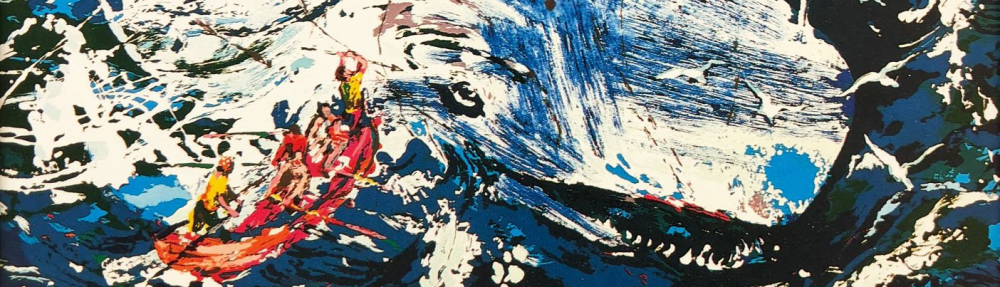
I have always viewed the ocean with such hesitancy, afraid of what the water might contain—but why exactly is that? That humans as a collective, have such a compelling fear towards this part of our world?
Perhaps because the ocean acts much like a beast as it roars recklessly—too close for comfort. Unlike the stars which are only a glimpse into the heavens, untouching in nature, unless we reach out to it, the ocean is willing and wanting to drag you into the depths of its underworld.
However, despite this fear, I have an unrelenting urge to understand its dark beauty as a reflection of my own. I’ve learned now that the fear that I’ve come to associate the ocean with is imaginative at most, a product of projected emotions towards something I can’t fully comprehend, so my own mind chooses to fill in the gaps.
“The human mind delights in grand visions of supernatural beings. And the sea is their very best medium, the only environment in which such giants . . . can be produced and developed.” (Jules Verne).
This monstrous scale of how big the ocean is, is quite terrifying. However, looking at the ocean from the lens of modern western culture, we can draw similarities to these collective feelings, that help us explain why we feel this way while simultaneously learning more about the ocean and ourselves.
The Western Front was initially characterized as dangerous, unfit for civilized life, and full of the unknown both good and bad–much like how people view the ocean. It wasn’t until man took that step into the wild that he was able to see the enriching qualities of what the land had to offer in terms of what we can extract from it and what we can extract from within ourselves by understanding the nature around us.
However, that’s not to say that we don’t have our own monsters inside us that the water reflects quite clearly back at us. Monsters that drive us to pursue and kill wonderful creatures to exchange for profit. Much like the west, the ocean is a wilderness of its own right—having been subjected to the same cruelties of the effects of industrialization.
Shifting the view of thinking about the land by understanding it as a part of us, humanizes it, and propels us away from that fear of the unknown.
Hey Athena, I’m in the same boat as you are, having always been intrigued by yet fearful of the ocean. 70% of our planet is practically an entire alien world that we’ve only explored about 20% of, we could probably spend the rest of our existence going into the oceans before turning to the stars. It’s this unknown nature that instills fear in us, but it could also be a source of potential for growth. There’s going to be a lot of this exploration of the ocean and nature in comparison to our place in the world throughout the book, right away Ishmael talks about man’s draw to the sea in the first chapter. I think you’ll really like chapter 58 “Brit”, it is the one chapter I remember the most and it resembles a lot of what you wrote here; even your final sentence is very similar to the last paragraph of that chapter.
These are good ideas, Athena, but I would like to see you engage more directly with the text at hand. Which quotes sparked your reflection, and why?