- What other oceanic studies were there before the rise of blue humanities?
- How much does the study of the ocean in blue humanities include life in the ocean and how they interact with it?
- How are places such as aquariums and Sea World viewed from a blue humanities perspective?
- What are some consequences that may arise if we were to ignore blue humanities?
- Can a similar approach to the ocean in blue humanities be applied to other frontiers, such as the desert?
Extra Credit Questions For Mentz!
I can’t wait to ask these questions in class! Maybe these will spark more questions people might have in the room!
- What other words/phrases would you say or use to describe blue humanities?
- As we see our world changing due to climate change, how can we relate this back to blue humanities and what can we do oursleves to educate people on what is happening in our world?
- Is there an art peice or anything that you would show to others to inspire them to learn more on blue humanities?
- Are there other poems that you would point to that you also enjoyed that are about the ocean besides Dickinson or Whitman’s?
- Where did your love of the ocean stem from to then bring you to study and write on this subject matter?
Extra Credit Questions for Mentz
How do you see oceanic language shaping our understanding of human relationships with the sea?
In what ways does “Blue Humanities” challenge dominant historical/cultural narratives about exploration and colonization?
What role do you think storytelling plays in helping people connect emotionally and ethically with the ocean?
EXTRA CREDIT: QUESTIONS FOR STEVE MENTZ
While you may never read this post verbatim, Mr. Mentz, I thought that I might address you directly here. We were given an extra credit assignment for this class, instructed to create 5 questions that we might want to ask you for your visit next week. While I may not know much about the Blue Humanities, there is something inherently interesting about them, something alluring that makes me want to learn more. So, my questions are:
- If there was a single word in the English Lexicon that you could change from terracentric to aquacentric, which word would you choose and why?
- Was there a particular piece of media that inspired you to pursue the Blue Humanities?
- What is an essential piece of media to consume when beginning the journey to understanding Blue Humanities? This can be fiction or fact, but it should be something that a person needs to spend time analyzing.
- What is your definitive edition of Moby Dick?
- What piece of media has done sincere harm to the Blue Humanities? How should one engage with this piece of media?
Thank you for taking the time to visit our class and impart on us wisdom regarding the Blue Humanities! I look forward to Tuesday, though I will have to miss the larger event due to a conflict in my schedule.
Week 4: Advancing Our Knowledge of the Sea= a revert back to the superficial?
While rereading the article on the Blue Humanities, I kept thinking how when a society advances we become self-reliant and dependent. In addition, Steve Mentz’s “A poetics of planetary water” solidifies the idea that the sea should be a meditative condition, not necessarily something to believe by sight. The sea as a form of the unknown and unconventional would diminish in value, being purely for aesthetic and commercial appeal if its knowledge becomes easily reproducible. Gillis states that “Until the nineteenth century, notes writer James Hamilton-Paterson,”… our understanding of the sea was “literally superficial, . . . a navigable surface, obviously, above an abyss.(Gillis)” In this instance, the sea was a superficial symbol to status because we had less information about the sea to even acknowledge its significance. The article illustrates the depth to how much information we hold in digital and real time, but with that power, the aesthetic of the sea repeats itself as it becomes recycled and reproduced overtime. With this in mind, Mentz also suggests that water is everywhere– as a solid liquid, and gas– but, it is something we feel the most: “Water changes appear intimately and tangibly. We feel them on our skin(Mentz 144-145).” Consequentially, would already knowing the sea mean we have the advantage to dismiss subjectivity and prioritize Western principle in institutions as beforehand during the Industrial era? In modern day, it can be witnessed digitally without any thought of its significance. I guess there is no real concern besides the sea becoming less anticipated and groundbreaking as before, but one can only speculate how the symbol of the sea becomes marketable– in a good or bad way? In a way, planetary water is restricted for the elite knowledge and the sea as a symbol of hope for marginalized communities becomes a medium to manipulate the less privileged.
For a summer class, I studied anthropology and how literature keeps the area of study alive with its material culture. While the sea is a body of water that cannot be analyzed all at once, one notable thing stood out to me in the class, which is: the anticipation of fiction, with maritime curiosity, helps us prepare for events that are unexpected and out of the ordinary. I think there are pros and cons into regulating and advancing the information of the sea, but it depends on how it is viewed as in society’s grapple. With this in mind, I am interested to see how we then prepare for this advancement of knowing the seas and how we preserve maritime literature for future generations.
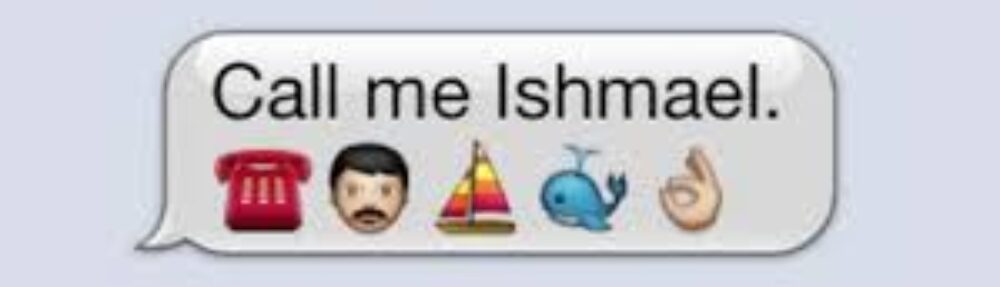
”What Moby-Dick Means to Me”
While reading Hoare’s article, it made me more eager to get started on Moby Dick. This man hypes up Melville and shows major appreciation for the novel. So, I am very excited to begin reading it.
In Hoare’s article, he writes that Moby Dick should not be treated as a regular novel because it is more than just words on a page. It allows the audience to gain a better understanding of the relationship between man and nature. He says “It’s more an act of transference, of ideas and evocations hung around the vast and unknowable shape of the whale, an extended musing on the strange meeting of human history and natural history.” Moby Dick makes the reader conscious and encourages the reader to think deeper on what the whale exactly stands for, and what man’s relation with nature can be like. The relationship between man and nature can be seen as obsessive for example. But it is entirely up the reader to interpret the story and characters how they see fit. I know for me personally, figuring out what means what and trying to figure out the deeper meaning can be difficult sometimes. Another thing I wanted to add is, I find it interesting how Moby Dick is open for interpretation. In some previous English classes, while reading a book, the teacher usually gives us the main point or theme of the story and I had to find evidence to back that point up. However, I am interested in seeing how I navigate this novel and seeing what I take from it.
Hoare also states that Moby Dick “stands both as a historical reference for the great age of Yankee whaling and as a work of imagination in which whales become avatars as much as they are real animals.” In the 19th century, whaling was a big deal and whale oil was a hot commodity. So, Moby Dick is also able to provide major historical context. Even though it is fiction, you can still get an idea of what whaling was like and of what sea life was like then. Also seen in this quote here, Hoare mentions using your imagination for the whale and seeing what they represent. And, while yes, Moby Dick is a work of fiction, the fictional characters can symbolize and mean much more rather than being seen as just an animal/person.
What “What ‘Moby-Dick’ Means to Me” Means to Me
I know that this post falls after the deadline, but I’m writing it more to jot down my ideas and key takeaways from the readings and see if anyone else can relate. When Hoare wrote that “‘Moby-Dick’ is not a novel,” but “an act of transference, of ideas and evocations hung around the vast and unknowable shape of the whale, an extended musing on the strange meeting of human history and natural history,” it kind of clicked for me. It reminds me of our first day of the semester, when most of us were confessing to feeling overwhelmed before even starting the novel. Hoare’s comment connects to how Melville, as an author, didn’t write the novel as just a book, but a time capsule of the ideas of the 19th century. Emerson, whom we’ve talked about influencing Melville, urged 20th-century scholars to think for themselves and to work towards intellectual development constantly. This singular quote from this article began a domino effect on how to better approach Moby Dick as an intimidated reader. Instead of reading Moby Dick as a novel like Pride and Prejudice (where the details aren’t elaborated on too extensively and it’s very specifically plot-focused instead of detail-focused), it’s meant to be interpreted, not merely clicked off on my Goodreads “read” shelf.
Thinking about language
I love literature because it inevitably gets you thinking; about life, yourself, humanity, love, and so on. I also love it because the same work can mean entirely different things for two different people, or, on the flip side, help to people realize they had more in common than they thought. In that sense, reading Philip Hoare’s article makes me happy, because it shows his appreciation for this work. Phrases like, “Few books are so filled with neologisms; it’s as if Melville were frustrated by language itself, and strove to burst out of its confines,” prove my point. We don’t actually know if Melville was frustrated by language and thus invented a bunch of words, but the fact that he does is worthy of note. The invention of new words as a result of frustration is a cool concept and it gets me thinking about how language constrains our understanding of the universe. Language shapes the way we think, but it has limits; and even as someone who is bilingual, sometimes not even two languages are enough to express everything I think and feel. Anyway, I’m excited to learn some new words I’ve never seen before through this book, and hopefully they make their way into my vocabulary to help with that feeling of restriction I sometimes find myself experiencing in terms of language.
What “Moby-Dick” Means to Me
While reading through the article “What Moby-Dick Means to Me” it created a more comfortable space to start diving into this reading. Much like Hoare this book has been one that I have pushed to the side for years. For Hoare it was his watching of the 1956 John Huston film and feeling as though the intense adventure story that he imagined was replaced with a more dense and wordy story that he was unable to connect to. For me Moby-Dick always seemed intimidating, after hearing many people over the years explain what a life changing read it was I felt that I would never have the same experience. However, I began to feel a comfortability in the uncomfortable when Hoare stated “I didn’t know then what I do now: that “Moby-Dick” can be whatever you want it to be. It took me thirty years to discover what the book was—or what it was not” (Hoare). This book is not made to be perfectly interpreted, but rather it will take each of its readers on their own journey that will create a depth to their own reading. This makes me think about all of the different personalities we have in this class. How amazing it is that through all of our individual experiences we will be reading this novel together and be able to share our own feelings of love, excitement, and even confusion throughout this novel. The perspective that Hoare gave throughout this article changed the way that I have been looking at it and I couldn’t be more excited to dive deep into it with everyone!
Another section of this article that drew my attention was how Hoare explained the book to feel both like travel back in time and also drastically modern. The article states “Sometimes I read it and I feel like I’m going backward, fast. It reads like something that was written before books were invented, yet it is utterly modern” (Hoare). One reason I have always loved literature is because it allows us to see the perspective of events that happened in the world during different eras first hand through these writers. An example of this being exactly what we talked about in class revolving around whaling. I had no idea what whaling was and learning how large and intense the industry was caused a shift for my understanding of depth that this novel will lead us into. This book will allow me to travel back in time to witness these different aspects of history while also being able to connect those aspects to modern ideas. The ability for a book to travel through generations and still be relevant to all those that read it is what makes up a true masterpiece.
“The Blue Humanities”
I’m fascinated with this week’s reading, ” The Blue Humanities,” this article really stood out to me, especially this quote by: Jules Verne, who wrote: “The human mind delights in grand visions of supernatural beings. And the sea is their very best medium, the only environment in which such giants . . . can be produced and developed.” The fact that he mentions this on how the ocean can create such imaginative beings and creations of whatever comes to mind by the power of ‘nature’ is truly marvelous. Getting a bit off topic, as a child I was obsessed with anything of the ocean: animals, shells, sea creatures, mythical sea creatures, etc. Anything that involved the ocean I would write and create stories about it. Even as an adult I sometimes write and describe the ocean as an actual “human being” with emotions. The sea is full of mystery, wonder, power, curiosity in many aspects, and now being considered as a piece of art and inspiration to others for creativity and escape. Everyday people create stories and songs involving the power of nature to be used as an escape and appreciation, Melville being inspired by the ocean and thus came the creation of Moby-Dick, by wanting us to feel inspired by it.