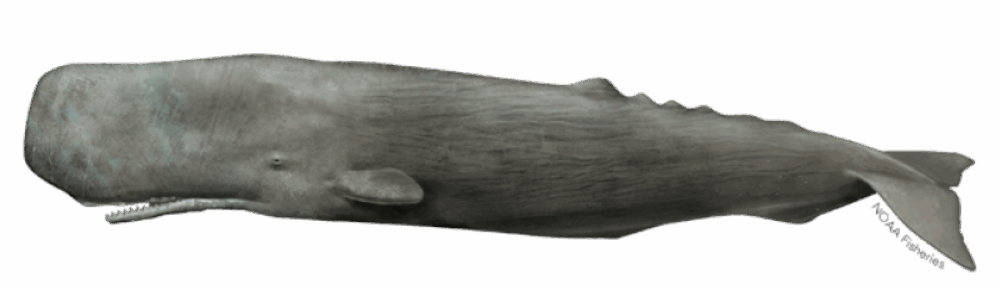
Week 3: Moby-Dick still intimidates me

As a person who had a hard time reading past the first chapters of Moby-Dick, I still feel uneasy about getting into this novel. This behemoth of a story has an absurd amount of chapters, way more than expected for a typical novel, and its 800-page count is very intimidating for people who like to read medium-length novels like me. However, reading Philip Hoare’s article What “Moby-Dick” Means to Me at least eased these feelings of discomfort of having to read a difficult book in a class about reading a difficult book. Here are my thoughts while reading through the article:

Hoare frames Moby-Dick as “an act of transference, of ideas and evocations hung around the vast and unknowable shape of the whale, an extended musing on the strange meeting of human history and natural history.” instead of an actual novel. As of writing this (I got through Chapter 1 and part of chapter 2), I’d probably agree with Hoare. A good portion of the first few chapters of Moby-Dick is Ishmael monologuing about the city and his preparations before his whaling journey–at least, that’s what it looks like to the amateur reader. The book is more than 170 years old, and the English language has changed since then, and that probably explains why the book was difficult for its time. Either that, or this generation is not used to reading books as much as older generations do.

Moving on, Hoare talks about what reading Moby-Dick feels like to him: it feels like a drug that, when “taken” (read), makes him travel backward in time to the point where reading it is like reading “something that was written before books were invented” despite being modern. Reading that part of the article makes me even more curious as to why this work of literature is so acclaimed and influential. The first two chapters seem like Ishmael’s stream of consciousness, describing his surroundings as if they were parts of a painting. My opinion of this book may change when we all start reading it as a class later on.

Moby-Dick was definitely the novel of novels at its time, and reading about how the book had such an impact on a person’s life clued me in as to what to expect from a novel that’s split into many chapters and pages. The book is difficult, yes, but it’s a good way to challenge oneself especially after not reading for so long. Maybe when we start diving into the novel (no pun intended), we’ll see what Moby-Dick means to us.

Fear and Curiosity

What comes first? Fear or curiosity? Being curious over something could inspire you into learning more about it but the strength of the information could become fearful and push you away from further entertaining it. Or being fearful of something can overtime inspire curiosity in order to no longer have that fear.

John Gills backs up this idea in “The Blue Humanities” when stating that before the nineteenth century “The sea was portrayed as dangerous and repellant, ugly and unfit for literary or artistic representation.” At the time, many did not seem to think that the sea was anything to entertain or to be thought of aesthetically. How come? The waters are beautiful, the waves are satisfying to watch but people did not understand it, they did not feel connected to sea so they shunned it away as only a source of travel and food. It wasn’t until writers and painters looked at the sea with inspiration to create, being sensitive with the waters softened the viewing lens of others.

After learning that Melville was a whaler and seaman in class, Melville’s observation that “mediation and water are wedded forever” as pointed out by Gill does not come surprising since he crafted “Moby-Dick”. This is what Emerson was talking about in “The American Scholar” that we as scholars should not only be looking for the accomplishment of the perfect grades and the diploma but more so gain inspiration from the reading/ media you indulge in to create new thoughts and ideas. Maybe a new book, a new painting, a new song, etc., potentially inspiring curiosity into others to do the same regardless of fear. Just as I am nervous of a thick book like “Moby-Dick” but still curious enough to read the book from start to finish to understand why this book is a must read book.

When The Sea Became More Than Just Water

One of the most striking points in John R. Gillis’s essay The Blue Humanities is how recently we began to imagine the ocean as something more than a void. For much of human history, the sea was feared, crossed, and used, but rarely admired. It was simply a highway to somewhere else, a space you had to endure on the way to land. Art, both painting and literature, transformed the sea from a background setting into a powerful presence in human imagination.

Before the 19th century, seascapes were almost invisible in the Western artistic tradition. Artists might sketch ships or bustling harbors, but the water itself was rarely the subject. The ocean was considered too flat, too empty, or too dangerous to deserve attention. That changed when painters like J. M. W. Turner and Winslow Homer turned their canvases toward the waves. Turner’s furious storms pull viewers into chaos, and Homer’s quiet horizons make us feel the vulnerability of human beings against vast waters. Suddenly, the sea wasn’t just scenery. It was the story.

Literature took the same turn. When Melville wrote Moby-Dick, he didn’t just write about whaling; he gave the sea moods, tempests, and silences that felt as alive as the characters themselves. The ocean was a force that shaped every decision and every outcome. Later writers like Rachel Carson combined science and lyricism in The Sea Around Us, reminding us that the waves that seemed distant actually sustain life on Earth. Through these works, the ocean became less of a barrier and more of a mirror, reflecting both human ambition and human fragility.

What I find most powerful about Gillis’s argument is that art didn’t just change how we look at the sea, but it changed what the sea means. Once painters and writers showed us that the ocean had depth, power, and beauty, it became part of culture. It became visible. And visibility matters. We cannot imagine climate change, rising tides, or marine ecosystems today without drawing on the images and stories that first made the ocean real to us.

This is the essence of the “blue humanities”: they remind us that the ocean is not blank space at the edges of our maps, but a central part of human life and imagination. To see the sea differently is to see ourselves differently, small, vulnerable, and yet connected to something vast and enduring. Art painted and wrote the sea into being, and now we can’t stop seeing it.

Week 3: Reclamation of the Blue Humanities

From reading both articles, I now understand that Moby Dick is an extensive novel that exposes human greed. In other words, we categorize and label experiences based on our implicit biases and pride, whether we like to accept this factual statement or not. I feel that there is a working between outside events and subjective intake that has plagued the working class of the 19th century, because we cannot accept ideologies apart from Western ideology or societal principle.

The Blue Humanities article talks about how the symbolic features of the sea can be inadvertently used to justify uplifted status in the terrestrial land. ” It became a symbol of eternity, a comfort to those who, having lost their faith in divine dispensation of everlasting life, came to see in its apparently timeless flows evidence of nature’s immortality and a secular promise of life everlasting.(Gillis)” While this is indicative that there is co-existence that is present with the sea, the symbol of nature and the sea as “transcendent” bleeds into the human supremacy of the privileged groups on land. In a way, this metaphor for life and living becomes a danger for those unprivileged and marginalized groups in land. Consequentially, I think that Melville uses Moby Dick to call out the symbol within the Industrial Age.

On the contrary, the symbol of the sea works to articulate the invisible power of marginalized communities during the Industrial age, and gives a platform for those voices. Even though the experimental novel works to examine the romantic senses that is excessively capitalized in the Industrial Age, its spiritual symbol is so authentic to human culture, surpassing elite status or upper class society within the terrestrial land hierarchy. For example, the symbol is reflective of our behavior and brings back the sentiment of human contentedness and hope when comparing our labor to the immense infrastructure of the sea and what we don’t know.

Week 3: What Moby Dick Means to Me

What I found interesting in the reading this week was from What Moby Dick Means To Me. The concept of it being whatever you want it to be opens the door for projection and transference, in my opinion. I started the book, and the introduction presents similar ideas of taking the book as you want it, and that it isn’t and shouldn’t be forced into a box. I think this is an interesting way of looking at literature, a way that isn’t traditionally taught in schools, especially middle/high school. In my experience, teachers invite you to look at the book with a critical viewpoint, but they keep the idea that there’s a certain motif or central theme in the book that should be recognized. Whereas Moby Dick seems to go against that and invites this personal transference. As a psychology major, I find this interesting. Projection has such negative connotations around it nowadays, yet it is such an insightful tool and can have a positive impact when used the right way. 

Another way to look at this idea of projection is how it might change over time. This article also mentioned the book being used as a religious item in a time of religious uncertainty. How can we use this book now, and will we only use it in what is lacking or can we learn to use it as a tool for overall growth? This also reminds me of a lot of constitutional debates, and how what was written hundreds of years ago should be applied and interpreted nowadays. I have discussed this topic in many classes, and there’s never a straight forward conclusion because of all the different interpretations with their biases. 

I am excited to see all the different emotions and memories that Moby Dick evokes for people in the class. I believe a big part of who we are is shaped by experience; and how we perceive art such as literary text is deeply influenced by these experiences. I also think that looking at this book with different perspectives from different people in the class will allow for more open-mindedness toward ideas and interpretations.

“The Blue Humanities” and the Curious Nature of the Ocean

Within the article, “The Blue Humanities” by John R. Gillis, alludes to the teachings of Emerson. Gillis writes, “[T]he desire for an experience of untamed nature originated in the eighteenth century among a small group of European aesthetes, for whom the awesome power of the sea, as witnessed from the safety of land, was a powerful emotional and mental stimulant”. It truly made me realize that oceanic research is so new to humans and the level of knowledge during the era of whaling. The newfound exploration of the nature of the ocean “became a fountain of images and metaphors” with the emergence of oceanic writings such as Moby-Dick. With Melville spending time at sea and having knowledge of the ocean, he used the ocean as a metaphor. What that metaphor is, is yet to come with my reading of the book. He allows the average person, who has no ocean knowledge, to immerse themselves into the curious nature of the deep undiscovered ocean.

“Blue Humanities” and Modern Day Obsession with the Ocean

This week while reading “The Blue Humanities”, this particular tidbit stood out to me: “A shift in attention from land to sea is under way in several fields simultaneously.” The piece goes on to explain how differing scientific fields have now shifted to an oceanic point of view, this quotation in particular got me thinking about how the ocean and all it offers, both real and imagined, are portrayed in popular culture.

Now, I’m going to be honest here. I grew up without cable, so I didn’t grow up with many popular “oceanic” tv shows, except for shows that talked about all kinds of animals, such as “Wild Kratts”. But in middle school, I began to have an obsession over mermaids. I was always binging “H2O” and “Mako Mermaids”, not to mention reading books with mermaids at the forefront, such as “Siren” by Kira Cass. And, as I look back at my pre-teen self, I realized how I romanticized the creatures. Because, in reality, the mythology behind them is so much more interesting than the “dumbed down” version of them in popular culture. Am I saying that these pieces are bad? Not by any means! But they do not portray mermaids at their core. Classically speaking, mermaids lured sailors to their deaths. And, while these pieces do portray mermaids as having extraordinary singing ability, they don’t portray the true deadliness of that power. (Which does make sense, as most of these are for kids. And who wants their child to watch sailors drown?)

That’s why nowadays I am more drawn into media that portrays mermaids more like the “monster” they are in old mythology, such as in ” Into the Drowning Deep” by Mira Grant. When you really get more in depth on the creatures, I find said media to be much more interesting, and feel much more real.

But it’s not only mermaids that have become main stream pop culture, but marine veterinarians as well. My best friend growing up’s favorite movie was “Dolphin Tale”. And now she’s studying to become a Wildlife Vet! This pop culture phenomenon is inspiring thousands of people to take an interest in oceans. While the more “dumbed-down” versions of ocean mythology are what have gained popularity, at least in main stream media, they have and will inspire future scientists and artists.

“Blackfish” also comes to mind. A group of activists fighting for the Ocean animals within the Sea World parks to be released into the wild, or, at the very least, gain better living conditions. We now value ocean life more than ever!

And what’s even more amazing is how the re-emergence of “Moby Dick” really started all of it! Scholars critiquing the whaling industry took center stage, pointing out it’s brutality. Because the process is described so in depth within the novel, we, as readers, are able to truly understand it. It shows how far we have come with how we treat our sea-faring friends, both within the real world, and with how we portray them within the pages of a book.

The Blue Humanities – John R. Gillis

I think what I connected to the most in John R. Gillis’ article The Blue Humanities, was his understanding of the way in which we as people get curious. It seems to almost be in human nature to want to understand what is unknown. We have always put our dreams into the vast unexplored spaces of the universe, i.e. space, unexplored land, etc, and the ocean is not an exception to that. The quote “Dreams and nightmares that had previously been projected on terrestrial landscapes were now invested in seascapes. Even as the oceans became an object of science, they produced new myths.” is one that I think reflects this perfectly. As we explore the sea more and more, it just becomes more apparent that there is so much of it that will potentially not even be explored in our lifetime, and this is what intrigues people. The unknown world that exists simultaneously with us creates an endless desire to understand it within people because it allows us to imagine what could possibly be living among us. It’s different from just reading a fairytale or fantasy book, this is stuff that could possibly be real and the less we know the more we want to. I think this concept also resonates with and connects to what Emerson was saying in his speech about going out and exploring nature in order to learn. The desire to understand the world around us and create ideas of what might be in the world around us allows us to become more independent thinkers. This allows our brains to be stimulated in a completely different way than just reading and understanding someone else’s point of view.

Melville was a genius (and maybe a time traveler)

After reading the article, “What ‘Moby-Dick’ Means to Me” by Philip Hoare, I’m convinced that Herman Melville was a genius who was way ahead of his time (which is why he could also be a time traveler). This article really gave me great insight into the novel and Melville himself, and learning of the influence that the novel has far after Melville passed away shows that his work has clearly reached across many different generations. It was fascinating to learn that a prow had to be built on the pulpit in the New Bedford Bethel because of how many people were expecting it to be there after reading Moby-Dick. The amount of detail that is contained within the novel is also something I’ve heard so much about, both in this article and in class, and it really shows how much effort Melville put into his piece of art.

In the article, Hoare writes, “To my mind, there are only two other works with which it bears comparison: Mary Shelley’s ‘Frankenstein’ (1818), and Emily Brontë’s ‘Wuthering Heights’ (1847). The former, in its own witness to one man’s obsessive interference with nature, was a direct influence on Melville.” Obsession with nature and the idea of conquering it has been and always will be in human nature. I’m sure Melville’s own experiences bled through the novel, and there’s no doubt that his work in a way served somewhat as a response to his journeys on the sea.

I think what fascinated me most in this article, was learning about how Moby-Dick wasn’t truly appreciated until decades after Melville’s death. “In 1923, D. H. Lawrence published his idiosyncratic, if not faintly crazy, ‘Studies in Classic American Literature.’ Lawrence proclaimed Melville to be ‘a futurist long before futurism found paint,’ the author of “one of the strangest and most wonderful books in the world.” The words “a futurist long before futurism found paint,” really stick out to me as it shows how Melville was able to write a novel whose words can be reached long after it’s publishing year. To learn about his genius and his ability to create work that can be appreciated for over a century, as well as seeing themes of his novel still being prevalent in the modern world, really excites me to begin reading Moby-Dick.

The Greatest American Novel

In his article “The Blue Humanities” John R Gillis informs us that the blue humanities are a “belated recognition of the close relationship between modern western culture and the sea.” The seascape is nothing more than a backdrop until the nineteenth century. Gillis notes that one of the first novels representing the sea in more than just a utilitarian concept is Herman Melville’s Moby Dick. According to Gillis the “metaphysical sophistication” of the novel is what sets it apart. But it is more than just Melville’s allusions of pelagic grandeur that buoys Moby Dick into the blue humanities. It is the centric of whaling. Whaling is humanity’s first glimpse, our first attempt, at conceptualizing oceanography. It sounds like a paradox. Whaling, this egregious act against one of nature’s most majestic oceanic creatures. But, considering Gillis’ assertion of early ocean explorers that “Oceans were explored as a means to reach distant lands, little attention was paid to the waters themselves… they used the sea merely as a highway to get to the next landfall.” One can say whalers were the first voyagers who sought what was within the ocean instead of what was across it. Whaling expeditions that extended years only relied on land as a means to resupply their ships. The ocean became the anchor for whalers, their constant. And knowing these whales, their migration patterns, their feeding grounds, their habits, was arguably humanity’s first dive into marine biology. Specifically, the Nantucket whaling industry, where the Pequod hails from. In 1712 the first documented kill of a sperm whale occurred at the hands of Nantucketer Christopher Hussey. Thus launching an industry of deep-ocean whaling specialized in Nantucket.* The same time Americans began to cast their war upon sperm whales, Europeans were shifting “terror and awe religious folk held for the supernatural to nature itself”. Reshaping the Enlightenment era into the emergence of Romanticism. Gillis mentions a 1712 anecdote by Joseph Addison: “Of all objects that I have ever seen, there is none which affects imagination so much as the sea or ocean.” Americans were conquering some of the most fearsome creatures in the world’s most fearsome environment. The centric of whaling not only gives Moby Dick a place in blue humanities, but it hoists it up as America’s greatest novel, honoring the culture and heroes of America’s first past time.

* https://www.pbs.org/wgbh/americanexperience/features/whaling-history-whaling-america/