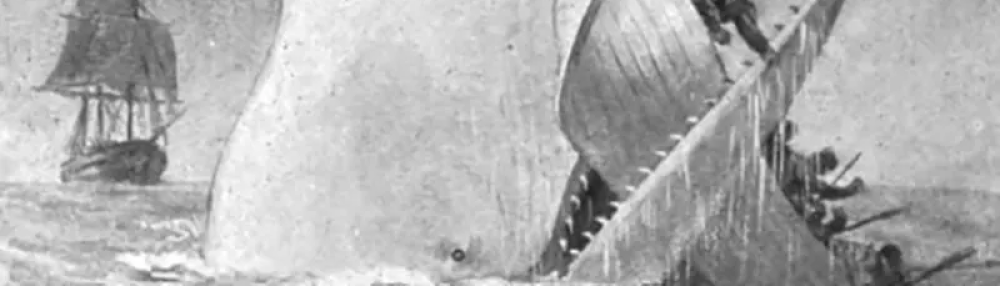
The Horror of the Essex

Of the two readings that we were set to read this week, The True-Life Horror That Inspired ‘Moby Dick’ was significantly more enthralling to me. In particular, due to the nature of the tragedy and the timing of the event. As mentioned in the article by Gilbert King, the trouble began for the Essex in 1819 – 65 years before the first account of the criminalization of nautical cannibalism for survival in the court case R v Dudley and Stephens in 1884. Arguably, the Essex tragedy was significantly worse – with only 8 of the 20 man crew surviving vs. the 3 of the 4 man crew surviving, with the person who died having already been gravely ill due to drinking sea water. The crew of the Essex was also at sea significantly longer – 3 months as opposed to the 3 weeks of the Mignonette.

I had actually learned about the tragedy of the Mignonette through a podcast that I listen to from time to time – Lore by Aaron Mahnke – so I was not surprised with the cannibalism in the tale of the Essex, but the degree of the tragedy was not lost on me; the cruel irony of being forced to abandon their whaling ship due to a whale attack, the avoidance of the closer islands due to rumors of cannibalism only to succumb to it themselves, as well as Pollard having to eat his first cousin that he had promised to look out for, all of it was a horrible series of tragic errors. The fact that 8 people managed to survive at all was truly miraculous.

Reading about the truth behind the story has made me significantly more interested in reading Moby-Dick than I had already been. There are so many layers within the history of the narrative, alongside the narrative itself, that I’m really excited at the prospect of coming to class discussions looking like Charlie from It’s Always Sunny in Philadelphia when he had his Pepe Silvia conspiracy board.

[Edit: Fixed formatting, removed the HTML]

Hi I’m Jackie!

Hi everyone my name is Jackie! I am an English and Comparative Literature major who transferred from San Diego Miramar College this year. I am super excited to continue my education here at SDSU and I’m looking forward to all the knowledge I will gain from classes. My favorite form of writing is creative writing, I feel like I can write for so long and just pour out my ideas freely. I currently work in dentistry and love working with teeth just as much as I love writing creatively. I am so passionate about both and after graduation I hope to continue working in dentistry while still continuing my writing because why not? 🙂

Outside of work and school, I enjoy creative outlets that mainly involve working with my hand such as painting (even though I am not super great at it), ceramics— which I did in 3 semesters of at Miramar. A newer creative outlet I’ve picked up is learning how to play the drums. My dad is a musician and has guided me into learning how to play the drums, it was so hard for me at first but I’m proud to be able to play a couple songs now. With most of these hobbies, I tend to put them on pause during the semester because things can get pretty hectic with work and schoolwork so I definitely look forward to them during the breaks. 

I am looking forward to this semester with all of you!

Intro

Hi everyone! My name is Angelina Gonzalez! I have lived in San Diego my whole life, and though I’ve always wanted to travel the world (and hopefully I will when I can afford it), I know that I’ll always come back to San Diego. I love to complain about the monotony of San Diego’s usually temperate weather, but deep down, I know I could never handle the struggle of the extreme cold or heat. I feel truly spoiled to live in this beautiful city! 

I transferred from Southwestern College in Chula Vista in 2023. Originally I was set on pursuing my major in psychology, but as I moved along in the college process, I felt like I was missing something. I’m currently double majoring in Psychology, as well as English & Comparative Literature. I feel so happy that I get to learn about something that I am truly passionate about, and expand my understanding of the world. 

A little bit about me, is that Im the second of four daughter, and we are animal lovers. I currently have 5 dogs and one cat, so you’ll often see me covered in dog hair (which I try and fail at removing). I love to knit, and crochet, although I often unwind most of my projects because I’m a terrible perfectionist. This means it takes me forever to finish a project. I am by no means an expert and every project I start teaches me something new! Like most in this class, I am fond of reading, specifically from the works of Jane Austen, which have been accused of being a bit boring and slow. While this critique can be true, I still love to read about the way Jane Austen portrays women during this time as complex, flawed, and intelligent. 

I’m so excited to be part of this class’s effort to tackle this book together! I look forward to learning from all of you!

Introduction

Call me Jesmond.
I am a Lao-American in their fourth year of majoring in English. There’s not much to this post since I am a quiet person and not really experienced in writing long posts but I’ll try to introduce myself as best as I can.

I am a neurodivergent person (austistic) who loves to read and game. I used to read a lot of books in middle school and high school, and I am especially interested in monsters such as vampires, zombies, and ghosts. Since I am taking this class along with ECL 305, my monster curiosity is beginning to expand to those of the deep: mermaids, sharks, whales, and the great unknown.

I initially chose this class to fulfill a requirement for my major, but when I learned that it was about Moby-Dick from an email from the professor, it resparked a memory. I have tried reading Moby-Dick in the past, but I wasn’t able to make it past the first chapter because it’s that dense. But when I learned that there are other classmates here who are facing similar struggles regarding this book, I knew I wasn’t alone. So, I am taking this opportunity to learn more about Moby-Dick and hopefully the reason whales are involved in this novel by the notorious Herman Melville himself.

As always, I am looking forward to hearing from you all and getting to know you more. For now, here’s a selfie I took at the Del Mar Fairgrounds on the month of July.

My thoughts on “The American Scholar”

Ralph Waldo Emerson’s “The American Scholar” is easily established as an inspiring piece. One that incites progress concerning American education and societal advancement during a tumultuous time in American history, the 1830’s. Considering turbulence, many are quick to cite the struggle over slavery and the oncoming civil war. But something else was happening in the United States at the time. In 1830 The Indian Removal act was signed into law by Congress under President Andrew Jackson. Thousands of Native Americans were forcibly removed from their southeastern homelands and made to march the fatal “Trail of Tears” to Oklahoma. Because of this, I find a tremendous amount of irony in “The American Scholar” regarding Emerson’s beckoning for man to connect with nature. “Ever the wind blows; ever the grass grows… the scholar is he of all men whom this spectacle most engages” (paragraph 10). Emerson poetically asserts that the scholar who recognizes the unimaginable amount of learning to be had in nature is on the path to possess intellect. To engage with the awes of nature is to engage with one’s place in the world and therefore one’s understanding of it. Is not the principle belief held by Native American culture based on recognizing the importance of the intricacies of nature? This cultural significance, the reverence of nature, is what led our WASP settlers to judge these people as barbaric. Native Americans possess this engagement with the spectacle of nature. To make these claims while they are deemed savages and marched to the brink of death is harrowing. Now, I am not here to punish Emerson for the crimes of the United States government, nor place blame on him for this irony. It is most likely that he hardly, if at all, knew what was happening on the Trail of Tears, or any extent of Native American culture. I only aim to uncover a tragic irony. And a paradoxical instance that is assumed by our government. Beholding a white man for arousing intellectual connection with the natural world, while nature revering “savages” are being advanced to their impending doom.

Introduction – Marley Arreola

Hello everyone, it is nice to meet you all. My name is Marley and it is my last semester here as an ECL major. I am ecstatic to be graduating soon. I look forward to revisiting Moby Dick, because I want to get transported back to the world that Melville has created. Because of its length, prose, and beautiful, rich storytelling, this book has been a challenge for me. I mostly read books to escape, and I have given myself grace for not retaining most of Moby Dick the first time round. I look forward to reading it with a new lens.

This is me with my border collie when he was just a puppy.

Introduction – Omar Arvizu

Hi everyone! My name is Omar Arvizu, and I’m an English Comparative Literature major starting my junior year here at SDSU after transferring in from Southwestern College. My goal is to become a teacher eventually, but my ultimate life goal is to write the script for a movie (and why not, win one of those little statuettes that Hollywood personalities love to hand out to themselves).

I grew up in Tijuana, Baja California, Mexico, and moved to San Diego when I was 16 years old. I had to learn English in a matter of weeks to keep up with the classes. I have lived in National City and Chula Vista since 2018, so these cities have become my home, even though Tijuana will always be my true home. Outside of school, I’m a huge Dodgers fan (huge as in, I watch all 162 games each season, plus the postseason), I love writing fiction, and sometimes, when I feel really inspired, I write poems. The movie theater is my safe place (This year, I started going alone, and it is a one-of-a-kind experience; I fully recommend it). I also enjoy listening to rap music and playing board games with my friends.

As an English major, I have developed a love for reading the classics, which offer such an insight into humanity, even centuries later. I’ve always heard about Moby-Dick but never actually read it, so I’m curious to finally see what makes it such a classic. It definitely looks intimidating, but after reading The Canterbury Tales in Middle English, I feel ready to tackle any complex text. I’m excited to break Moby-Dick down together and hear everyone’s thoughts in class.

Looking forward to getting to know you all this semester!

The current image has no alternative text. The file name is: IMG_5865-scaled.webp

Intro

Hello everyone, my name is Kate Fletcher and I am a senior majoring in English Single Subject. I transferred here from San Jose State University during COVID, which set me a few semesters behind, but I have finally reached my last year of undergrad! After I graduate, I plan to get my teaching credential and my hope is to teach 10th or 11th grade.

I have lived in San Diego my whole life (except for the year in person at SJSU) and plan to live here forever. In my free time I love surf, hike, and play volleyball. I also just ran my first marathon this year and plan to do another in January! If I am not at school or work I am always at the beach. I also love to travel. I just got back from traveling to Germany for the past three weeks visiting family. In the future I would love to go to either Spain or Australia.

I am very excited to dive into Moby-Dick since it is such an iconic book. It is referenced so much in pop culture and I want to be able to understand them. The size of the book is a bit daunting, but I am happy we get to dissect each section of the book rather than get a quick lecture about it. I am eager to hear all the different interpretations in class!

Week 2: Emerson and King

The marvel of human transcendentalism in Emerson’s work, “The American Scholar”, is challenged by the real catastrophe of the Essex, as themes of contention and circumstances that are out of man’s control is tested by nature. Melville’s accounts of Pallard’s biography and general real life occurrences are what he argues to be the major instigator for what and who has the reigns of freewill and power in society. It is not as easy as it seems to be in align with one’s morals when tribulations such as starvation and isolation mode enter the human survival phase. An article by Smithsonian gives light to the causes of the Essex event, indicating that the madness ensued made men lose their morals: “Humanity must shudder at the dreadful recital” of what came next, … They then roasted the man’s organs on a flat stone and ate them.”(King) This sorrowful account experienced by the vulnerable men on the ship alludes to how men cannot fully triumph over nature or predict the future in an immediate notice. The sad reality is that we as humans are inevitably subject to this defeat of vulnerability that has plagued many minority group’s conditional state in light of general corrupt leadership. As Emerson believes us to be able to rise above the past, we are still fated to the past; in a larger sense, we are still fated to become mere machines to capitalism that tears down our sense of individuality.

In addition, I find it fascinating that the connection of a hunger for knowledge outside being a machine in capitalism can overlap with the physical, literal senses of hunger as accounted during the Essex event. Emerson states that, “…when the intervals of darkness come, as come they must,–when the sun is hid, and the stars withdraw their shining, –we repair to the lamps which were kindled by their ray, to guide our steps to the East again, where the dawn is…. The Arabian proverb says, “A fig tree, looking on a fig tree, becometh fruitful.”(Emerson) Here, Emerson explains that, because we should become advocates for our individuality in light of capitalism and collective thinking, we can learn from our close relational peers towards a utopian society. However, Melville’s novel alludes to how this educational feat can become a danger when outside circumstances and factors arise. While Emerson strives lifting each other up in, there is a grotesque underlying of “feeding” that literally eats one’s individuality away into the subjectivity of human pleasure. It might be a reach, but I feel that this imagery of eating has some great part(and potential) in the discussion regarding human transcendentalism in concern with dealing with our fleshly desires.

Intro

(Left: me Right: my friend) 🙂

Hi class!

my name is Arabelle, and this will be my last year at state. I am majoring in English and Comparative Literature, and am very excited to start grad school some time in the future! I enjoy my time reading on the beach with friends, hiking some of the trails here at san diego! One major thing I would love to do after graduation is visit the Philippines, along with Thailand and other Southeast Asian countries during the summer. I really enjoy hiking, so I am very adamant that my friends and family start day one in the Chocolate Hills in Northern Luzon! Besides future excursions and activities, I try to help my mom with the donation and charities back at her hometown in Cebu. So far, we have washed and folded as many clothes in boxes to ship overseas. With that, I love being organized and thrifty with my money so I try to do my own diy bangs at home, which I am in the process of growing back again. Excited to learn about the material in class and getting to know all of you!